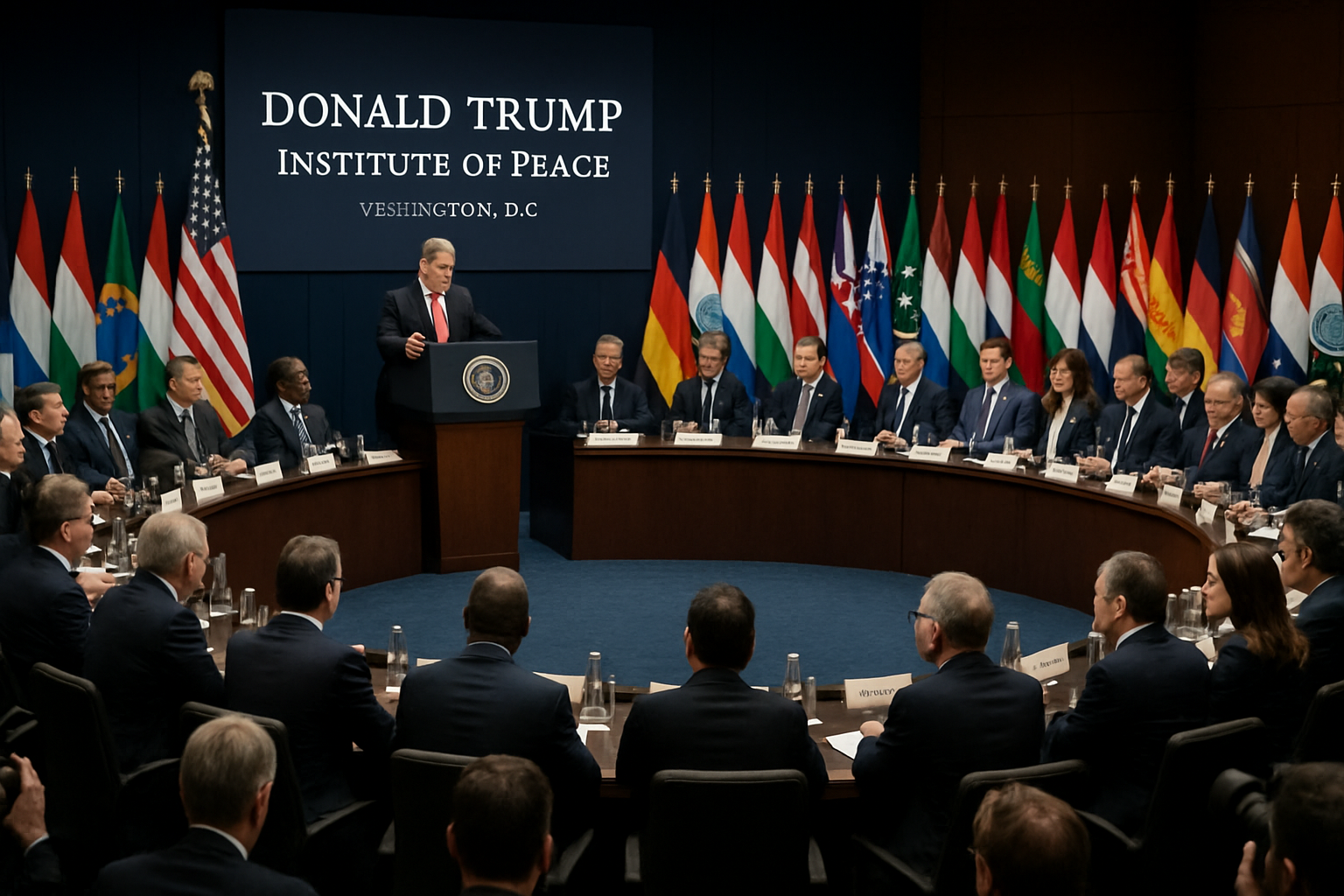
President Donald Trump convened the inaugural meeting of his Board of Peace on Thursday, February 19, 2026, at the newly renamed Donald Trump Institute of Peace in Washington, bringing together representatives from 27 nations with over $5 billion in Gaza reconstruction pledges amid mounting challenges to his unconventional diplomatic approach.
The historic summit represents Trump's most ambitious foreign policy initiative of his second term, establishing what the administration calls a "business approach" to conflict resolution that deliberately departs from traditional UN frameworks. However, the meeting takes place against a backdrop of systematic ceasefire violations in Gaza and growing international concerns about undermining established diplomatic institutions.
Unprecedented International Participation
The Board of Peace has secured participation from major regional powers, with Hungarian Prime Minister Viktor Orbán confirming attendance alongside observers from Italy (Prime Minister Giorgia Meloni), Cyprus (President Nikos Christodoulides), and Romania (President Nicușor Dan). Vietnam's Party General Secretary To Lam arrived at Joint Base Andrews specifically for the summit, while Pakistan's Prime Minister Shehbaz Sharif is participating despite his Defense Minister's assertion that Israel recognition is "not on cards."
Notably, the Vatican declined participation through Cardinal Pietro Parolin, who cited "critical issues" and emphasized that "the UN should manage crisis situations." Mexico's President Claudia Sheinbaum also declined, citing her country's Palestine recognition policy. Germany is sending only an observer rather than Foreign Minister, reflecting broader European skepticism about the initiative.
"The president will inaugurate the meeting tomorrow with a speech and, in some way, formally preside over the start of the appointment before leaving for the state of Georgia."
— Karoline Leavitt, White House Press Secretary
Massive Financial Commitments Amid Crisis
The Trump administration has secured over $5 billion in Gaza reconstruction pledges from member nations, along with commitments for "thousands of personnel" to deploy as part of an International Stabilization Force. These commitments represent the largest coordinated international aid package for Gaza reconstruction since the territory's devastation.
However, the ambitious reconstruction plans face severe obstacles on the ground. Since the October 2025 ceasefire, over 1,600 systematic violations have been documented, resulting in 573+ Palestinian deaths during what was supposed to be a peace period. The Gaza Civil Defense has completely shut down due to fuel shortages, while the Rafah crossing operates at severely limited capacity—only 27 Palestinians crossed on the first day versus a 200-person quota.
Hamas Rejection Creates Fundamental Challenge
The peace initiative faces a critical challenge from Hamas, whose leader Khaled Meshaal delivered a categorical rejection of disarmament demands during a February 8 statement in Doha. Meshaal declared that "criminalizing resistance, weapons and those who carried it out" is unacceptable, maintaining that armed resistance is justified "while occupation exists."
Israeli sources estimate that Hamas retains approximately 20,000 fighters, fundamentally challenging traditional post-conflict reconstruction models that require demilitarization. This creates a complex dynamic where international donors are being asked to invest billions in reconstruction while the primary militant organization refuses to disarm.
International Condemnation of Ongoing Violations
Eight Arab nations—Saudi Arabia, Jordan, Egypt, UAE, Qatar, Indonesia, Pakistan, and Turkey—have issued unprecedented joint condemnations of continued ceasefire violations. Over 400 EU diplomats have demanded increased pressure on Israeli authorities, while a European Left Coalition petition against EU-Israel partnerships has exceeded 400,000 signatures.
The systematic nature of the violations has prompted descriptions of "implementation failures" rather than isolated incidents. The total Gaza death toll has reached 71,800, with 20,000 Palestinians currently awaiting medical evacuation through the severely restricted Rafah crossing.
"Where is the ceasefire?"
— Dr. Mohamed Abu Selmiya, Al-Shifa Hospital Director
Business Diplomacy Meets Institutional Skepticism
The Board of Peace represents Trump's vision of "business approach" diplomacy, with the president maintaining executive authority as chairman. The initiative evolved from a conceptual proposal at the January 2026 World Economic Forum in Davos to an active organization with a signed charter and committed member nations.
European officials have privately expressed concerns about the initiative potentially undermining established international institutions. Critics argue that creating parallel diplomatic mechanisms outside the UN framework could set dangerous precedents for international cooperation, particularly as the initiative operates without the traditional multilateral oversight mechanisms.
Broader Regional Context Complicates Mission
The Board of Peace meeting occurs amid multiple diplomatic crises that test its innovative approach. The New START treaty expired on February 5, marking the first time in over 50 years without US-Russia nuclear constraints. Simultaneously, Trump administration officials are conducting nuclear negotiations with Iran while managing Ukraine-Russia peace talks with a June 2026 deadline.
The timing is particularly challenging given Israel's approval of the most comprehensive West Bank land registration since 1967, which 85 UN member states have condemned as illegal annexation. Finance Minister Bezalel Smotrich's policies targeting hundreds of thousands of dunams in the Jordan Valley have been described by Energy Minister Eli Cohen as implementing "factual sovereignty" with the goal of establishing "reality on the ground that there will be no Palestinian state."
Economic Incentives vs. Political Realities
The Trump administration's theory is that substantial economic incentives can overcome deep-rooted political and security challenges. The $5+ billion commitment, combined with International Stabilization Force deployment, represents an unprecedented resource mobilization for Gaza reconstruction.
However, the approach faces skepticism from traditional diplomacy experts who argue that economic reconstruction requires stable security conditions that are currently absent. The systematic ceasefire violations, Hamas's refusal to disarm, and ongoing territorial disputes create an environment where traditional reconstruction models have historically failed.
Strategic Implications for Global Governance
The success or failure of the Board of Peace initiative extends far beyond the immediate Gaza crisis. The summit represents a potential template for 21st-century conflict resolution that prioritizes leader-driven formats over traditional multilateral institutions.
If successful, the initiative could provide a model for addressing other global conflicts, including the ongoing Ukraine-Russia war and various territorial disputes. However, failure could undermine confidence in alternative diplomatic approaches and potentially accelerate military solutions to international conflicts.
The initiative also tests whether concentrated executive authority can mobilize resources more effectively than distributed institutional processes. European observers are particularly attentive to the precedent being set for international cooperation in a multipolar world order.
Implementation Challenges Ahead
The Board of Peace faces immediate implementation challenges that will determine its credibility. The systematic ceasefire violations suggest that current enforcement mechanisms are insufficient to ensure compliance with peace agreements.
Traditional reconstruction requires not only financial resources but also stable governance structures, demilitarized zones, and sustained international oversight. The refusal of Hamas to disarm, combined with ongoing territorial expansion in the West Bank, creates conditions that have historically made reconstruction efforts ineffective.
Additionally, the initiative must navigate complex regional dynamics, including the role of Arab nations that have normalized relations with Israel while condemning current policies, and the position of Iran-backed groups that view the peace process as legitimizing occupation.
"We are encouraged by what mediators in touch with Hamas are reporting, but we have no illusions about the challenges ahead."
— Senior US Official
February 19: A Defining Moment
As delegates gather at the Donald Trump Institute of Peace, the February 19 summit represents a critical test of innovative diplomacy in addressing one of the world's most intractable conflicts. The meeting brings together the largest coordinated international effort for Gaza reconstruction in history, with financial commitments and personnel deployments that dwarf previous initiatives.
However, the fundamental challenges remain unchanged: systematic violations of peace agreements, refusal by key parties to disarm, ongoing territorial disputes, and deep-seated mistrust between all sides. The Board of Peace must demonstrate that economic incentives and direct leader-to-leader engagement can overcome these obstacles where traditional diplomatic frameworks have struggled.
The stakes extend beyond Gaza to fundamental questions about international cooperation, conflict resolution mechanisms, and the role of alternative diplomatic institutions in global governance. The world will be watching whether Trump's "business approach" to peace can deliver results where conventional diplomacy has faltered, or whether the initiative represents an expensive experiment that ultimately reinforces the importance of established international frameworks.
The success of the February 19 summit will be measured not just in financial commitments secured, but in concrete progress toward ending the systematic violations that have plagued the ceasefire since October 2025. For the Board of Peace to achieve its ambitious goals, it must demonstrate that its unprecedented resources and political commitment can address the fundamental obstacles that have perpetuated this conflict for decades.