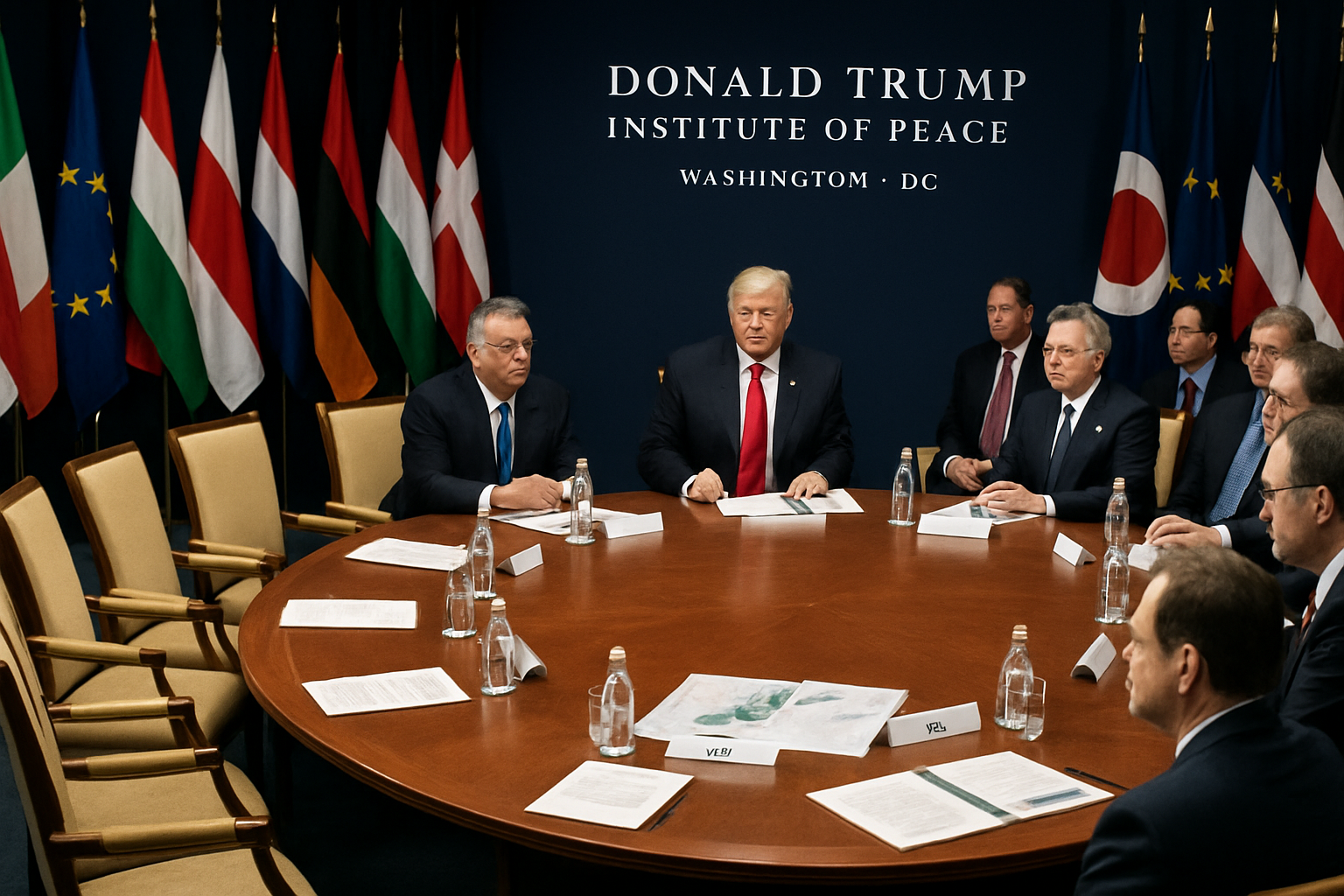
President Donald Trump convened the inaugural meeting of his controversial "Board of Peace" on Thursday at the Donald Trump Institute of Peace in Washington, securing $5+ billion in Gaza reconstruction pledges from 27 member nations while facing a significant diplomatic crisis as major European allies refused to participate.
The historic gathering, aimed at addressing the Gaza crisis and establishing a new framework for international conflict resolution, proceeded despite conspicuous absences from key Western partners. Vatican Secretary of State Cardinal Pietro Parolin declined participation, emphasizing that "the UN should manage crisis situations," while Mexico's President Claudia Sheinbaum cited her government's Palestine recognition policy as grounds for refusal.
European Divisions Expose Diplomatic Tensions
The most striking aspect of Thursday's summit was the selective European participation that highlighted deep divisions within the Western alliance. While Italy's Prime Minister Giorgia Meloni, Cyprus President Nikos Christodoulides, and Romania's President Nicușor Dan attended as observers, major powers including Germany and France remained notably absent.
The European Commission's surprise decision to dispatch Commissioner for the Mediterranean Dubravka Šuica to the gathering sparked immediate outrage among several member states. During a Wednesday meeting of EU ambassadors, diplomats described member states as being "up in arms" over Šuica's participation, which was not communicated to capitals beforehand.
"Member states were up in arms in the meeting. There is some concern in the international community that Trump has established the body as a counter to traditional UN frameworks."
— Anonymous EU Diplomat
The controversy reflects broader European concerns about Trump's "business approach" to diplomacy, which departs from traditional UN frameworks while concentrating executive authority in the U.S. president's hands.
Gaza Crisis Threatens Mission Success
The Board of Peace faces immediate challenges stemming from systematic violations of the October 2025 Gaza ceasefire. International monitors have documented over 1,600 violations since the truce began, resulting in more than 573 Palestinian deaths during what was supposed to be a peace period.
The humanitarian situation has deteriorated significantly, with the Rafah crossing severely restricted to only 27 crossings versus the agreed 200-person daily quota. Hamas officials condemn what they describe as "systematic harassment" by Israeli security forces, with 20,000 Palestinians currently awaiting medical evacuation.
Gaza's Civil Defense has been forced to shut down due to fuel shortages, hampering emergency response capabilities as the total death toll reaches 71,800 according to local authorities. A landmark study published in The Lancet Global Health suggests the actual casualty figure may be 35% higher than officially reported.
Hamas Rejects Disarmament Framework
The Board's reconstruction mission faces fundamental obstacles following Hamas leader Khaled Meshaal's categorical rejection of disarmament demands. In a February 8 statement in Doha, Meshaal declared that "criminalizing resistance is unacceptable" and maintained that armed resistance remains a "fundamental right while occupation exists."
Israeli sources estimate approximately 20,000 Hamas fighters remain active, creating challenges for traditional post-conflict reconstruction models that typically require demilitarization as a prerequisite for international aid.
Unprecedented Financial Commitments
Despite the political obstacles, the Board of Peace achieved significant financial commitments. The $5+ billion pledge represents one of the largest humanitarian reconstruction packages ever assembled for a single conflict zone. Additionally, member states committed "thousands of personnel" for an International Stabilization Force deployment.
Hungarian Prime Minister Viktor Orbán's attendance was particularly notable, given his often-contrarian stance within European councils. Other key participants included representatives from Albania, Pakistan, and several Middle Eastern nations, though the composition notably lacked representation from major Western European powers.
West Bank Crisis Complicates Peace Efforts
The Board's Gaza-focused mission has been further complicated by simultaneous developments in the West Bank. The Israeli government's approval of the most comprehensive land registration program since 1967 has drawn condemnation from 85 UN member states.
Finance Minister Bezalel Smotrich's declaration that the policies will "continue to kill the idea of a Palestinian state" and Energy Minister Eli Cohen's acknowledgment of "factual sovereignty" implementation have sparked an unprecedented diplomatic response. Eight Arab nations, including Saudi Arabia, Jordan, and the UAE, issued a joint condemnation calling the measures violations of international law.
"These measures are aimed at imposing unlawful Israeli sovereignty and undermining the two-state solution."
— Joint Arab Nations Statement
International Law Concerns Mount
UN Secretary-General António Guterres expressed "grave concern" over both the West Bank developments and the broader implications of Trump's parallel diplomatic framework. The systematic extension of Israeli civilian law and administration into occupied territory meets international legal definitions of annexation, according to legal experts.
More than 400 EU diplomats have demanded increased pressure on Israeli authorities, while a European Left Coalition petition against EU-Israel partnerships has exceeded 400,000 signatures, reflecting growing grassroots opposition to current policies.
"Business Diplomacy" Under Global Scrutiny
Trump's Board of Peace represents a fundamental departure from traditional multilateral diplomacy, embracing what administration officials describe as a "business approach" to conflict resolution. This model concentrates decision-making authority in Trump's hands as chairman while seeking to mobilize resources more rapidly than conventional UN processes.
The initiative evolved from a conceptual proposal at January's Davos World Economic Forum into an active international organization with a signed charter. The renaming of the venue to the "Donald Trump Institute of Peace" underscores the administration's desire to establish a lasting institutional legacy.
However, international observers express concern that this approach could undermine established frameworks for global diplomacy and conflict resolution. The timing of the initiative coincides with multiple global crises, including Ukraine-Russia negotiations with a June 2026 deadline and ongoing Iran nuclear talks.
Regional Reactions Divided
Middle Eastern responses to the Board of Peace have been notably mixed. While Pakistan's Prime Minister Shehbaz Sharif participated despite his Defense Minister's earlier statement that Israel recognition is "not on the cards," other regional powers have maintained cautious distance.
The Organization of Islamic Cooperation condemned what it termed "continuing massacres" in Gaza, while Egypt maintains 150 hospitals on alert with 300 ambulances deployed for potential medical evacuations.
Implementation Challenges Ahead
The Board of Peace faces severe implementation challenges that threaten its core mission. Traditional reconstruction efforts require stable security environments and successful demilitarization – conditions notably absent in Gaza. The systematic nature of ceasefire violations suggests that current enforcement mechanisms are insufficient to ensure compliance with international agreements.
The pattern of violations has been described by international observers as "systematic implementation failures" rather than isolated incidents, requiring fundamental changes to enforcement mechanisms if reconstruction efforts are to succeed.
Global Governance Implications
The Board of Peace initiative arrives at a critical moment for international relations, coinciding with the expiration of the New START treaty between the US and Russia – the first time in over 50 years without nuclear constraints between the superpowers. This nuclear governance crisis adds extraordinary urgency to diplomatic innovations.
Success could provide a template for 21st-century conflict resolution that combines economic incentives with direct leader engagement. However, failure may undermine confidence in alternative approaches to traditional multilateral frameworks, potentially accelerating military solutions to complex global challenges.
The stakes extend far beyond the immediate Gaza crisis, touching fundamental questions about the future of international cooperation, global governance evolution, and conflict resolution mechanisms in an increasingly multipolar world.
Looking Forward
As the Board of Peace meeting concludes, the international community faces a critical test of whether leader-driven, business-oriented diplomacy can overcome deep-rooted political and security challenges through economic incentives alone. The absence of major European allies raises questions about the initiative's legitimacy and long-term viability.
The coming weeks will determine whether the unprecedented financial commitments and political capital invested in this diplomatic innovation can translate into tangible progress on the ground, or whether the Board of Peace will join the list of well-intentioned but ultimately ineffective international initiatives.
With Gaza's humanitarian crisis deepening, West Bank tensions escalating, and traditional diplomatic channels strained, Trump's Board of Peace represents both an ambitious attempt at diplomatic innovation and a risky departure from established international norms. The world watches to see whether this business-style approach to peacemaking can succeed where traditional diplomacy has struggled.