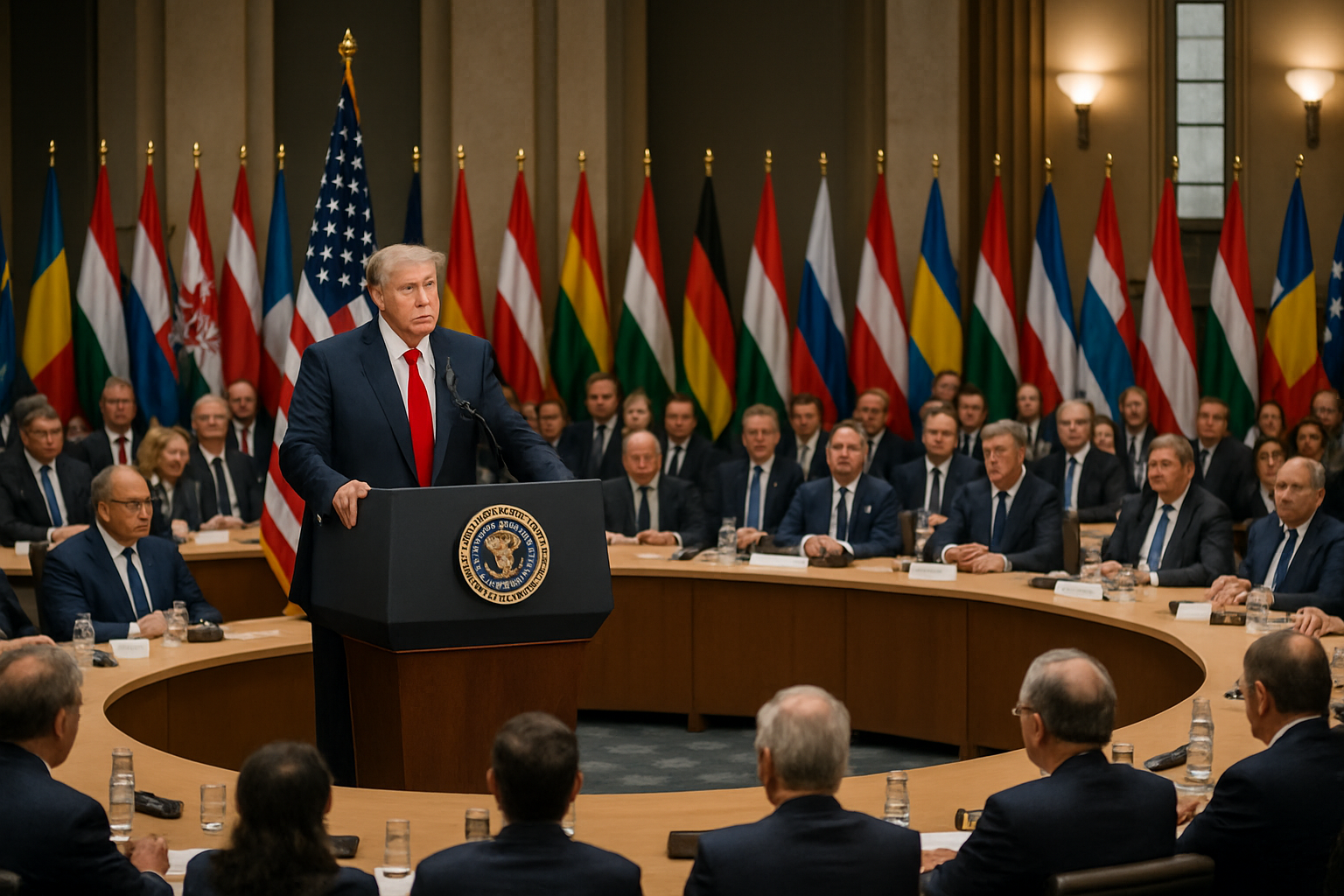
President Donald Trump launched his ambitious yet controversial 'Board of Peace' initiative on February 19, 2026, promising $10 billion in U.S. funding for Gaza reconstruction while simultaneously delivering a stark 10-day ultimatum to Iran, creating a diplomatic paradox that has divided international opinion.
The inaugural meeting at the newly renamed Donald Trump Institute of Peace in Washington brought together representatives from 27 nations, with notable absences from major European powers raising questions about the initiative's global legitimacy and long-term viability.
A Diplomatic Gamble Amid War Clouds
Speaking to the assembled delegates, Trump characterized the Board of Peace as "nothing more powerful and prestigious" while addressing what he described as the urgent need for innovative conflict resolution mechanisms. However, the meeting's atmosphere was overshadowed by escalating tensions with Iran, as Trump declared: "We need to make a meaningful deal with Iran, or bad things are going to happen."
The president's stark warning came with a precise timeline: "We'll find out about Iran in about 10 days," he told the gathering, while U.S. aircraft carriers Gerald R. Ford and Abraham Lincoln maintain the largest American naval presence in the Middle East in years.
"What we're doing is very simple: peace. But sometimes you have to be strong to achieve peace."
— Donald Trump, U.S. President
This dual approach—promising reconstruction aid while threatening military action—exemplifies Trump's "business approach" to diplomacy, departing from traditional United Nations frameworks in favor of direct, executive-driven negotiations.
Mixed International Response
The Board of Peace has attracted a diverse coalition of 27 member nations, including Albania, Azerbaijan, Hungary, Paraguay, and Pakistan, while conspicuously lacking participation from major European powers like Germany, France, and the United Kingdom. The Vatican officially declined participation, with Cardinal Pietro Parolin emphasizing that "the UN should manage crisis situations."
Prime Minister Edi Rama of Albania used his address to the Board to appeal directly to Trump regarding the prosecution of former Kosovo President Hashim Thaçi at The Hague, demonstrating how member nations view the initiative as an alternative avenue for addressing their specific grievances with international institutions.
Pakistani Prime Minister Shehbaz Sharif attended the meeting, emphasizing the need for an end to ceasefire violations in Gaza as "very important" for lasting peace. His participation highlighted the initiative's appeal to nations seeking alternatives to traditional diplomatic channels.
The Gaza Reconstruction Promise
Central to the Board of Peace's mission is the ambitious $10 billion U.S. commitment for Gaza reconstruction, with Trump announcing that member nations have pledged an additional $7 billion. The initiative also includes commitments for thousands of International Stabilization Force personnel to be deployed in Gaza.
Jared Kushner, serving as a key negotiator for the Gaza initiative, emphasized the humanitarian focus: "We can't change the past, but we can change the future through right decisions and international cooperation. We've secured funds to help Gaza's people and improve living conditions, with emphasis on peace and global solidarity."
However, the implementation faces significant obstacles. Since the October 2025 ceasefire agreement, over 1,600 systematic violations have been documented, resulting in 573+ Palestinian deaths during what was supposed to be a peace period. Hamas has categorically rejected disarmament demands, with leader Khaled Meshaal stating that armed resistance is justified "while occupation exists."
European Skepticism and EU Division
The initiative has exposed deep divisions within the European Union, with EU Commissioner Dubravka Šuica's attendance sparking controversy among member states who were not consulted beforehand. French officials criticized the lack of coordination, while Lithuania raised "fundamental questions" about the Board's legitimacy and potential to undermine established international institutions.
Italy participated as an observer after heated parliamentary debates, with Foreign Minister Antonio Tajani defending participation against opposition accusations of supporting "colonialism." Cyprus President Nikos Christodoulides described the invitation as "particularly important," while Romania's President Nicușor Dan attended his first U.S. visit to participate as an observer.
The absence of major European allies reflects broader concerns about Trump's approach to multilateral diplomacy and the potential precedent of parallel institutions competing with the UN system.
The Iran Nuclear Standoff
Trump's 10-day ultimatum to Iran represents the most explicit threat of military action since his return to office. With uranium enrichment at 60% purity—approaching the 90% threshold for weapons-grade material—Iran continues to reject demands to include ballistic missiles and proxy support in any nuclear agreement.
The president's dual-track approach combines maximum economic pressure with military positioning. The deployment of two aircraft carrier strike groups signals serious intent, while maintaining diplomatic channels through intermediaries in Geneva and Oman.
Regional coalition support from Saudi Arabia, UAE, Qatar, and Egypt provides unprecedented Middle Eastern backing for the diplomatic process, representing a significant shift from previous negotiation attempts.
Implementation Challenges
The Board of Peace faces substantial obstacles in achieving its stated objectives. In Gaza, the ongoing ceasefire violations and Hamas's refusal to disarm challenge traditional post-conflict reconstruction models that require stable security environments.
The Rafah crossing remains severely limited, with only 27 Palestinians crossing daily versus the agreed quota of 200, while 20,000 Palestinians await medical evacuation. Gaza's Civil Defense has completely shut down due to fuel shortages, hampering emergency response capabilities.
International legal experts have raised concerns about potential violations of UN Security Council resolutions and Geneva Conventions, particularly regarding Israel's recent approval of the most comprehensive West Bank land registration since 1967.
Global Implications
The Board of Peace initiative represents a significant test of Trump's "business diplomacy" approach to international conflict resolution. Success could provide a template for 21st-century peace-building that bypasses traditional multilateral frameworks, while failure may undermine confidence in alternative diplomatic approaches.
The timing coincides with multiple global crises: Ukraine-Russia peace negotiations, the recent expiration of the New START treaty, and China's expanding nuclear capabilities. These parallel challenges underscore the broader questions about international cooperation and global governance in an increasingly multipolar world.
European officials privately express concerns about the precedent of parallel diplomatic mechanisms that could undermine established international institutions. The success or failure of the Board of Peace may influence how future administrations approach complex international challenges.
Looking Ahead
With Trump's 10-day Iran deadline approaching and $17 billion in reconstruction pledges on the table, the coming weeks will prove crucial for determining whether this controversial diplomatic experiment can deliver on its ambitious promises.
The initiative's emphasis on direct leader-to-leader engagement and economic incentives over institutional processes represents a fundamental departure from post-World War II diplomatic norms. Whether this approach can address deep-rooted political and security challenges remains to be seen.
As international observers monitor developments closely, the Board of Peace stands as both a bold diplomatic innovation and a potential threat to the multilateral order that has governed international relations for decades. The stakes extend far beyond individual conflicts to fundamental questions about how the world addresses complex security challenges in the 21st century.