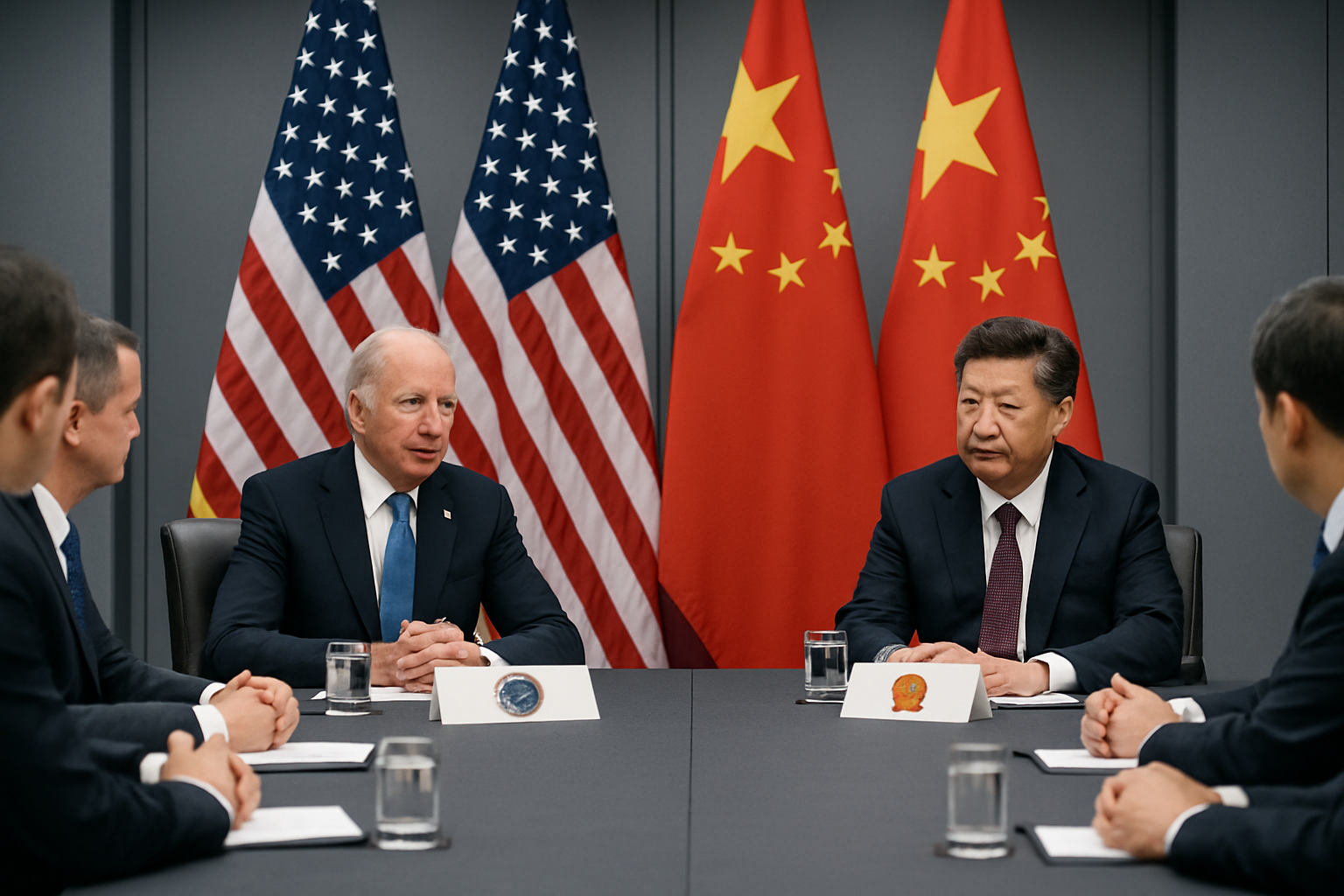
President Donald Trump's scheduled visit to China from March 31 to April 2 will proceed under dramatically different circumstances than originally planned, following the Supreme Court's historic 6-3 ruling that struck down his sweeping tariff authority and fundamentally altered the leverage dynamics for what was intended to be a high-stakes trade summit with Chinese President Xi Jinping.
The White House announced the Beijing visit in February, marking Trump's first official trip to China during his second term and setting the stage for critical negotiations between the world's two largest economies. However, the February 21 Supreme Court decision declaring Trump's use of the International Emergency Economic Powers Act (IEEPA) for global tariffs unconstitutional has removed a key tool the administration planned to wield in trade discussions.
Supreme Court Decision Reshapes Summit Dynamics
Chief Justice John Roberts' majority opinion applied the "major questions doctrine," ruling that IEEPA "does not authorize president to impose tariffs" without clear congressional authorization for actions of "vast economic and political significance." The decision effectively stripped Trump of his most potent economic weapon against China, where he had imposed 34% tariffs as part of his maximum pressure campaign.
Trump's immediate response was characteristically defiant, calling the ruling "deeply disappointing" and claiming he was "absolutely ashamed of certain members of court." Within hours, he announced a new 10% global tariff using different legal authorities, but trade experts question whether these alternative measures will withstand legal challenges.
"The court's decision leaves Trump with less leverage against China during negotiations, which observers noted could actually open space for more conventional diplomatic engagement."
— Trade Policy Analysis, South China Morning Post
Diplomatic Groundwork and Historical Context
The upcoming summit builds on months of diplomatic engagement that began with a strategic February 4, 2026 phone call between Trump and Xi Jinping. That conversation, described by Trump as "excellent," covered a broad range of issues including Taiwan tensions, trade relations, the Iran nuclear situation, and the Ukraine war.
According to diplomatic sources, Xi emphasized a "mutual respect" approach during the call and called for 2026 to be a "year of peaceful coexistence and cooperation." The conversation represented a significant diplomatic warming following their October 2025 meeting in South Korea that established a fragile trade truce after months of tariff escalation.
The personal relationship between the two leaders has evolved considerably since Trump's first term. Xi had previously characterized Trump-China relations as "extraordinarily strong" following their November 2025 phone call, suggesting both nations recognize the need for direct dialogue despite competing strategic interests.
China's Strategic Position Strengthened
The Supreme Court ruling has paradoxically strengthened China's position heading into the March summit. Beijing welcomed the decision as vindication of its longstanding criticism of unilateral U.S. trade measures. Chinese officials, who had been targeted with some of the highest tariffs, now enter negotiations knowing that Trump's most aggressive trade tools face legal constraints.
This shift comes at a time when China has been actively expanding its global economic influence through initiatives like the February announcement of zero-tariff access for 53 African countries starting May 1, 2026—the most comprehensive China-Africa trade expansion in history. The move positions Beijing as a champion of multilateral economic cooperation in contrast to Trump's bilateral approach.
China's economic relationship with other regions has also been evolving strategically. The country has successfully negotiated sector-specific trade arrangements with the European Union, reducing dairy tariffs from 21.9%-42.7% to 7.4%-11.7%, affecting over $500 million in trade. These successes demonstrate China's growing sophistication in economic diplomacy beyond its relationship with the United States.
Leverage and Legal Challenges
The legal landscape surrounding Trump's trade authority has become increasingly complex. The House of Representatives passed legislation 219-211 to end Trump's tariffs on Canada, with six Republican defections joining Democrats in the first significant bipartisan rebuke of his trade policies during his second term. This congressional pushback signals growing domestic resistance to Trump's aggressive trade approach.
Treasury Secretary Scott Bessent has argued that while the Court "took away leverage," it also "made it more draconian because [it] agreed president has right to full embargo." However, legal experts question whether Trump's alternative authorities can support the broad trade restrictions he seeks to impose.
The administration's new 10% global tariff, announced immediately after the Supreme Court ruling, faces its own legal challenges. World Trade Organization rules limit unilateral trade actions, and international partners are already consulting on coordinated responses to what they view as continued American trade unilateralism.
Taiwan and Regional Security Implications
The China visit occurs against the backdrop of heightened tensions over Taiwan, which Xi Jinping has called "the most important issue" in China-U.S. relations. During their February phone call, Xi urged "prudence" on American weapons supplies to Taiwan, while Trump maintained that U.S.-Taiwan relations remain "rock solid."
Chinese military pressure on Taiwan has intensified significantly, with aircraft activity up 23% in 2025 and daily deployments around the island designed to "exhaust" the population, according to Taiwan Defense Minister Wellington Koo. Recent large-scale exercises in December 2025 demonstrated Beijing's continued military preparations.
Taiwan officials have welcomed the Trump-Xi dialogue as potentially stabilizing, expressing hope that direct communication between the leaders might reduce the risk of miscalculation in the volatile Taiwan Strait. The upcoming Beijing summit will be closely watched for any progress on managing these tensions.
Economic Stakes and Global Implications
Despite Trump's extensive tariff policies, the U.S. trade deficit reached $901.5 billion annually as of December 2025—essentially unchanged from pre-tariff levels. This data underscores the structural nature of trade imbalances and raises questions about the effectiveness of tariff-based strategies.
The March summit will need to address not only bilateral trade issues but also broader questions of global economic governance. China's role in critical minerals supply chains—controlling 60% of global production and 90% of refining capacity—gives Beijing significant leverage in discussions about technology cooperation and supply chain security.
Both nations face domestic pressures that could influence the summit's outcomes. In China, the leadership must balance economic cooperation with nationalist expectations, while Trump faces criticism from American businesses about trade uncertainty and from Congress about the expansion of executive trade authority.
Diplomatic Innovation Under Constraints
The altered circumstances may actually create opportunities for more conventional diplomatic engagement. With the most aggressive tariff tools constrained by legal challenges, both sides may be more inclined to pursue negotiated solutions on trade disputes.
The summit agenda is expected to include discussions on agricultural purchases, technology cooperation, and financial services access—areas where progress might be possible without the aggressive posturing that has characterized recent trade relations. Chinese officials have indicated willingness to increase purchases of U.S. agricultural products and energy, which could provide face-saving wins for both leaders.
Global Context and Multilateral Challenges
The Trump-Xi summit occurs within a broader context of shifting global alliances and economic partnerships. The recent expiration of the New START treaty on February 5, ending more than 50 years of U.S.-Russia nuclear constraints, adds urgency to great power coordination. China's nuclear expansion and broader military modernization create additional strategic complexity.
European allies are watching the summit closely, concerned about the extraterritorial effects of U.S.-China trade disputes on global supply chains and economic stability. The EU has been pursuing its own strategic autonomy in critical technologies while maintaining economic relationships with both Washington and Beijing.
Looking Ahead: Expectations and Limitations
As Trump prepares for his March 31-April 2 Beijing visit, expectations remain modest given the fundamental structural challenges in U.S.-China relations. The Supreme Court ruling has removed some of the most coercive tools from American trade policy, potentially creating space for more cooperative approaches.
However, deeper strategic competition between the two nations continues across multiple domains—from technology and military capabilities to influence in international institutions. The summit's success will likely be measured not by breakthrough agreements but by the establishment of mechanisms to manage competition and reduce the risk of confrontation.
The visit represents a critical test of whether the world's two largest economies can find ways to cooperate on shared challenges while managing their strategic rivalry. With legal constraints limiting Trump's most aggressive trade tools, the focus may shift toward more traditional diplomatic engagement—potentially opening new pathways for U.S.-China cooperation in an era of strategic competition.