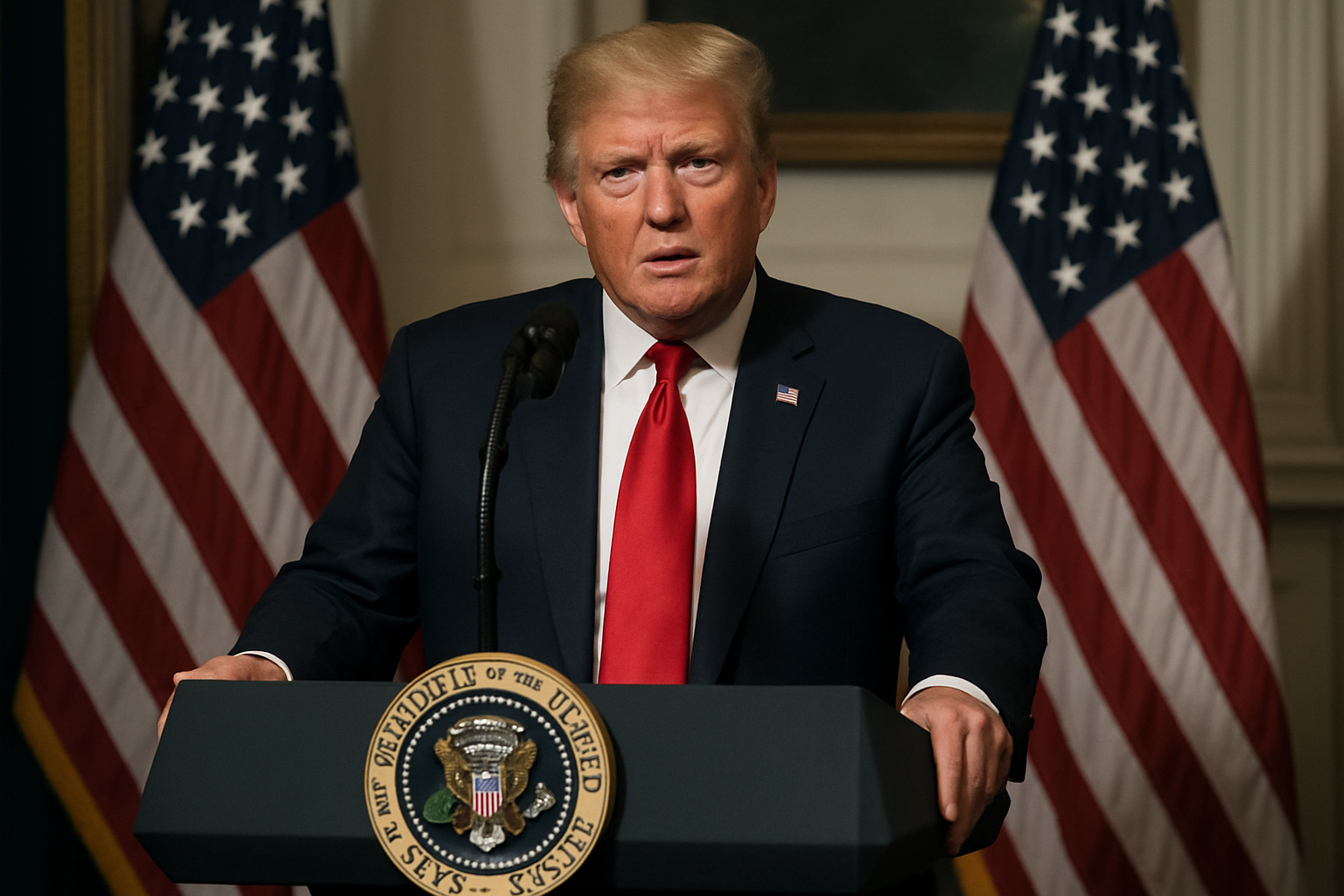
President Donald Trump declared on Tuesday that the United States has successfully achieved "regime change" in Iran and received a "big gift" from the Iranian government, marking the most significant claims about progress in the three-week military conflict that has upended global energy markets and triggered the worst international crisis since the Cold War.
Speaking to reporters in the Oval Office on March 24, Trump asserted that Iran has agreed not to enrich uranium and made substantial concessions related to oil and gas production in the strategically vital Strait of Hormuz. The statements come as his administration faces mounting congressional pressure over the costs and scope of Operation Epic Fury, the largest U.S.-Israeli military operation since the 2003 Iraq invasion.
Trump's Victory Claims Amid Mounting Pressure
The president's triumphant tone represents a stark shift from the escalating rhetoric that has characterized the Iran conflict since it began March 1 with the death of Supreme Leader Ali Khamenei. Trump told reporters that the Iranian government "can't have certain things" and suggested that negotiations are progressing with "new leaders" in Tehran, though he cautioned he would "see how they turn out."
According to multiple international sources, Trump's claims center on Iran's alleged agreement to halt uranium enrichment activities and provide energy concessions that he described as a "very big gift" to the United States. The president indicated that Iran has made these offers "tonight," suggesting recent diplomatic developments not yet publicly confirmed.
However, Tehran has consistently denied participation in any negotiations for ending the conflict, which is now in its fourth week and has resulted in unprecedented global disruptions. Iranian officials maintain their position that the country will "never abandon uranium enrichment even if war is imposed," contradicting Trump's assertions about nuclear concessions.
Congressional Scrutiny Intensifies
Trump's victory claims come as bipartisan lawmakers are demanding comprehensive answers about the administration's Iran strategy, costs, and potential ground troop deployment. Democratic senators have expressed particular alarm after classified briefings, with Senator Richard Blumenthal stating he is "more concerned than ever" about the possibility of "boots on the ground."
The conflict's unpopularity is "almost unprecedented" for military operations in their early stages, according to political analysts. Professor Stephen Zunes noted that opposition spans traditional political divisions, including "much of Trump's base," with only 25% of Americans supporting the strikes according to recent polling.
"The administration is struggling to provide clear answers about exit strategy, cost projections, and the risk of expanded military commitment"
— Congressional source familiar with classified briefings
Operation Epic Fury has already cost $11.3 billion in its first week alone, with 150 U.S. troops wounded and three confirmed killed. The Pentagon has prepared operations extending through September, far beyond Trump's initial 4-6 week timeline predictions.
Global Economic Disruption
The Iran conflict has triggered the most severe global economic disruptions since the 2008 financial crisis. Oil prices have surged past $80 per barrel—a 10% increase—while Iran has effectively closed the Strait of Hormuz, which handles 40% of global oil transit. Over 150 tankers remain stranded in the Persian Gulf, carrying billions of dollars worth of cargo.
The aviation industry faces its worst crisis since COVID-19, with more than 18,000 flights cancelled worldwide. Eight countries have simultaneously closed their airspace, including Iran, Iraq, Israel, UAE, Qatar, Syria, Kuwait, and Bahrain. Dubai International Airport, the world's busiest with 86 million annual passengers, remains shuttered due to missile damage.
Natural gas prices have increased 24% in Europe and 78% in the United States, while major shipping companies including Maersk and MSC have suspended Persian Gulf operations. The crisis has exposed fundamental vulnerabilities in global supply chains dependent on Middle Eastern logistics networks.
Nuclear Diplomacy Collapse
Trump's current claims of Iranian nuclear concessions stand in stark contrast to the complete breakdown of diplomatic efforts that preceded the military conflict. Despite achieving a "broad agreement on guiding principles" in Geneva talks—described as the most significant progress since the 2018 JCPOA collapse—fundamental disagreements proved insurmountable.
Iran had maintained that ballistic missiles and regional proxy activities were "red lines" excluded from nuclear-only negotiations, while the U.S. demanded comprehensive agreements addressing missiles, armed groups, and human rights. Iran continued enriching uranium to 60% purity, approaching the 90% weapons-grade threshold, with intelligence assessments suggesting sufficient material for multiple weapons if weaponized.
The diplomatic failure occurred amid a broader nuclear governance crisis, with the New START treaty expiring February 5—marking the first time in over 50 years without U.S.-Russia nuclear constraints. UN Secretary-General António Guterres has warned that nuclear risks are at their "highest level in decades."
Regional Consequences and Iranian Succession
Following Khamenei's death on March 1, Iran has experienced its first hereditary succession in Islamic Republic history, with his son Mojtaba Khamenei emerging as the favored candidate. CIA assessments suggest a Revolutionary Guards member is likely to assume power, indicating a hardline military shift from traditional clerical governance.
Iran's massive retaliation campaign, dubbed "Operation True Promise 4," has caused regional casualties across U.S. allies. The UAE reported one civilian killed in Abu Dhabi, Kuwait recorded 32 injured in airport strikes, and Qatar suffered eight injuries despite Patriots intercepting 65 missiles and 12 drones. Most significantly, Iranian drones struck RAF Akrotiri in Cyprus—the first attack on European territory since World War II.
The unprecedented regional coalition of Saudi Arabia, UAE, Qatar, and Egypt that had backed diplomatic efforts now faces severe strain as Iranian retaliation targets their territories. Egyptian President Abdel Fattah el-Sisi condemned attacks on "sisterly countries," warning of "comprehensive chaos" across the region.
International Response and NATO Involvement
The conflict has drawn direct NATO engagement for the first time, with alliance defense systems intercepting an Iranian ballistic missile targeting Turkey. This marks a significant escalation beyond Middle Eastern boundaries and raises questions about broader international involvement.
European allies have issued urgent travel warnings, with the UK, France, Germany, and Poland advising against regional travel. Spain's Prime Minister Pedro Sánchez condemned the U.S.-Israeli offensive as a "breach of international law," prompting Trump to threaten cutting "all trade" with Spain.
The crisis represents the greatest test of multilateral cooperation in the modern era, according to UN officials. The rapid transition from diplomatic framework to military confrontation demonstrates the fragility of crisis management in the multipolar international system.
Humanitarian Crisis and War Crimes Allegations
Iran's Red Crescent reports over 787 civilian casualties from U.S.-Israeli strikes, with the Pentagon confirming responsibility for elementary school attacks that killed 165-185 students due to "outdated targeting data." The Minab school strike, which killed 53-85 students and staff during regular hours, has prompted Geneva Conventions investigations.
International evacuations are occurring on an Arab Spring scale, with Australia reporting 115,000 citizens trapped in the region and Germany working to evacuate 30,000 stranded tourists. The EU activated its ESTIA evacuation protocol for Cyprus for the first time in the bloc's history.
"This represents the most comprehensive international evacuation since the Arab Spring of 2011, affecting hundreds of thousands worldwide"
— European Union crisis management official
Trump's Evolving Iran Strategy
The president's current victory claims represent the latest evolution in an Iran policy characterized by rapidly shifting timelines and contradictory statements. Trump has varied war duration predictions from "4-5 weeks" to "8 weeks" while simultaneously claiming operations are "almost completed" and warning Iran faces "20 times harder" strikes.
His explicit regime change advocacy—declaring Iranian government overthrow would be the "best thing that could happen"—represents a dramatic policy shift from nuclear-focused diplomacy to comprehensive political transformation. Trump has claimed the right to personally choose Iran's next Supreme Leader, the most direct assertion of American control over Iranian affairs since the 1979 revolution.
Financial markets are emerging as the "ultimate constraint" on conflict escalation, with Pakistan's KSE-100 index suffering its largest decline in history (-8.97%) and global supply chain disruptions affecting automotive, electronics, and textiles manufacturing worldwide.
Looking Ahead: Victory or Quagmire?
As Trump's claims of regime change success dominate headlines, fundamental questions remain about the sustainability of any achievements and the long-term costs of military confrontation. The administration faces the challenge of translating tactical military success into stable political outcomes without ground troop deployment—a prospect that increasingly concerns congressional lawmakers.
The Iran crisis has become a template-setting moment for 21st-century international relations, testing whether diplomatic solutions remain viable for nuclear crises or whether military confrontation becomes the default approach. The stakes extend far beyond the immediate region, affecting global energy security, nuclear governance credibility, and the post-World War II international order.
Whether Trump's victory claims prove prophetic or premature will likely determine not only the immediate trajectory of the Iran conflict but also establish precedents for international crisis management in the multipolar era. The world watches as the most dangerous international crisis since the Cold War continues to unfold with implications extending decades beyond current events.