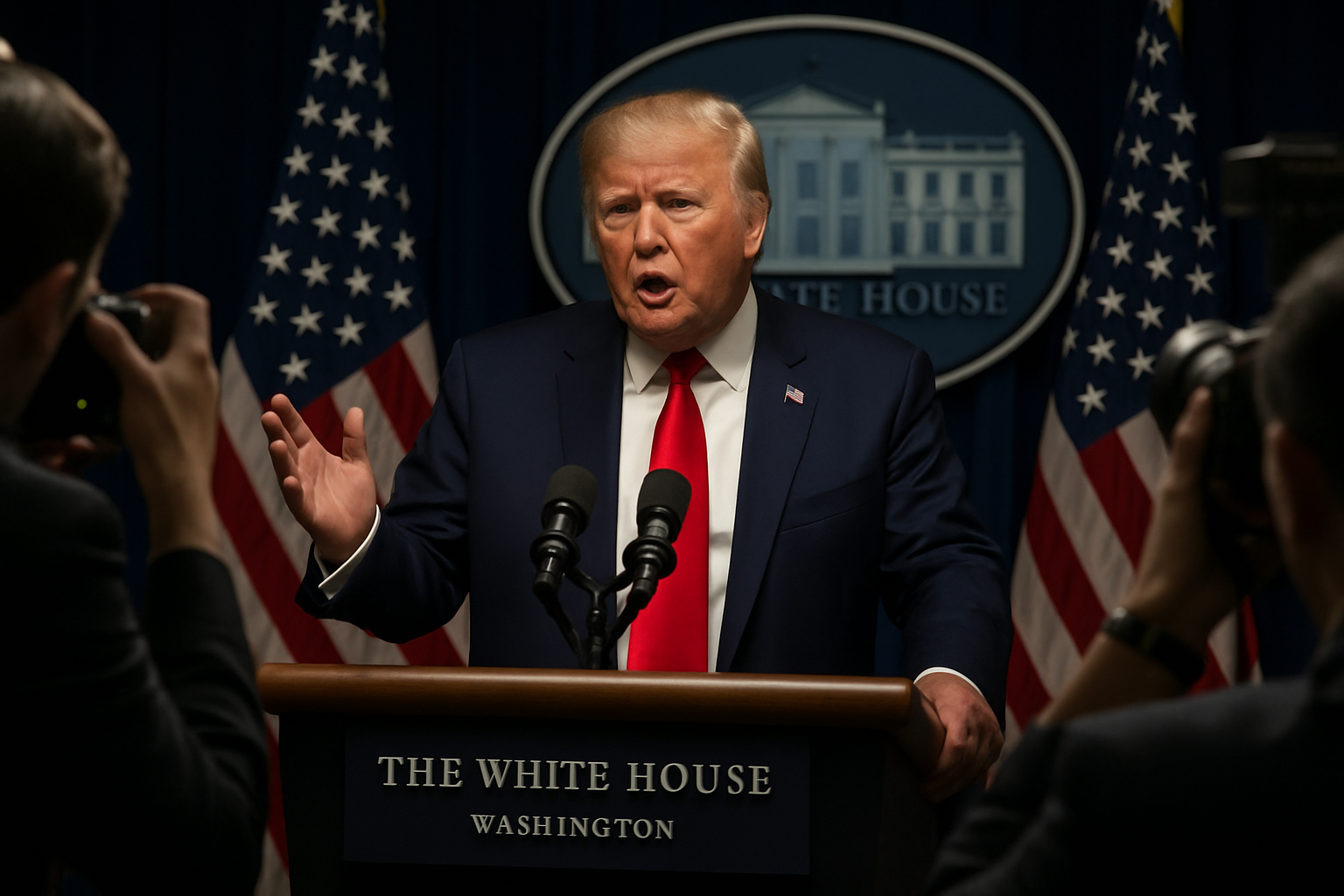
President Donald Trump declared Tuesday that the United States could end its military campaign against Iran within "two or three weeks," signaling a possible shift toward concluding the month-long conflict even as attacks on regional infrastructure continue unabated.
Speaking to reporters at the White House, Trump suggested the US could wind down operations regardless of whether Tehran agrees to negotiations. "We'll be leaving very soon," the President stated. "Iran doesn't have to make a deal, no. They don't have to make a deal with me."
The comments mark a notable evolution in Trump's rhetoric as Operation Epic Fury enters its fifth week, having evolved from what was initially described as a 4-6 week campaign into what Pentagon officials now acknowledge could extend through September 2026.
Ongoing Military Operations and Regional Attacks
Despite Trump's optimistic timeline, fighting continues across the region with significant new developments. Iranian forces struck fuel storage tanks at Kuwait International Airport using drone attacks, while a tanker was reportedly hit near Qatar, demonstrating Tehran's continued capability to target regional infrastructure.
The Islamic Revolutionary Guard Corps (IRGC) maintains its position that "no red lines remain," continuing Operation True Promise 4 with systematic targeting of US and allied facilities. Iran has deployed an estimated 2,000-6,000 naval mines in the Strait of Hormuz, effectively closing the waterway that handles 40% of global oil transit.
Secretary of State Marco Rubio told Fox News that Washington can now see the "finish line" in the war, though he cautioned the end is "not in the very short term." The remarks came as European allies have largely refused Trump's demands for naval coalition support to reopen the strategic waterway.
Escalating Global Crisis
The conflict has created unprecedented global disruptions. Over 18,000 flights have been cancelled worldwide – the most extensive aviation crisis since COVID-19 – as eight Middle Eastern countries maintain simultaneous airspace closures. Dubai International Airport, the world's busiest with 86 million passengers annually, remains shuttered due to missile damage.
Oil prices have surged past $100 per barrel, with warnings they could reach $200 if the crisis continues. The International Energy Agency has released a record 400 million barrels from strategic reserves – the largest intervention in the agency's 50-year history – to stabilize markets.

Diplomatic Efforts Through Pakistan
Behind the scenes, Pakistan has emerged as a crucial mediator, with Foreign Minister Ishaq Dar confirming "indirect talks" between the US and Iran through a "message relay system." The US has reportedly shared a 15-point peace proposal that Iran is currently deliberating, though Iranian officials have called Trump's demands "dreams they should take to their grave."
China has expressed "full support" for Pakistan's mediation initiative, with officials suggesting talks could begin "in the coming days" in Islamabad. The diplomatic channel represents the most serious peace effort since the conflict began following the breakdown of Geneva nuclear negotiations in February.
Congressional Pressure and Public Opposition
Trump faces mounting pressure from Congress, with bipartisan lawmakers demanding answers about strategy, costs, and the possibility of ground troop deployment. Senator Richard Blumenthal expressed being "more concerned than ever" about boots on the ground, particularly as Pentagon officials prepare operations extending well beyond the original timeline.
The conflict maintains historically low public support at just 25% approval – "almost unprecedented" for early-stage military operations. Financial markets have emerged as what experts call the "ultimate constraint" on further escalation, with Pakistan's stock exchange suffering its largest single-day decline in history.
Operation Epic Fury has cost $11.3 billion in its first week alone, making it the most expensive military campaign in recent years. The operation has resulted in 150 US troops wounded, with 8 in critical condition and 3 confirmed deaths – the first American casualties in the largest Middle East operation since the 2003 Iraq invasion.
Iranian Leadership and Succession Crisis
The conflict began following the confirmed death of Supreme Leader Ali Khamenei on March 1, ending his 37-year rule. His son, Mojtaba Khamenei, has emerged as the new Supreme Leader – marking the first hereditary succession in the Islamic Republic's 47-year history and representing a shift toward greater Revolutionary Guards control.
Trump has explicitly rejected the succession, claiming the right to personally choose Iran's next leader and calling Mojtaba Khamenei a "lightweight." This represents the most direct assertion of American control over Iranian internal affairs since the 1979 revolution.
"Iran has been set back 20 years. Major changes have taken place within Iran, and we're seeing the emergence of a less extreme group."
— Donald Trump, US President
European Territory Attacked for First Time Since WWII
In an unprecedented escalation, Iranian drones struck RAF Akrotiri in Cyprus – the first attack on European territory since World War II. The assault prompted an immediate naval coalition response, with HMS Dragon and vessels from Spain, Italy, France, the Netherlands, and Greece deploying to protect European interests.
The European Union activated its ESTIA crisis mechanism for the first time in the bloc's history, coordinating massive evacuations. Australia has 115,000 nationals trapped in the region, while Germany reports 30,000 stranded tourists – marking the largest international evacuation effort since the Arab Spring of 2011.
Energy Architecture Under Threat
The conflict has exposed fundamental vulnerabilities in global energy infrastructure. With the Strait of Hormuz effectively closed, natural gas prices have surged 24% in Europe and 78% in the US. Qatar has halted LNG production, affecting approximately 20% of global exports and threatening European winter energy supplies.
Major shipping companies Maersk and MSC have suspended operations in the Persian Gulf, with over 150 tankers worth billions in cargo stranded. Airlines are implementing emergency fuel surcharges as jet fuel prices spike from $85-90 per barrel to $150-200.
Nuclear Diplomacy Breakdown
The current crisis stems from the complete collapse of US-Iran nuclear talks in February, despite achieving what was described as "broad agreement on guiding principles" – the most progress since the 2018 JCPOA breakdown. The fundamental disagreement proved insurmountable: Iran wanted nuclear-only discussions, excluding ballistic missiles and proxy forces as "red lines," while the US demanded comprehensive talks covering missiles, armed groups, and human rights.
Iran continues enriching uranium to 60% purity with over 400 kilograms of weapons-grade material – sufficient for multiple nuclear weapons if weaponized. The crisis unfolds against a broader nuclear governance breakdown, as the New START treaty between the US and Russia expired in February 2026, marking the first time in over 50 years without such constraints.
Regional Coalition Under Strain
The unprecedented diplomatic consensus between Saudi Arabia, the UAE, Qatar, and Egypt supporting negotiations has been severely threatened by Iranian retaliation targeting their territories. The UAE has reported one civilian killed in Abu Dhabi, Kuwait has suffered 32 injuries from airport strikes, and Qatar sustained 8 wounded despite successfully intercepting 65 missiles and 12 drones using Patriot defense systems.
Egyptian President Abdel Fattah el-Sisi condemned attacks on "sisterly Arab countries," warning of "comprehensive chaos" if the conflict spreads further. The strain on this coalition represents a significant blow to Middle Eastern stability mechanisms that have taken decades to build.
Template-Setting Crisis for 21st Century
UN Secretary-General António Guterres has called the crisis "the greatest test of multilateral cooperation and crisis management in the modern era." The rapid transition from diplomatic breakthrough to military confrontation demonstrates the fragility of crisis management mechanisms in the multipolar era.
The stakes extend far beyond the Middle East, affecting regional war prevention, global energy security, nuclear governance credibility, and international law enforcement. Success in containing the crisis could provide a framework for future nuclear disputes, while failure may accelerate military solutions over diplomatic ones, potentially reshaping international relations for decades.
Looking Ahead
As Trump suggests a potential end to operations within weeks, the international community faces a watershed moment. The crisis affects Middle East stability, global energy markets, aviation networks, and nuclear proliferation mechanisms with implications extending decades beyond current events.
Pakistan's mediation efforts represent perhaps the last diplomatic window before further escalation. With financial markets serving as an "ultimate constraint" and congressional opposition mounting, the coming weeks will determine whether this becomes a template for diplomatic solutions or military confrontation in 21st-century international disputes.
The most dangerous international crisis since the Cold War's end continues to test post-WWII international order principles, with outcomes that will influence conflict resolution approaches, energy architecture evolution, and the balance between diplomatic and military solutions for generations to come.