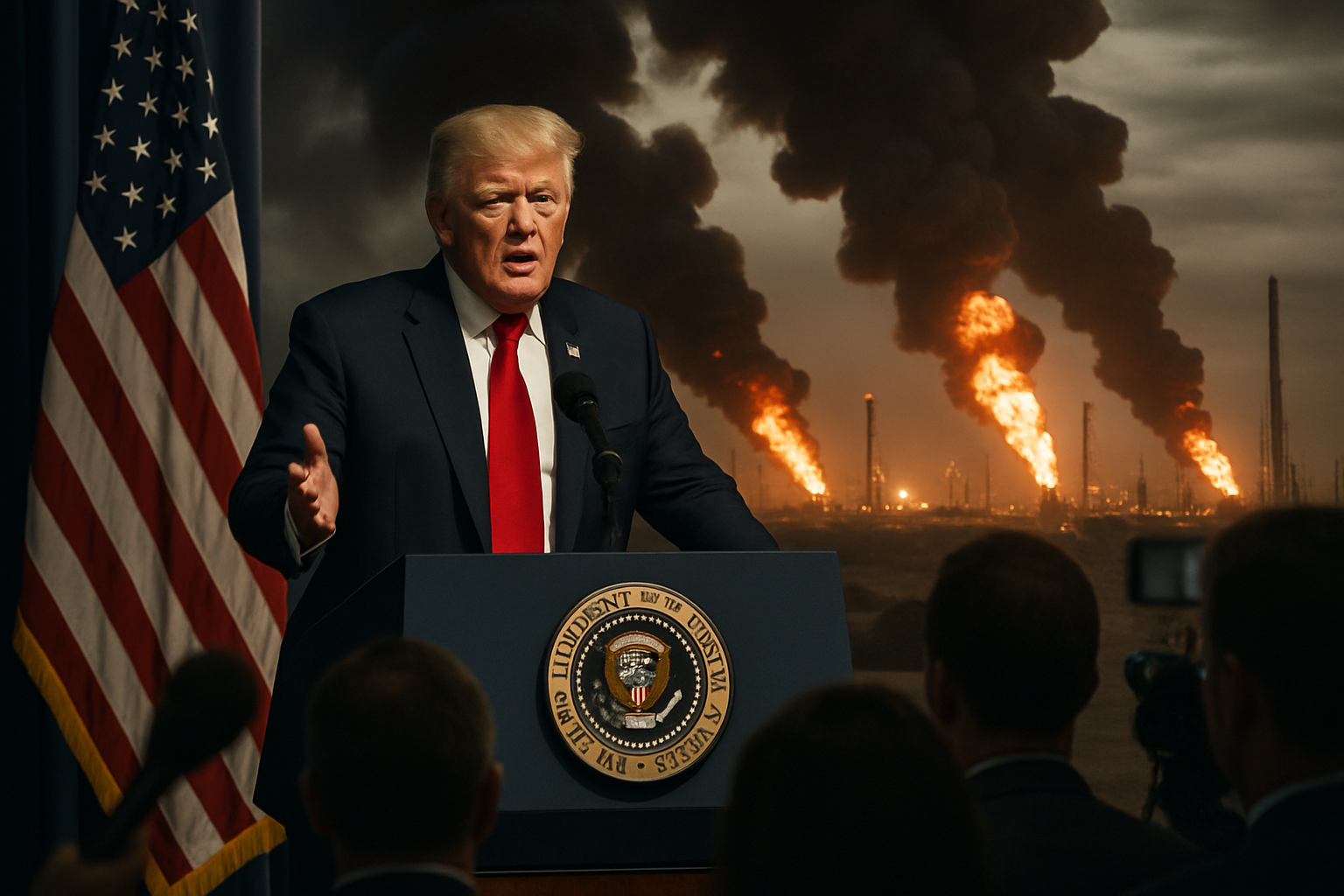
President Donald Trump delivered contradictory statements about the Iran war timeline on Monday, first suggesting the conflict could end "pretty quickly" before warning Iran would be hit "twenty times harder" if it disrupts oil supplies, as Operation Epic Fury enters its second week with unprecedented global ramifications.
The mixed messaging comes as the most dangerous international crisis since the Cold War continues to escalate, with Iran's Revolutionary Guard Corps (IRGC) maintaining its "no red lines remain" stance while systematic attacks target US and Israeli assets across the Middle East.
Contradictory Presidential Statements
Speaking to Republican members at Trump National Doral in Miami on Monday, the President told CBS that the US-Israeli assault was "very complete," suggesting an early conclusion to hostilities. However, hours later on Truth Social, Trump delivered a stark ultimatum: "If Iran does anything that stops the flow of oil within the Strait of Hormuz, they will be hit by the United States of America twenty times harder than they have been hit thus far."
The conflicting messages reflect mounting pressure from Trump's political and economic advisers to articulate a clear exit strategy from the Iran conflict, according to Wall Street Journal reports. The President simultaneously claimed that Iran no longer has a "navy," "communications," or "air force," while acknowledging the US hasn't "won enough" yet.
"The war could be over pretty quickly, but it's too soon to discuss that"
— Donald Trump, President of the United States
Operation Epic Fury Enters Second Week
The largest coordinated US-Israeli military campaign since 2003 has now struck over 5,000 targets across Iran, with costs reaching $3.7 billion in the first week alone – approximately $891.4 million daily. The operation, which began March 1 with the confirmed killing of Supreme Leader Ali Khamenei, has fundamentally altered Middle Eastern geopolitics.
Recent developments include the targeting of Iranian oil infrastructure around Tehran, creating massive fires and toxic black rain affecting nearly 10 million residents. The environmental crisis has prompted international concern as burning oil depots release acidic pollutants into the atmosphere.
Iranian President Masoud Pezeshkian apologized to neighboring countries for missile attacks while firmly rejecting Trump's surrender demands as "dreams they should take to their grave." This represents a complex diplomatic maneuvering amid active warfare, offering conditional ceasefire to neighbors while maintaining resistance to US demands.
Global Economic Disruption Intensifies
The conflict's economic impact has reached unprecedented levels, with over 18,000 flights cancelled worldwide – the most extensive aviation disruption since COVID-19. Eight Middle Eastern countries maintain simultaneous airspace closures, while Dubai International Airport, the world's busiest, remains shut due to missile damage.
Oil prices have surged 10% past $80 per barrel as Iran declared the Strait of Hormuz "unsafe for shipping," affecting 40% of global oil transit. Natural gas prices have increased 24% in Europe and 78% in the US, while over 150 tankers worth billions remain stranded in the Persian Gulf.
Major shipping companies Maersk and MSC have suspended operations, and Qatar has halted LNG production, threatening European energy supplies. The disruption demonstrates the fundamental vulnerability of global supply chains to geopolitical shocks.
Iranian Retaliation Campaign
Iran's "Operation True Promise 4" has caused casualties across the region under the IRGC's declaration that "no red lines remain." The systematic targeting has resulted in civilian deaths in the UAE, injuries at Kuwait International Airport, and the first attack on European territory since World War II when Iranian drones struck RAF Akrotiri in Cyprus.
The Cyprus attack has prompted an unprecedented naval coalition response, with HMS Dragon, Spanish frigates, and vessels from Italy, France, Netherlands, and Greece deploying to protect European interests. This marks a significant escalation in the conflict's scope beyond the Middle East.
Congressional Scrutiny Intensifies
Bipartisan lawmakers are demanding comprehensive answers on strategy, costs, and the potential deployment of ground troops. Senator Richard Blumenthal expressed being "more concerned than ever" about the possibility of "boots on the ground," while the conflict's unpopularity remains "almost unprecedented" in its early stages.
The Pentagon has confirmed preparations for operations extending through September, far beyond Trump's initial 4-5 week timeline. First US casualties have been confirmed: three service members killed and five wounded in the largest Middle East operation since 2003.
Regional Coalition Under Strain
The unprecedented coalition of Saudi Arabia, UAE, Qatar, and Egypt that had backed diplomatic efforts is now severely strained as Iranian retaliation directly targets member territories. Egyptian President Abdel Fattah al-Sisi condemned attacks on "sisterly countries," warning of "comprehensive chaos" spreading across the region.
The strain reflects the broader challenge facing regional powers caught between their alliance with the United States and the practical consequences of Iranian retaliation on their territories.
Nuclear Diplomacy Collapse
The current military escalation followed the complete breakdown of nuclear negotiations despite achieving a "broad agreement on guiding principles" in Geneva – the most significant diplomatic progress since the JCPOA collapse in 2018. The fundamental scope disagreement proved insurmountable: Iran excluded ballistic missiles and regional proxies as "red lines," while the US demanded a comprehensive agreement including missiles, armed groups, and human rights.
Iran continues uranium enrichment at 60% purity with over 400 kilograms of weapons-grade material, sufficient for multiple nuclear weapons if weaponized. The collapse of diplomacy amid the New START treaty's expiration has created the highest nuclear risks in decades.
Succession Crisis in Tehran
Following Khamenei's confirmed death on March 1, Iran's three-member transitional council continues governing under unprecedented wartime conditions. The Assembly of Experts is selecting a successor, with CIA assessments suggesting a Revolutionary Guards member is likely – representing a historic shift from clerical to military governance in the Islamic Republic's 47-year history.
Trump has explicitly stated he wants to be "involved in the appointment" of Iran's next Supreme Leader, rejecting Mojtaba Khamenei as "lightweight." This represents the most direct assertion of American control over Iranian internal affairs since 1979.
International Evacuations and Response
The crisis has triggered the largest coordinated international evacuation since the Arab Spring in 2011, with Australia reporting 115,000 nationals trapped and Germany evacuating 30,000 stranded tourists. The EU has activated its ESTIA evacuation plan for Cyprus for the first time.
UN Secretary-General António Guterres has called the crisis the "greatest test of multilateral cooperation and crisis management in the modern era," warning that decisions in the coming days and weeks will reverberate through international relations for decades.
Template-Setting Implications
The rapid transition from diplomatic framework to military confrontation demonstrates the fragility of crisis management in the multipolar era. The conflict's resolution will set precedents for 21st-century approaches to territorial disputes, nuclear crises, and energy security that extend far beyond the immediate region.
Success in containing the conflict could provide a framework for future nuclear crisis resolution, while failure may accelerate military solutions globally, encouraging proliferation and undermining diplomatic credibility for international disputes.
As Trump continues to deliver conflicting signals about the war's timeline while demanding Iran's "unconditional surrender," the stakes encompass regional war prevention, global energy security, nuclear governance credibility, and the fundamental principles of post-World War II international order – all tested simultaneously in what experts describe as the most consequential international crisis in decades.