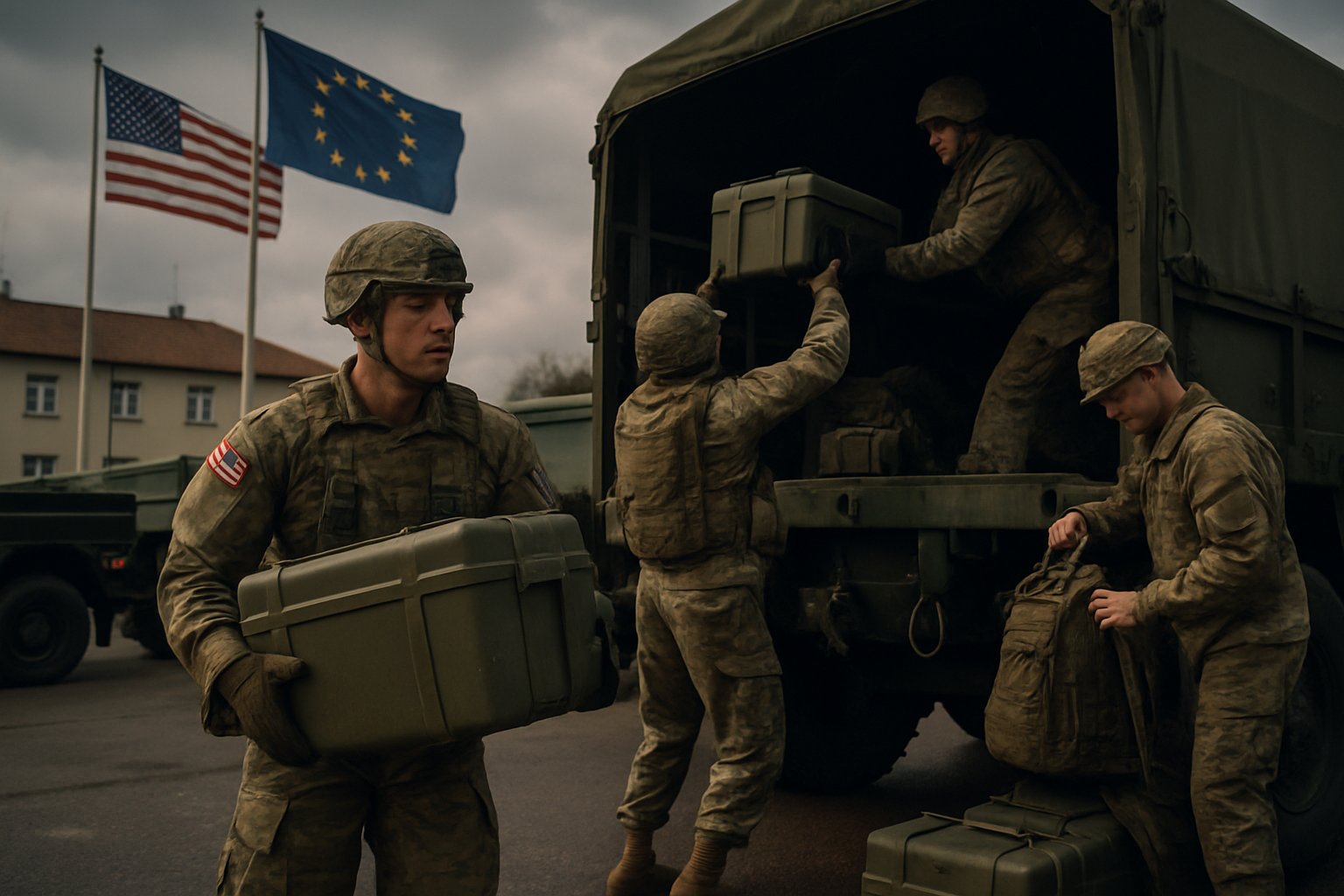
President Donald Trump is reportedly considering withdrawing some US troops from Europe amid escalating NATO tensions, following European allies' comprehensive rejection of American requests for military support in the ongoing Iran conflict, according to a senior White House official.
The potential troop withdrawal, first reported by Reuters and confirmed by multiple international sources, comes as the most serious alliance crisis since NATO's founding in 1949. European allies have delivered an unprecedented rejection of Trump's demands for military coalition support in the Strait of Hormuz, with German Defense Minister Boris Pistorius leading the resistance by asking "What does Donald Trump expect handful European frigates to do that powerful US Navy cannot?"
Alliance Fractures Reach Breaking Point
The crisis has been building since European allies rejected Trump's repeated requests for naval vessels to secure the Strait of Hormuz amid Operation Epic Fury, the largest US-Israeli military campaign since 2003. France explicitly rejected warship deployment, while Japan and Australia declined naval vessel requests despite their critical dependence on Persian Gulf oil transit routes.
Trump's frustration has been evident in increasingly harsh public statements. "We no longer 'need' or want assistance from NATO countries—IN FACT, WE NEVER NEEDED IT!" he declared on Truth Social, marking a complete policy reversal from traditional coalition-building approaches to unilateral military action.
"Without the United States, NATO is a paper tiger. They didn't want to go to war to stop nuclear-armed Iran."
— President Donald Trump, Truth Social
European Strategic Autonomy in Action
European leaders have demonstrated a new paradigm of selective cooperation, distinguishing between territorial defense and what they term "American military adventures." While rejecting Gulf operations, European nations rapidly coordinated when Iranian drones struck RAF Akrotiri in Cyprus—the first attack on European territory since World War II.
The response was immediate: an unprecedented naval coalition featuring HMS Dragon, Spanish frigates, and Italian, French, Dutch, and Greek vessels protecting Eastern Mediterranean waters. The EU activated its ESTIA crisis mechanism for the first time in the bloc's history, demonstrating European strategic autonomy in concrete terms.
Spain Escalates Resistance
Spain has emerged as the most vocal opponent of US operations, with Defense Minister Margarita Robles announcing the closure of Spanish airspace to US military aircraft involved in Iran operations. This escalation goes beyond Madrid's previous denial of base access at Rota Naval Station and Morón Air Base.
Prime Minister Pedro Sánchez condemned the Iran operations as a "breach of international law," prompting Trump to threaten to "cut off all trade" with Spain and order Treasury Secretary Scott Bessent to "cut off all dealings" with Madrid. The Spanish stance echoes the country's opposition to the 2003 Iraq War, which contributed to the Popular Party's electoral defeat in 2004.
Greenland and Strait of Hormuz Frustrations
According to the senior White House official, Trump's consideration of troop withdrawals is driven by multiple frustrations beyond the Iran conflict. The President remains "angry that his plans to acquire Greenland have not advanced," while being "upset at NATO allies' failure to help secure the Strait of Hormuz."
The Strait of Hormuz crisis has reached unprecedented levels, with Iran deploying an estimated 2,000-6,000 naval mines that have effectively closed the waterway carrying 40% of global oil transit. Oil prices have surged past $100 per barrel, while the International Energy Agency has authorized the largest strategic petroleum reserve release in its 50-year history—400 million barrels from 32 countries.
Nuclear Deterrence Renaissance
The alliance strain comes amid a broader nuclear governance crisis. The New START treaty expired in February 2026, marking the first time in over 50 years without US-Russia nuclear constraints. European leaders are now pursuing unprecedented nuclear deterrence discussions, with German Chancellor Friedrich Merz in direct negotiations with French President Emmanuel Macron about expanding French nuclear deterrence beyond national scope.
Finland has announced it will lift its comprehensive nuclear weapons ban "as soon as possible," while Sweden's Defense Minister Pål Jonson has indicated willingness to host nuclear weapons under wartime conditions—breaking an 80-year Nordic nuclear-free tradition.
Congressional and Public Opposition
Trump's Iran operations face historically low domestic support, with only 25% of Americans backing the military action—described by analysts as "almost unprecedented" unpopularity for early-stage operations. Senator Richard Blumenthal has expressed being "more concerned than ever" about potential ground troop deployment.
Operation Epic Fury has already cost $11.3 billion in its first week, with Pentagon operations now extending through September 2026—far beyond the initial 4-6 week timeline. The conflict has resulted in the first US casualties of a major Middle East operation since 2003, with 3 service members killed and over 150 wounded.
Economic Warfare Threats
Trump has weaponized economic pressure against resistant allies, threatening Spain with comprehensive trade sanctions. However, Spanish Economy Minister Carlos Cuerpo has justified the resistance as refusing to "participate in or contribute to a war which was initiated unilaterally and against international law." Madrid believes it has "necessary resources to contain impacts and diversify supply chains," backed by EU collective solidarity mechanisms.
Any unilateral US trade embargo would potentially violate World Trade Organization rules and existing EU-US agreements, complicating enforcement mechanisms.
Global Crisis Scope
The NATO crisis unfolds against a backdrop of unprecedented global disruption. Aviation networks have collapsed with over 18,000 flights cancelled worldwide—the most severe disruption since COVID-19. Eight Middle Eastern countries have simultaneously closed their airspace, severing critical Asia-Europe corridors and creating what analysts describe as an "aviation black hole."
Dubai International Airport, the world's busiest with 86 million passengers annually, remains shuttered due to missile damage. Major carriers including Emirates, Air France-KLM, and Wizz Air have suspended operations indefinitely, stranding hundreds of thousands of passengers globally.
Template-Setting Moment
UN Secretary-General António Guterres has characterized the current period as the "greatest test of multilateral cooperation in the modern era." European officials acknowledge they are "writing the template for 21st-century crisis management" with the world watching how democratic institutions adapt to contemporary challenges.
The crisis represents a fundamental test of whether NATO's institutional resilience can accommodate radical restructuring while maintaining democratic principles, or whether the alliance faces its most serious existential crisis since the 1956 Suez Crisis.
Polish Prime Minister Donald Tusk has warned that NATO's potential breakup would fulfill "Putin's dream plan," while Lithuanian President Gitanas Nausėda acknowledges that "tensions within the alliance are rising recently" despite maintaining confidence in collective defense mechanisms.
Historical Precedent and Future Implications
The current alliance strain echoes but surpasses previous NATO crises. While the 2003 Iraq War created diplomatic tensions, the current situation involves fundamental challenges to alliance governance structures and decision-making processes that could reshape transatlantic relations for decades.
European strategic autonomy is evolving from aspiration to operational reality, with concrete expressions through defensive military coordination while rejecting what Europeans characterize as discretionary American interventions. This selective cooperation paradigm could establish new precedents for alliance obligations versus national sovereignty balance in the 21st century.
The stakes extend far beyond current policy disagreements to encompass the sustainability of post-World War II international order principles, democratic nations' coordination mechanisms, and conflict resolution approaches that will influence global governance for generations to come.
As NATO Secretary-General Mark Rutte prepares for emergency consultations in Washington, the alliance faces a critical juncture determining whether institutional innovation can preserve Western unity or whether fundamental fragmentation will define the next era of international relations.