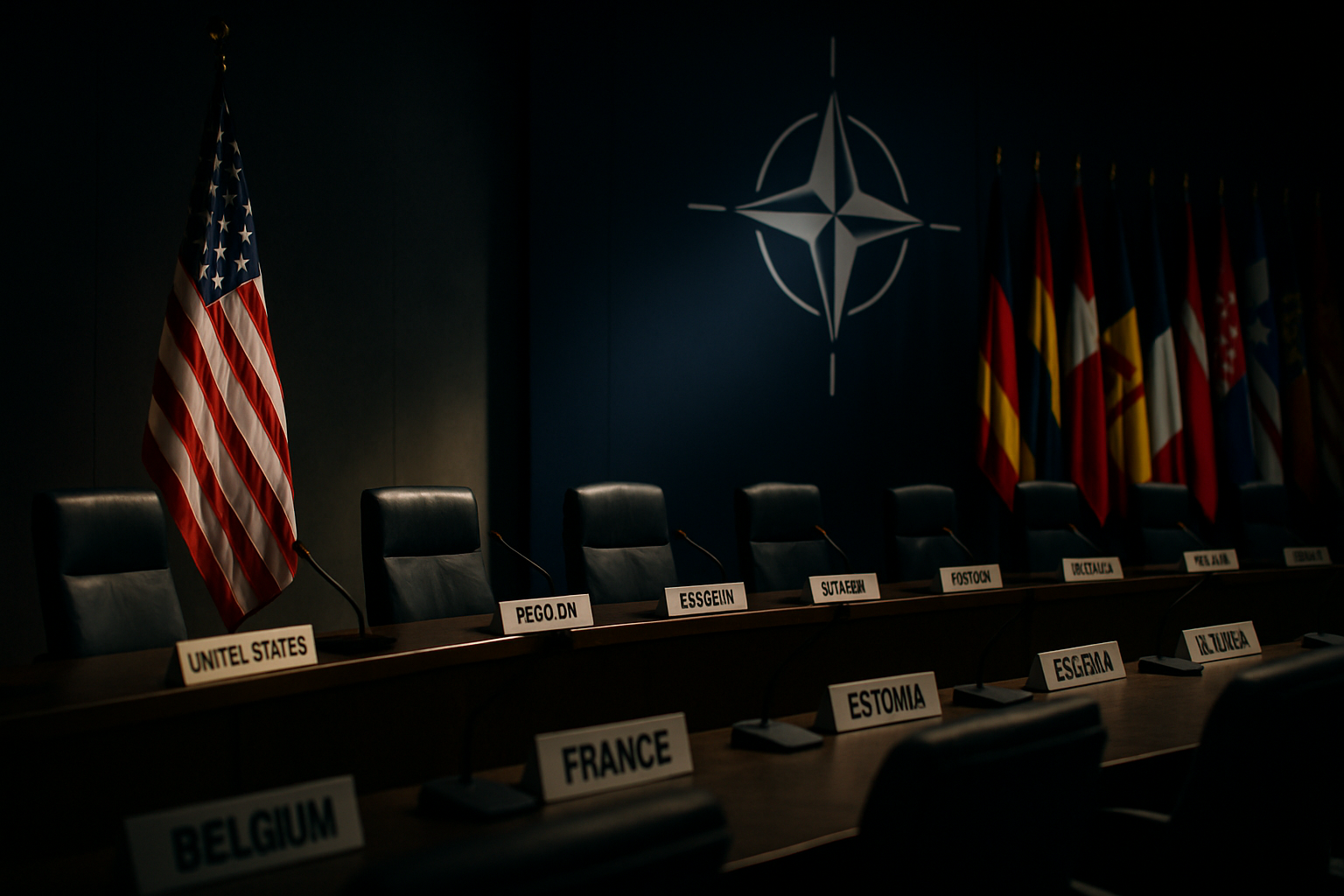
President Donald Trump declared he is "seriously considering" withdrawing the United States from NATO in an explosive interview with The Daily Telegraph, escalating a diplomatic crisis that began when European allies delivered a crushing rejection of American requests for military support in the Iran conflict.
The President characterized NATO as a "paper tiger" and said he had "always known" the alliance lacked substance, according to multiple international news sources reporting on the Telegraph interview published Wednesday morning. The statement represents the most direct threat to the transatlantic alliance since its founding in 1949, coming after what European officials describe as the most comprehensive rejection of American military leadership since the Iraq War.
Historic Allied Rejection
The crisis erupted when European allies, led by German Defense Minister Boris Pistorius, refused Trump's demands to send naval vessels to secure the Strait of Hormuz amid the ongoing Iran conflict. "What does Donald Trump expect a handful of European frigates to do that the powerful US Navy cannot?" Pistorius asked, in what sources describe as a coordinated European response invoking "Iraq lessons."
France explicitly rejected warship deployment, while Japan and Australia declined to send naval vessels despite their critical dependence on Middle Eastern oil. Sweden's Prime Minister Ulf Kristersson refused assistance entirely, with European leaders citing concerns about repeating "the same mistakes made in Iraq."
"United States informed by most NATO 'allies' they do not want participate our military operation Iran. We no longer 'need' or want assistance NATO countries—IN FACT, WE NEVER NEEDED IT!"
— Donald Trump, Truth Social
The President's Truth Social post marked a complete policy reversal from traditional American coalition-building approaches to a unilateral stance that has alarmed defense analysts and diplomats across the alliance.
Operation Epic Fury Costs Mount
The NATO crisis unfolds against the backdrop of Operation Epic Fury, the largest U.S.-Israeli military operation since the 2003 Iraq invasion. Pentagon sources confirm the operation has cost $11.3 billion in its first week alone, with current projections extending through September 2026—far beyond Trump's initial 4-6 week timeline.
Congressional opposition has intensified, with Senator Richard Blumenthal stating he is "more concerned than ever" about potential ground troop deployment. The conflict maintains historically low public support at just 25% among Americans, creating additional political pressure on the administration.
Iranian forces have responded with "Operation True Promise 4," which the Islamic Revolutionary Guard Corps describes as having "no red lines remaining." The campaign has targeted U.S. allies across the region, causing civilian casualties in the UAE, Kuwait, and Qatar, while Iranian drones struck RAF Akrotiri in Cyprus—the first attack on European territory since World War II.
European Strategic Autonomy Demonstrated
The crisis has revealed a striking paradox in European security thinking. While rejecting American requests for support in what Germans describe as Trump's "optional war," European nations immediately mobilized when Iranian forces attacked Cyprus, creating an unprecedented naval coalition featuring HMS Dragon and Spanish, Italian, French, Dutch, and Greek vessels.
This selective cooperation represents what experts are calling a new paradigm of European strategic autonomy—defending European territory while refusing to participate in discretionary American military adventures. The EU activated its ESTIA crisis mechanism for the first time in its history to coordinate the Cyprus response.
French President Emmanuel Macron has accelerated nuclear deterrence discussions with Germany, exploring ways to extend French nuclear protection beyond national boundaries—a development that would have been unthinkable during the Cold War era.
Global Economic Consequences
The Iran crisis has created worldwide economic disruption on a scale not seen since the COVID-19 pandemic. Oil prices have surged past $100 per barrel, with Brent crude reaching $119.50—an 18.98% single-day jump that represents the largest increase in recent history.
Iran's deployment of 2,000-6,000 naval mines in the Strait of Hormuz has effectively closed the waterway that carries 40% of the world's oil transit. The International Energy Agency has authorized the largest strategic petroleum reserve release in its 50-year history—400 million barrels from 32 countries.
Aviation networks have collapsed with more than 18,000 flights cancelled worldwide, while eight Middle Eastern countries have simultaneously closed their airspace, severing crucial Europe-Asia corridors. Dubai International Airport, the world's busiest with 86 million passengers annually, remains shut due to missile damage.
Nuclear Diplomacy Breakdown
The current crisis emerged from the complete collapse of nuclear diplomacy between Washington and Tehran, despite February's Geneva talks achieving what negotiators called "broad agreement on guiding principles"—the most progress since the 2018 JCPOA breakdown.
Insurmountable disagreements over scope derailed the promising negotiations. Iran insisted on nuclear-only discussions while excluding ballistic missiles and proxy groups as "red lines," while the U.S. demanded comprehensive agreements covering missiles, regional proxies, and human rights issues.
Iran continues uranium enrichment at 60% purity levels—approaching weapons-grade material—with over 400 kilograms of enriched uranium, sufficient for multiple nuclear weapons. The crisis unfolds without nuclear arms control constraints after the New START treaty expired in February 2026, marking the first time in over 50 years that the U.S. and Russia operate without nuclear limitations.
Congressional and Alliance Pressure
Bipartisan congressional opposition has emerged as a significant constraint on Trump's military options. The conflict's unprecedented unpopularity in early stages, combined with mounting costs and the prospect of extended operations, has created what defense analysts describe as "financial markets as the ultimate constraint" on military escalation.
Defense Secretary Pete Hegseth's notable absence from recent NATO defense ministers' meetings has highlighted growing concerns about American alliance commitment. European allies have launched their own Arctic Sentry mission, with the UK doubling troop presence in Norway and Sweden deploying Gripen jets to Greenland exercises—demonstrating burden-sharing capabilities independent of U.S. leadership.
Regional Coalition Under Strain
Trump's Iran strategy has severely strained the unprecedented Middle Eastern coalition that initially supported diplomatic approaches. Saudi Arabia, the UAE, Qatar, and Egypt had formed consensus backing Geneva negotiations, but Iranian attacks on their territories have created an impossible choice between U.S. alliance obligations and regional security.
Egyptian President Abdel Fattah el-Sisi condemned attacks on "sisterly Arab countries" while warning of "comprehensive chaos spreading across the region." The Gulf Cooperation Council has called emergency UN Security Council sessions as member states face direct Iranian retaliation.
Trump's Regime Change Demands
The President has escalated beyond nuclear concerns to explicit regime change advocacy, demanding Iran's "unconditional surrender" and claiming the right to "personally choose" Iran's next Supreme Leader. This represents the most direct assertion of American control over Iranian affairs since 1979, eliminating diplomatic solutions and hardening Iranian resistance.
Trump has rejected the succession of Mojtaba Khamenei, who assumed power after his father's death in March, calling him a "lightweight." This unprecedented involvement in Iranian succession politics reflects a policy evolution from nuclear-focused diplomacy to comprehensive political transformation.
Historical Significance and Implications
UN Secretary-General António Guterres has called the current crisis "the greatest test of multilateral cooperation in the modern era." March-April 2026 may prove to be a watershed moment determining whether 21st-century international disputes are resolved through diplomatic frameworks or military solutions.
The European rejection of American military requests while defending their own territory suggests a fundamental realignment of alliance relationships. NATO faces its most severe test since formation, with the outcome determining whether unity survives Trump's fury or marks a fundamental shift in global security arrangements.
The stakes extend far beyond the immediate conflict to include nuclear governance credibility, energy security architecture, and the enforcement of post-World War II international order principles. Success in containing the crisis could provide templates for future conflict resolution, while failure might accelerate military solutions that could reshape Middle Eastern geopolitics for decades.
As financial markets demonstrate the global consequences of regional conflicts—with Pakistan's stock exchange suffering its largest decline in history and supply chains worldwide facing disruption—the crisis reveals fundamental vulnerabilities in modern economic systems dependent on strategic chokepoints.
The coming weeks will test whether NATO's institutional resilience can accommodate Trump's demands for alliance restructuring or whether the organization faces its most serious existential challenge since the 1956 Suez Crisis, with implications extending decades into the future of democratic cooperation and international stability.