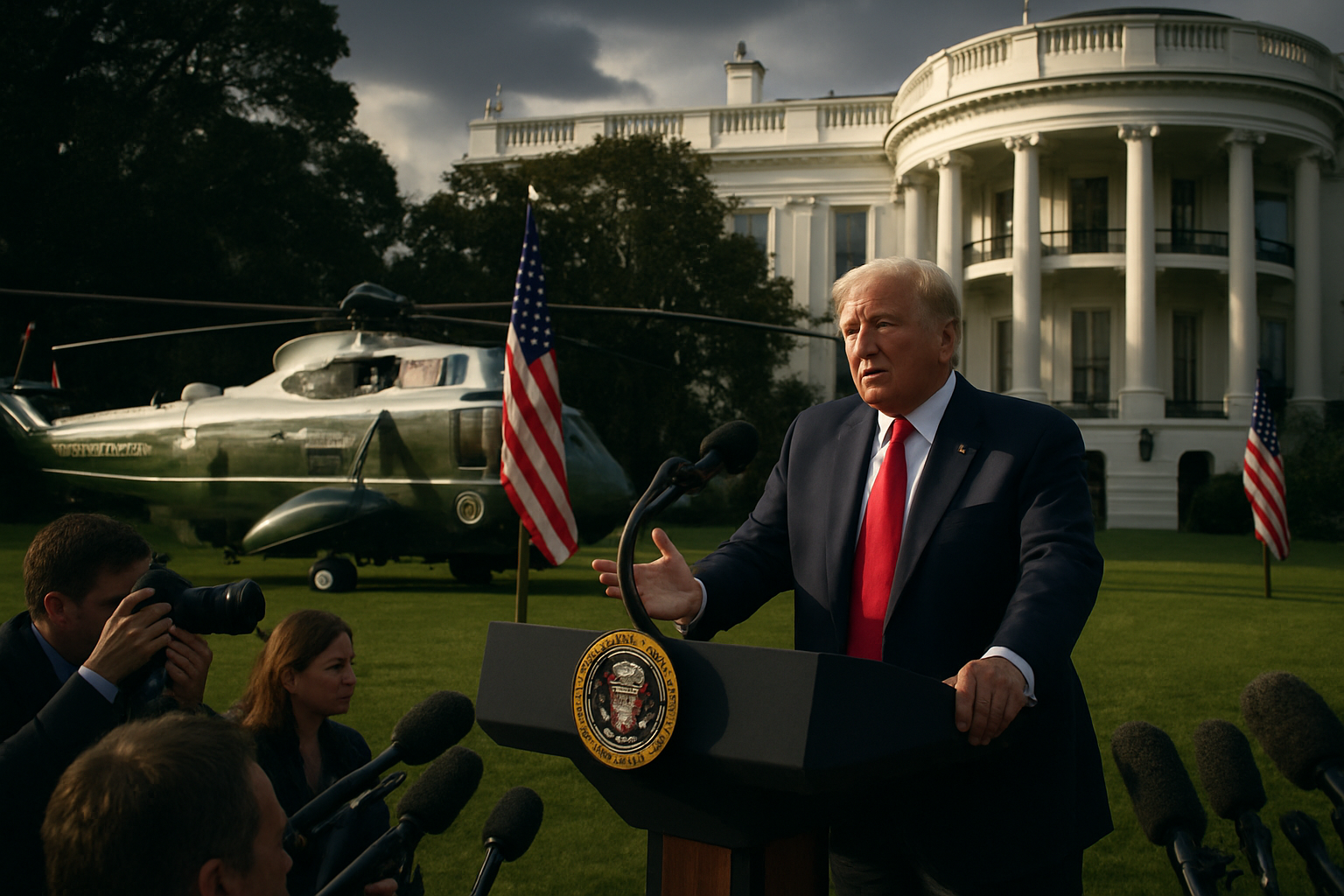
President Donald Trump suggested the United States could pursue a "friendly takeover" of Cuba during remarks to reporters on Friday, as the communist-run island faces its worst energy crisis since the 1990s Special Period.
Speaking before departing the White House for Texas, Trump indicated that Secretary of State Marco Rubio was handling discussions with Cuba "at a very high level," while describing the island nation as being in "big trouble" with "no money, no oil, no food."
"The Cuban government is talking with us, and they're in a big deal of trouble," Trump told reporters. "They have no money. They have no anything right now, but they're talking with us, and maybe we'll have a friendly takeover of Cuba."
Cuba's Unprecedented Crisis
Trump's comments come as Cuba faces its most severe economic emergency in decades. The island nation is experiencing complete aviation isolation through March 11, 2026, with zero jet fuel available at all nine major airports. Over 25,000 tourists, including 21,000 Canadians and 4,000 Russians, have been evacuated as major airlines suspended operations.
The energy crisis has reached critical proportions, with 51% of Cuba's population—approximately 5.5 million people—experiencing scheduled blackouts. Oil reserves have dwindled to a critical 15-20 day supply, while domestic production has collapsed from 3 million to 700,000 barrels daily.
Emergency measures implemented by the Cuban government include four-day work weeks, semi-virtual university classes, hospital surgery suspensions, and the closure of 90% of gas stations. The tourism industry has been devastated, with major hotel chains including Meliá, Iberostar, and Blue Diamond closing facilities in Varadero and northern coastal areas.
Trump's Maximum Pressure Strategy
The current crisis stems largely from the Trump administration's "maximum pressure" campaign against Cuba. A January 30, 2026 executive order threatened 25% tariffs on countries supplying oil to Cuba, effectively forcing Venezuela and Mexico to halt shipments despite humanitarian concerns.
Venezuela, under Acting President Delcy Rodríguez following the removal of Nicolás Maduro in January 2026, has completely stopped crude oil shipments to Cuba as it prioritizes rebuilding relations with Washington. Mexico, despite President Claudia Sheinbaum's humanitarian commitments, suspended oil deliveries while maintaining food aid through naval vessels.
The policy represents what experts call a 21st-century economic siege, deliberately targeting Cuba's energy infrastructure to create what Cuban President Miguel Díaz-Canel has described as "total asphyxiation" of the island's economy.
Rubio's High-Level Negotiations
According to Trump, Secretary Rubio is conducting negotiations with Cuban officials, though Havana has not publicly confirmed high-level talks. Cuban authorities have consistently denied engaging in direct negotiations with the current U.S. administration regarding any form of takeover or major political arrangement.
"I can see that happening. Marco Rubio is dealing on it and at a very high level," Trump said, adding that Cuba wants American help due to its economic desperation.
The comments represent Trump's most explicit statement about potential U.S. control over Cuba since taking office for his second term. Throughout his remarks, Trump emphasized Cuba's dire economic situation as leverage for potential negotiations.
Historical Context and Regional Impact
Trump's "friendly takeover" comments occur within the context of his administration's broader Caribbean strategy, dubbed the "Corolario Trump"—a 21st-century update to the Monroe Doctrine combining military pressure, economic coercion, and selective engagement.
The Cuba crisis has tested regional solidarity throughout Latin America, forcing countries to choose between maintaining traditional relationships with Havana and avoiding U.S. economic retaliation. Mexico's position exemplifies this dilemma, providing humanitarian aid while suspending energy cooperation under U.S. pressure.
International observers, including European media outlets, have characterized the situation as a "deliberately engineered humanitarian emergency" that exceeds the severity of Cuba's 1990s Special Period through systematic policy targeting rather than external economic collapse.
Cuban Exile Community Considerations
Trump specifically mentioned Cuban exiles during his remarks, suggesting that U.S. action could benefit "people that were expelled, or worse, from Cuba that live here." He noted that "we have people living here that want to go back to Cuba," indicating consideration of Cuban-American perspectives in any potential arrangement.
The Cuban-American community in Florida, a crucial Trump political base, has historically supported maximum pressure policies against the Cuban government while advocating for democratic transition on the island.
International Response and Maritime Tensions
Trump's comments come just days after a deadly incident in Cuban territorial waters where coast guard forces killed four people and wounded six others aboard a Florida-registered speedboat. The February 25 incident, which Cuban authorities claim involved individuals with "terrorist intentions," represents the most serious bilateral incident in years.
Secretary Rubio has indicated that the U.S. is investigating the incident and will "verify information and draw our own conclusions," suggesting measured American response aimed at preventing escalation during apparent negotiations.
The broader regional context includes Operation Southern Spear, which has resulted in over 145 deaths and 40 attacks since September 2025, transforming the Caribbean into an increasingly militarized zone under U.S. security operations.
Economic and Humanitarian Implications
The complete aviation isolation has eliminated medical evacuation capacity and severed Cuban-American family connections, affecting all 11 million Cuban inhabitants. Healthcare systems face critical challenges with surgery suspensions, staff transportation difficulties, and power outages threatening medical equipment and medicine storage.
International humanitarian responses have been limited by U.S. pressure. Russia has condemned the "economic strangulation" and pledged oil aid, while Jeremy Corbyn announced an international flotilla to challenge the blockade. China has demanded cessation of U.S. pressure, but practical assistance remains constrained.
The crisis has created what analysts describe as the most comprehensive test of modern economic siege warfare, with implications extending far beyond Cuba to questions of territorial sovereignty, civilian protection standards, and international law enforcement in the 21st century.
Future Implications
Trump's "friendly takeover" suggestion represents a significant escalation in rhetoric about Cuba's future, moving beyond traditional diplomatic pressure toward explicit discussion of political control. The comments indicate potential fundamental changes in U.S.-Cuba relations depending on ongoing negotiations and Cuba's response to economic pressure.
The success or failure of the current strategy will likely influence American approaches to similar challenges elsewhere, serving as a template for economic coercion capabilities in the multipolar era. Regional observers note that the Caribbean has become a laboratory for testing reimagined American hemispheric dominance through integrated military and economic pressure.
As Cuba enters its second month of unprecedented isolation, the international community faces critical decisions about responding to comprehensive economic pressure affecting civilian populations, with implications for future territorial disputes, democratic transitions, and great power competition management globally.