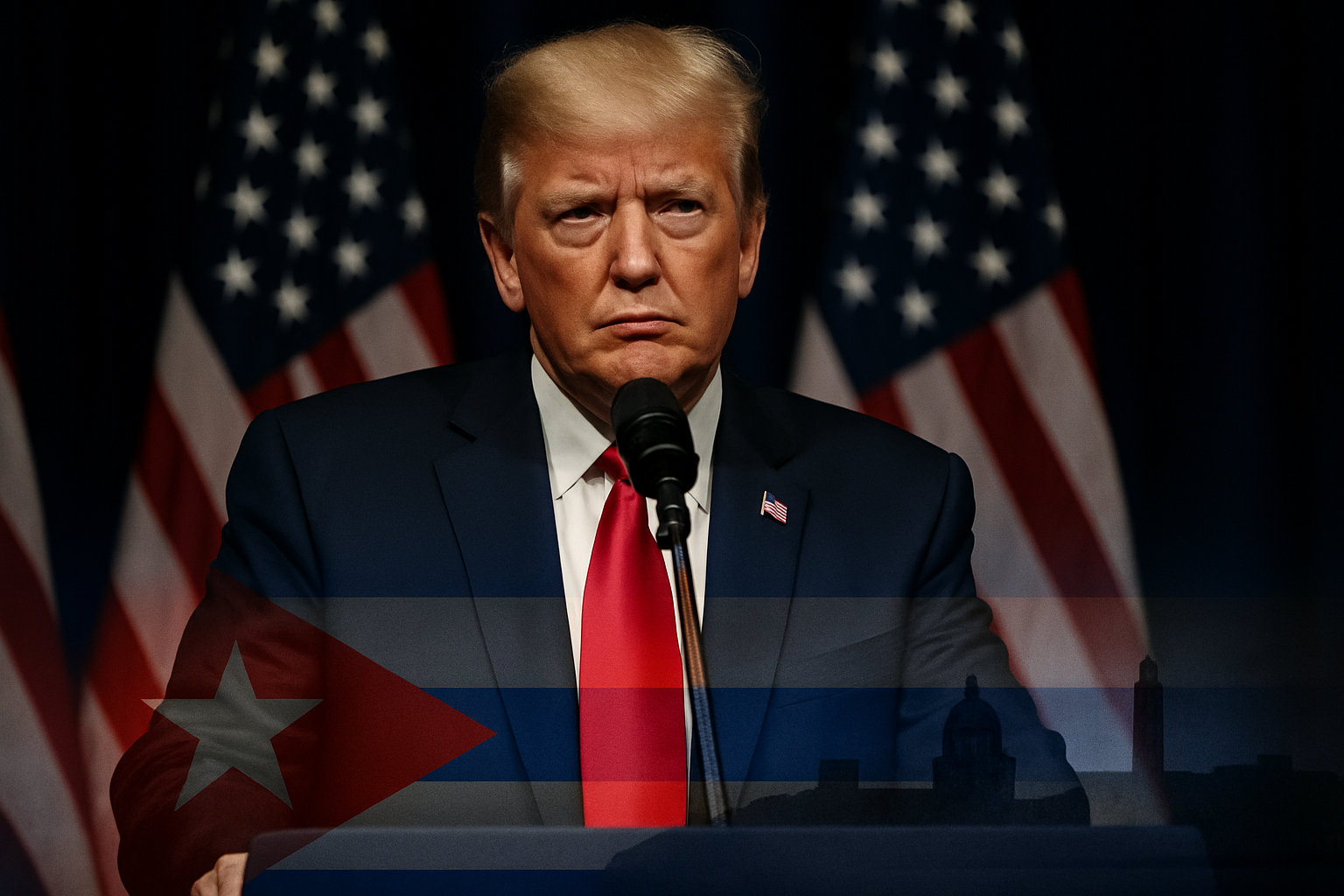
President Donald Trump on Friday delivered his most explicit threat against Cuba in decades, warning that the Caribbean island could become Washington's next target as Havana faces an unprecedented humanitarian crisis that has drawn international condemnation.
Speaking at the Saudi-backed FII Priority investment forum in Miami, Trump declared that "Cuba is next" while dismissing concerns that recent American military actions would cost him political support. The warning represents a dramatic escalation in the Trump administration's "maximum pressure" campaign that has achieved what officials describe as complete economic isolation of the communist nation.
Trump's threat comes as Cuba endures its worst energy crisis since the 1990s Special Period, with the island suffering from systematic infrastructure collapse that has left millions without power and forced the evacuation of over 25,000 foreign tourists. The president's comments mark the most direct U.S. discussion of potential Cuban intervention since the 1960s, signaling a potentially dangerous new phase in American-Caribbean relations.
Maximum Pressure Campaign Achieves Total Isolation
The Trump administration's January 30 executive order threatening 25% tariffs on countries supplying oil to Cuba has effectively severed the island's energy lifeline. Venezuela's interim government, installed after the U.S. military capture of Nicolás Maduro in January 2026, has completely halted crude shipments as it prioritizes relations with Washington. Mexico, despite historical solidarity with Cuba, has also suspended petroleum deliveries while maintaining limited humanitarian aid to avoid economic retaliation.
The campaign's success is evident in Cuba's catastrophic statistics: oil reserves have dwindled to a critical 15-20 day supply, domestic production has collapsed from 3 million to just 700,000 barrels daily, and the Cuban peso has reached a historic low of 500 units per dollar. The February fire at the Ñico López refinery eliminated the island's remaining domestic processing capacity, compounding the crisis indefinitely.
Complete aviation isolation from February 10 through March 11 forced major airlines including Air Canada, WestJet, and Russian carriers Rossiya and Nordwind to suspend all operations. The evacuation of 21,000 Canadian and 4,000 Russian tourists represents the most comprehensive aviation blockade since the 1962 Cuban Missile Crisis, affecting 400 weekly flights and 70,000 scheduled seats.
Humanitarian Emergency Reaches Critical Scale
The crisis has reached unprecedented proportions, with 51% of Cuba's population (5.5 million people) experiencing scheduled blackouts during peak hours according to Unión Eléctrica. The island has suffered six major nationwide blackouts since late 2024, with the most recent on March 17 affecting over 10 million inhabitants when the Antonio Guiteras thermoelectric power plant in Matanzas province failed.
"Cuba's government is going to fall very soon. They want to make a deal so badly."
— Donald Trump, President of the United States
Emergency measures implemented by the Cuban government include four-day work weeks, closure of 90% of gas stations, suspension of hospital surgeries, and the transition to semi-virtual university classes. The healthcare system faces a critical crisis with medical staff unable to reach facilities, power outages threatening equipment and medicine storage, and the complete elimination of medical evacuation capacity.
The tourism industry, a crucial source of foreign currency, has collapsed entirely. Major Spanish hotel chains including Meliá and Iberostar have closed their Varadero and northern coast facilities, while Canada has issued its highest travel warning citing "serious and potentially life-threatening risks." The economic devastation extends to agriculture, with the government officially acknowledging that domestic production is insufficient to cover national food requirements.
Civil Unrest Marks Historic Challenge to Communist Authority
The energy crisis has sparked the most significant civil unrest in Cuba since the 1959 revolution. On March 13-14, unprecedented scenes unfolded in Morón, Ciego de Ávila province, where protesters stormed and ransacked the local Communist Party headquarters, chanting "¡Libertad!" (Freedom) while dragging furniture, computers, and propaganda materials into the streets to create bonfires.
The attack on the party facility represents the first successful assault on a major Communist Party installation since the revolution, marking a watershed moment in Cuban history. Government priorities have shifted to "defense of internal order" as widespread "cacerolazos" (pot-banging protests) spread across multiple cities, with demonstrators using cellphone flashlights during blackouts.
Transportation systems have collapsed completely, with crowds waiting indefinitely at major transit hubs like Havana's Viaducto with backpacks and water bottles. Cuban officials acknowledge that "not even in the hardest years of the Special Period had we seen anything like this," highlighting the unprecedented nature of the current crisis.
International Response Divides Global Community
The Cuban crisis has exposed deep divisions in the international community's response to what European media has characterized as a "deliberately engineered humanitarian emergency." Russia has condemned the U.S. campaign as "economic strangulation" and pledged oil aid as humanitarian assistance, though no timeline has been provided for deliveries.
Former UK Labour leader Jeremy Corbyn has announced an international flotilla to challenge the U.S. oil blockade, while China has demanded the immediate cessation of American pressure on the island. Mexico continues to provide humanitarian aid through naval vessels carrying 814 tons of supplies while carefully avoiding petroleum shipments that could trigger U.S. tariffs.
Ireland has issued its second-highest travel warning, classifying Cuba under "serious and potentially life-threatening risks," while Spain has announced humanitarian aid through UN channels including food and essential health products. The Vatican postponed planned papal visits due to concerns about return travel logistics.
"Corolario Trump" Reshapes Western Hemisphere
Trump's Cuba threats are part of a broader Caribbean strategy that analysts have termed "Corolario Trump" – a 21st-century update to the Monroe Doctrine that combines military pressure, economic coercion, and selective engagement to establish American hemispheric dominance. The approach has already achieved remarkable success in Venezuela, where the interim government of Acting President Delcy Rodríguez has overseen a 60% surge in oil exports to 800,000 barrels daily, with the U.S. displacing China as the top customer.
The strategy represents a systematic reconfiguration of inter-American relations that forces regional powers to choose between U.S. economic relationships and traditional solidarity with leftist governments. The success of the Venezuelan transformation provides a template that the administration appears eager to replicate in Cuba, though the Caribbean island presents different challenges due to its political structure and economic base.
Secretary of State Marco Rubio, positioned as the lead negotiator for potential Cuba talks, has developed a three-phase plan similar to the Venezuelan model: stabilization through pressure, economic recovery through cooperation, and democratic transition. However, Cuban authorities have not publicly confirmed the existence of high-level negotiations despite Trump's claims of ongoing discussions.
Regional Security Implications Escalate
The Cuban crisis occurs within the broader context of Operation Southern Spear, the U.S. military campaign in Caribbean waters that has resulted in over 145 deaths since September 2025. A deadly maritime incident on February 25, where Cuban coast guard forces killed four and wounded six aboard a Florida speedboat in territorial waters, has added a lethal dimension to the diplomatic standoff.
The incident represents the most serious bilateral confrontation in years and highlights the growing militarization of the Caribbean region. The Trump administration has deployed the world's largest aircraft carrier to Venezuelan waters and conducted systematic strikes against suspected drug trafficking vessels, fundamentally altering the security landscape of the Western Hemisphere.
CARICOM member states face increasingly difficult choices between maintaining solidarity with Cuba and preserving vital economic relationships with the United States. Trinidad and Tobago has openly supported U.S. military operations, with Prime Minister Kamla Persad-Bissessar dismissing the regional "zone of peace" policy, creating unprecedented divisions within the Caribbean integration framework.
Historical Precedent and Future Implications
The current crisis exceeds the severity of Cuba's 1990s Special Period through systematic U.S. policy rather than external collapse. Unlike the previous emergency, which maintained some international connectivity, the current isolation is complete and unprecedented since the 1962 Cuban Missile Crisis. The complete aviation connectivity severance affects 11 million inhabitants and represents a new dimension of economic warfare.
International law experts express concern about the normalization of collective punishment affecting entire civilian populations beyond political objectives. The Cuban template demonstrates the effectiveness of modern economic coercion capabilities while raising questions about territorial sovereignty principles and humanitarian protection standards in the 21st century.
The stakes extend far beyond bilateral U.S.-Cuba relations to broader questions of international cooperation, global governance evolution, and territorial sovereignty enforcement in an increasingly multipolar world. Success in Cuba could provide the Trump administration with a crisis resolution template applicable globally, while failure might establish dangerous precedents for comprehensive economic siege warfare.
Crisis Resolution Remains Uncertain
Cuban authorities have provided no timeline for resolving the restrictions, and the crisis appears to require either a diplomatic breakthrough, alternative supply arrangements circumventing U.S. pressure, or fundamental changes to Cuba's energy infrastructure. The international community faces an unprecedented test of how to respond to economic coercion affecting entire populations.
Trump's explicit threats of a potential "takeover" scenario, combined with his claims that Cuba is "ready to negotiate," suggest the administration believes the maximum pressure campaign has created conditions for a fundamental political transformation. However, the complex dynamics of Cuban society, the regime's focus on "defense of internal order," and the unprecedented nature of the civil unrest make the outcome highly uncertain.
As the crisis enters its third month, the coming weeks will be decisive in determining whether innovative diplomatic solutions emerge or whether Cuba faces sustained economic siege that could reshape Caribbean geopolitics for decades. The international community's response will likely influence future approaches to territorial disputes, democratic transitions, and great power competition management globally.
The Trump administration's success in completely isolating Cuba demonstrates the gravitational pull of American economic power in forcing regional compliance despite ideological commitments. Whether this approach ultimately leads to the democratic transformation Trump envisions or deeper radicalization remains the critical question facing policymakers as the humanitarian crisis deepens and international tensions escalate.