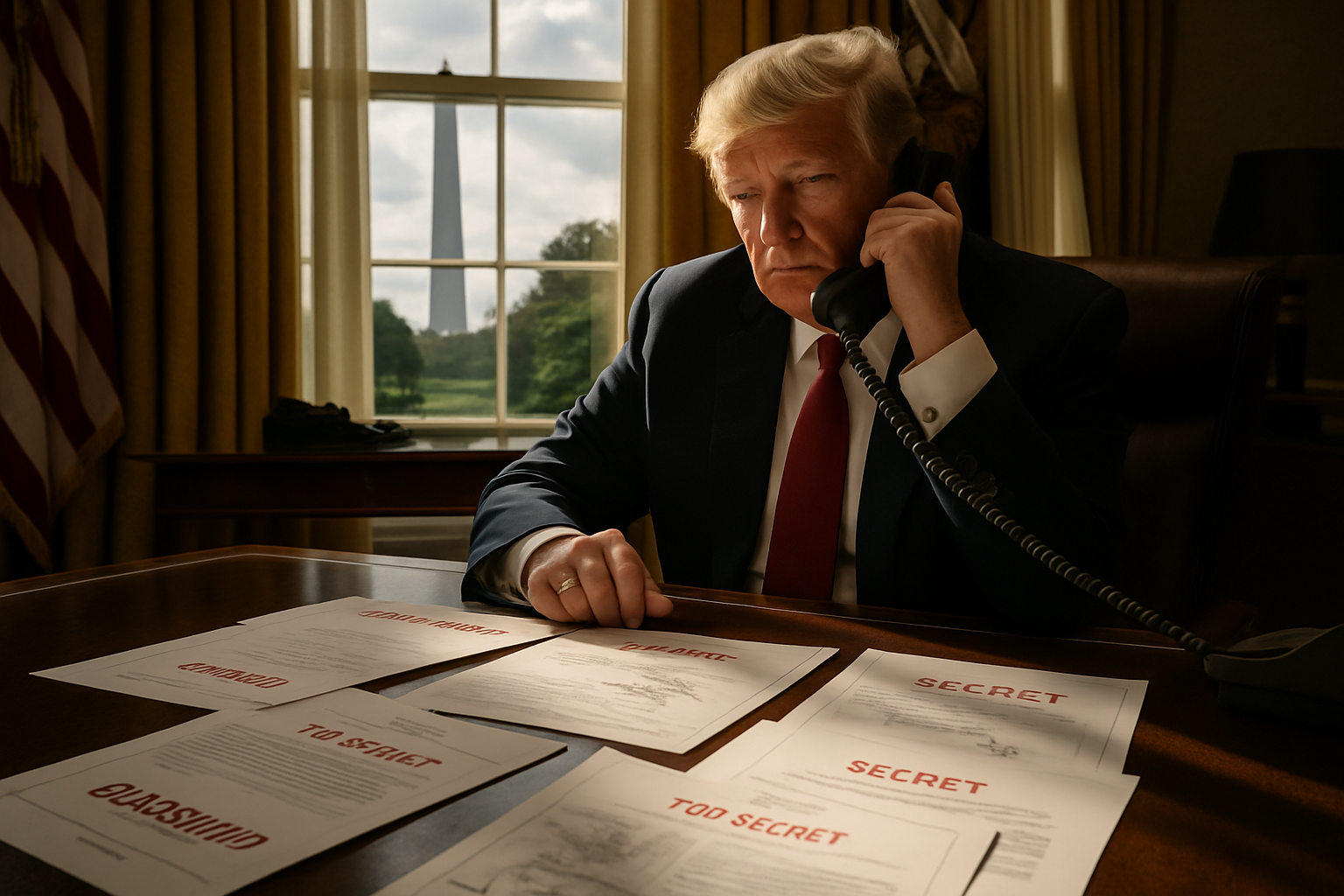
President Donald Trump announced Monday that he has instructed the Department of War to postpone all military strikes against Iranian power plants and energy infrastructure for five days, citing "very good and productive conversations" with Iran over the past two days. The decision comes just hours before the expiration of Trump's explosive 48-hour ultimatum that threatened to "obliterate" Iran's power grid.
The announcement, made via Truth Social in all capital letters, represents a dramatic shift from the unprecedented civilian infrastructure targeting that Trump had threatened if Iran failed to fully reopen the Strait of Hormuz. The president claimed that the United States and Iran have held discussions regarding a "complete and total resolution of our hostilities in the Middle East."
"Based on the tenor and tone of these in depth, detailed, and constructive conversations, which will continue throughout the week, I have instructed the Department of War to postpone any and all military strikes against Iranian power plants and energy infrastructure for a five day period, subject to the success of the ongoing meetings and discussions," Trump wrote.
Iran Denies Diplomatic Engagement
However, Iran's semi-official Fars news agency swiftly contradicted Trump's claims, stating there are "no direct or indirect communications with the US." An Iranian source told Fars that Trump had backed down after receiving Iran's "warnings" about potential retaliation that would target all power plants and energy facilities throughout the region.
The Iranian denial adds a layer of uncertainty to Trump's announcement, raising questions about whether genuine diplomatic progress has been made or if the postponement reflects other strategic considerations. Iran's Revolutionary Guard had previously declared that "no red lines remain" and warned that any attack on Iranian infrastructure would trigger systematic regional retaliation targeting US and Israeli facilities.
Market Reactions and Global Impact
Financial markets responded immediately to Trump's announcement, with oil prices plunging more than 14% before recovering approximately half those losses. The volatility underscores the global economic implications of the Iran crisis, which has already pushed oil prices past $100 per barrel for the first time since 2022, with Brent crude reaching $119.50 and WTI hitting a record 18.98% single-day jump to $108.15.
The crisis has created the most severe energy disruption since the 1970s oil shocks, with Iran deploying thousands of naval mines in the Strait of Hormuz, effectively closing the waterway that handles 40% of global seaborne oil transit. The International Energy Agency has released a record 400 million barrels from strategic reserves across 32 countries, the largest intervention in the agency's 50-year history.
Stock markets have surged following Trump's announcement of the postponement, reflecting investor relief at the prospect of avoiding immediate escalation in what has become the most dangerous international crisis since the end of the Cold War.
Context of Unprecedented Ultimatum
Trump's original 48-hour ultimatum, issued Saturday, represented an unprecedented threat to target civilian power infrastructure. The president had demanded that Iran "FULLY OPEN, WITHOUT THREAT, the Strait of Hormuz, within 48 HOURS" or face attacks on "various POWER PLANTS, STARTING WITH THE BIGGEST ONE FIRST."
The ultimatum came amid the ongoing "Operation Epic Fury," the largest US-Israeli military campaign since the 2003 Iraq invasion, utilizing dual-carrier deployment of the USS Gerald Ford and USS Abraham Lincoln representing approximately one-third of the active US Navy fleet. The operation has already cost $11.3 billion in its first week, with 150 US troops wounded and three confirmed deaths.
Iran has responded with "Operation True Promise 4," systematic strikes across the region that have caused casualties in multiple countries. The UAE has reported one civilian killed in Abu Dhabi, Kuwait suffered 32 injuries from airport strikes, and Qatar intercepted 65 missiles and 12 drones despite eight personnel being wounded. Most significantly, Iranian drones struck RAF Akrotiri in Cyprus, marking the first attack on European territory since World War II.
Global Aviation Crisis Continues
The postponement of strikes has not yet resolved the broader crisis affecting global transportation networks. More than 18,000 flights have been cancelled worldwide in what represents the most severe aviation disruption since the COVID-19 pandemic. Eight Middle Eastern countries maintain simultaneous airspace closures, creating an "aviation black hole" that has severed critical Asia-Europe air corridors.
Dubai International Airport, the world's busiest with 86 million annual passengers, remains shut down due to missile damage. Major carriers including Emirates, Air France-KLM, and Wizz Air have suspended operations indefinitely, stranding hundreds of thousands of passengers globally.
Nuclear Diplomacy Breakdown
The current crisis stems from the complete collapse of nuclear negotiations despite a breakthrough in Geneva talks that achieved "broad agreement on guiding principles" - the most significant diplomatic progress since the 2018 collapse of the Joint Comprehensive Plan of Action (JCPOA). However, fundamental scope disagreements proved insurmountable, with Iran excluding ballistic missiles and regional proxies as "red lines" from nuclear-only talks, while the US demanded comprehensive agreements addressing missiles, armed groups, and human rights.
Iran continues enriching uranium at 60% purity, approaching the 90% weapons-grade threshold, with more than 400 kilograms of enriched material sufficient for multiple weapons if weaponized. The crisis unfolds against the backdrop of broader nuclear governance concerns, as the New START treaty between the US and Russia expired in February 2026, marking the first time in over 50 years without nuclear constraints between the superpowers.
Regional Coalition Under Strain
The escalating conflict has severely strained the unprecedented regional coalition that had backed diplomatic efforts. Saudi Arabia, the UAE, Qatar, and Egypt had formed an extraordinary Middle Eastern consensus supporting negotiations, but Iran's systematic retaliation targeting coalition member territories has threatened this unity.
Egyptian President Abdel Fattah el-Sisi condemned Iran's attacks on "sisterly countries," warning of "comprehensive chaos" if the conflict continues to spread. The Gulf states now face an impossible choice between their alliance with the United States and protection from Iranian retaliation, potentially reshaping decades-old security arrangements in the region.
Congressional Opposition Mounts
Domestic political pressure continues to build against the military campaign, with bipartisan lawmakers demanding comprehensive briefings on strategy, costs, and the potential deployment of ground troops. Senator Richard Blumenthal stated he is "more concerned than ever" about the possibility of boots on the ground, while public support remains at historically low levels of just 25% - described as "almost unprecedented" for early-stage military operations.
The Pentagon has indicated that operations could continue through September, far beyond the originally projected 4-6 week timeline, raising questions about the long-term sustainability of the campaign. Financial markets have been described as the "ultimate constraint" on prolonged military action, with stock exchanges worldwide experiencing severe disruptions.
Historical Significance and Global Implications
UN Secretary-General António Guterres has described the current crisis as the "greatest test of multilateral cooperation in the modern era." The rapid transition from diplomatic breakthrough to military escalation demonstrates the fragility of crisis management in the multipolar era, with implications extending far beyond the immediate region.
The crisis affects energy security architecture, nuclear governance credibility, and international law enforcement mechanisms simultaneously. Success in containing the conflict could provide a template for future nuclear dispute resolution, while failure may accelerate the trend toward military solutions, potentially encouraging nuclear proliferation globally and undermining diplomatic credibility for decades.
The five-day postponement announced by Trump offers a narrow window for diplomatic resolution, though the contradictory claims about ongoing negotiations raise questions about whether genuine progress is possible. As the world watches, the coming days will determine whether this crisis can be resolved through dialogue or will escalate into a broader Middle Eastern conflict with global implications extending far beyond current events.