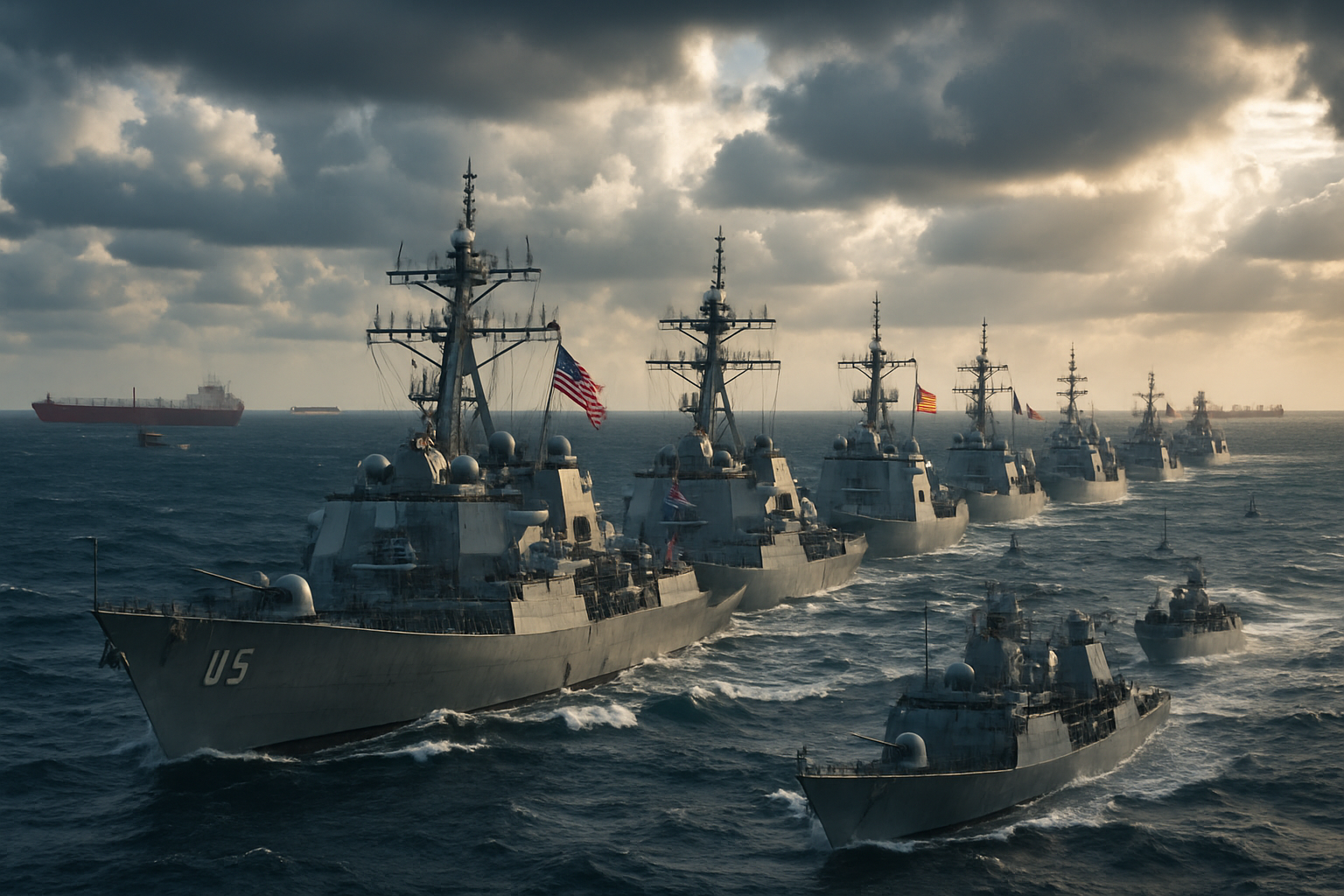
President Donald Trump on Sunday demanded that seven countries contribute warships to a multinational coalition aimed at reopening the Strait of Hormuz, as Iran's blockade of the vital waterway enters its third week and threatens to push global oil prices beyond $200 per barrel.
Speaking to reporters at Mar-a-Lago, Trump called specifically on China, France, Japan, South Korea, and the United Kingdom to send naval vessels to work alongside U.S. forces in securing the 21-mile-wide chokepoint that handles 40% of global seaborne oil transit. The unprecedented demand comes as the Iran crisis reaches its most dangerous phase since the conflict began March 1.
"I think China should help too because China gets 90% of its oil from the strait," Trump told the Financial Times, adding he would prefer to know Beijing's position before his planned summit with President Xi Jinping later this month. The president warned he may delay the high-profile meeting depending on China's response.
Crisis Reaches Critical Phase
The Strait of Hormuz remains effectively closed after Iran's Revolutionary Guard deployed an estimated 2,000-6,000 naval mines throughout the waterway, declaring it "unsafe for shipping." U.S. forces have destroyed 28 Iranian mine-laying vessels in response, but the blockade persists with over 150 oil and LNG tankers stranded in the Persian Gulf, representing billions in cargo value.
Oil prices have surged past $100 per barrel for the first time since 2022, with Brent crude peaking at $119.50 and West Texas Intermediate reaching $108.15—an 18.98% jump representing the largest single-day increase on record. Qatar's Energy Minister Saad Al Kaabi has warned that Gulf states may be forced to declare force majeure "within weeks," potentially driving oil toward $150-200 per barrel and threatening to "bring down economies of the world."
The International Energy Agency announced the largest strategic petroleum reserve release in its 50-year history—400 million barrels from 32 countries—more than double the release during the 2022 Ukraine crisis. Japan will release 80 million barrels starting March 16, its first such deployment since the 2011 Fukushima disaster.
Global Impact Intensifies
The crisis has triggered unprecedented global disruptions across multiple sectors. Aviation faces its worst crisis since COVID-19, with over 18,000 flights cancelled worldwide as eight Middle Eastern countries maintain simultaneous airspace closures. Dubai International Airport, the world's busiest with 86 million passengers annually, remains completely shut down from missile damage.
Financial markets have crashed globally, with Pakistan's KSE-100 suffering its largest single-day decline in history at -8.97%, while South Korea's KOSPI fell 12% triggering circuit breakers and pushing the won to a 17-year low. Natural gas prices have exploded 24% in Europe and 78% in the United States, reaching €47.32/MWh—the highest level since February 2025.
Consumer impacts are being felt worldwide, from fuel rationing affecting 170 million people in Bangladesh to gas reserves dwindling to just two days in Bosnia-Herzegovina. Sweden faces electricity increases of 10-20 öre and gasoline price rises of 1-2 kronor per liter, with the Malmö region most exposed due to continental European market integration.
European Response Takes Shape
European nations are responding to the crisis with unprecedented naval deployments. The UK is considering sending minesweeping drones to help clear the vital waterway, with government officials reluctant to dispatch ships amid concerns that complying with Trump's demands could escalate the crisis.
The European Union is exploring strengthening its existing Operation Aspides mission in the Red Sea as an alternative to Trump's proposed coalition. France has repositioned the Charles de Gaulle carrier group from the Baltic to the Mediterranean, while an unprecedented four-nation European naval coalition—including Britain's HMS Dragon destroyer, Spanish frigates, and vessels from Italy, France, Netherlands, and Greece—protects Cyprus following the first attack on European territory since World War II.
Diplomatic Breakdown and Nuclear Concerns
The current crisis stems from the complete breakdown of U.S.-Iran nuclear negotiations despite achieving a "broad agreement on guiding principles"—the most progress since the JCPOA collapsed in 2018. Iran maintained that ballistic missiles and regional proxies were "red lines" to be excluded from nuclear-only talks, while the U.S. demanded comprehensive agreements including missiles, armed groups, and human rights issues.
Iran continues enriching uranium at 60% purity with over 400kg of weapons-grade material—sufficient for multiple nuclear weapons if weaponized. The crisis unfolds against the backdrop of the New START Treaty's expiration on February 5, creating the first 50-year gap without U.S.-Russia nuclear constraints and prompting UN Secretary-General António Guterres to warn that nuclear risks are at their "highest in decades."
Regional Coalition Under Strain
The unprecedented Saudi-UAE-Qatar-Egypt consensus supporting diplomatic solutions is severely strained by Iranian attacks on coalition member territories. The UAE suffered one civilian death in Abu Dhabi, Kuwait had 32 injured in airport strikes, and Qatar sustained 8 casualties while intercepting 65 missiles and 12 drones with Patriot systems.
Egyptian President Abdel Fattah el-Sisi condemned attacks on "sisterly Arab countries," warning of "comprehensive chaos" spreading across the region. The targeting of coalition members' territories represents a fundamental alteration in Gulf states' strategic calculations and threatens decades-old security arrangements.
"We may delay," Trump said of his planned China visit, emphasizing that countries relying heavily on Persian Gulf oil have a responsibility to help protect shipping routes.
— President Donald Trump
Military Operations Escalate
Operation Epic Fury, the largest U.S.-Israeli coordinated campaign since 2003, has cost $11.3 billion in its first week alone, with Pentagon operations planned through September—far beyond the initial 4-6 week timeline. The dual-carrier deployment of USS Gerald Ford and USS Abraham Lincoln represents one-third of the active U.S. Navy fleet.
U.S. casualties have mounted to 150 troops wounded (8 in critical condition) and 3 confirmed killed. The USS Charlotte submarine achieved the first enemy vessel sinking by a U.S. submarine since World War II, destroying the Iranian frigate IRIS Dena near Sri Lanka with over 80 crew killed.
Congressional opposition is mounting, with Senator Richard Blumenthal stating he is "more concerned than ever" about potential ground troop deployment. The conflict's unpopularity is "almost unprecedented" with only 25% American support, while 46 Senate Democrats have demanded a swift investigation into a Pentagon-confirmed U.S. school bombing that killed 165-185 students using "outdated targeting data."
Iran's Leadership Transition
Following Supreme Leader Ali Khamenei's death on March 1, Iran faces its first wartime succession in the Islamic Republic's history. Mojtaba Khamenei, the former leader's son, has emerged as the favored successor in what would be the first hereditary succession in the nation's 47-year history. CIA sources suggest Revolutionary Guard members are likely to gain unprecedented control, indicating a shift toward military governance.
Trump has explicitly rejected the succession, calling Mojtaba Khamenei a "lightweight" and claiming the right to personally choose Iran's next Supreme Leader—representing the most direct assertion of American control over Iranian affairs since 1979. The president's demands for "unconditional surrender" have effectively eliminated near-term diplomatic solutions.
Template-Setting Crisis
UN Secretary-General Guterres has called the situation the "greatest test of multilateral cooperation in the modern era." The rapid transition from diplomatic breakthrough to military escalation demonstrates the fragility of crisis management mechanisms in the multipolar era.
The crisis exposes dangerous over-dependence on strategic chokepoints and the vulnerability of modern logistics systems to geopolitical disruption. The Persian Gulf serves as a critical trade hub beyond energy, affecting consumer goods and industrial materials worldwide. Manufacturing in automotive, electronics, and textiles faces severe disruptions due to Gulf-dependent supply networks.
Success in containing the crisis could provide a framework for future nuclear crisis resolution and strengthen diplomatic precedents. Failure may accelerate military solutions reshaping Middle Eastern geopolitics for decades, encourage nuclear proliferation globally, and undermine diplomatic credibility worldwide.
International Evacuations Unprecedented
Mass evacuations rival those during the Arab Spring in 2011, with Australia reporting 115,000 nationals trapped and Germany evacuating 30,000 tourists. The European Union activated its ESTIA evacuation plan for Cyprus for the first time in the bloc's history following Iranian drone strikes on RAF Akrotiri—the first attack on European territory since World War II.
Recovery timelines remain uncertain, depending on military operations and diplomatic normalization rather than predictable weather disruptions. Aviation industries cannot maintain long-term scheduling with multiple airspaces closed, while energy markets remain volatile with critical transit routes blocked.
As the crisis enters its third week, Trump's demand for international naval support represents both an escalation in military pressure and a recognition that the United States cannot resolve the Strait of Hormuz blockade alone. The response from China, Japan, and European allies will likely determine whether the crisis remains contained or expands into the broader regional war that many experts fear could reshape global energy security and international relations for decades to come.