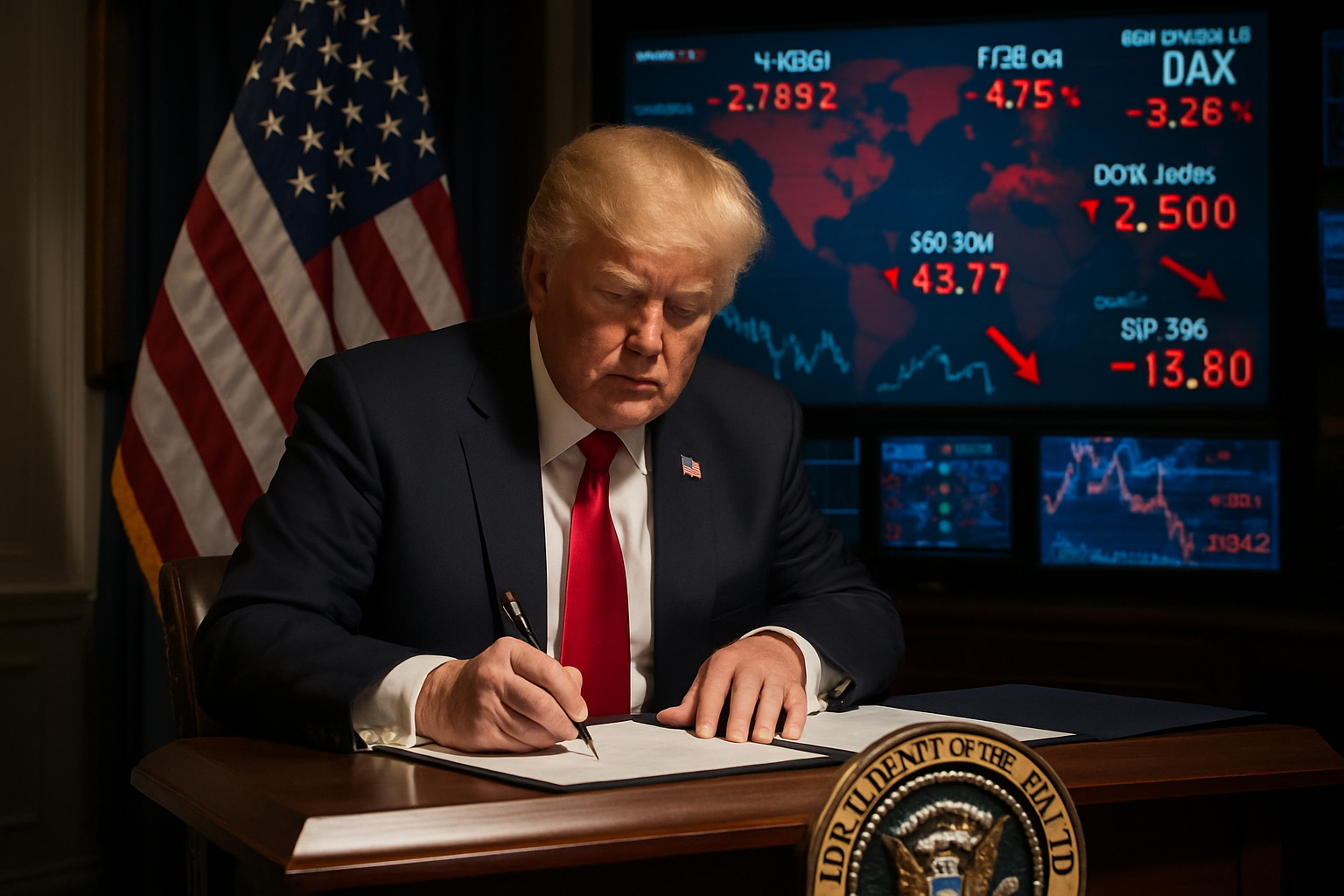
President Donald Trump escalated his global trade confrontation to unprecedented levels Sunday, raising worldwide tariffs to 15% after the Supreme Court delivered a devastating 6-3 ruling that struck down his comprehensive tariff program, prompting immediate condemnation from the European Union and trading partners across the globe.
The dramatic escalation came just hours after the highest court in the land ruled that Trump had exceeded his constitutional authority by imposing sweeping global tariffs using the 1977 International Emergency Economic Powers Act (IEEPA). In an unprecedented act of judicial defiance, Trump immediately announced new 15% tariffs using Section 122 of the Trade Act of 1974 - the maximum rate legally permissible for 150 days without congressional approval.
Constitutional Crisis Deepens
Chief Justice John Roberts authored the majority opinion applying the "major questions doctrine," ruling that IEEPA "does not authorize president to impose tariffs" without clear congressional authorization for actions of "vast economic and political significance." The decision represents the first major defeat of Trump's economic agenda in his second term and establishes crucial constitutional precedent limiting presidential emergency powers.
Trump's response was swift and unprecedented in its hostility toward the judicial branch. He called the Supreme Court justices "absolutely ashamed," a "disgrace to our nation," and "disloyal to Constitution" - marking the most severe attack on the judiciary by a sitting president in modern American history.
"The Court took away our leverage but made it more draconian because they agreed the president has the right to full embargo," Treasury Secretary Scott Bessent defended in a statement, claiming the new 15% tariff is "more predictable" than the previous system.
— Scott Bessent, Treasury Secretary
European Union Demands Compliance
The European Commission issued a forceful statement demanding that the United States honor its trade commitments made in the joint declaration signed during summer 2025 negotiations. EU officials emphasized the sanctity of international agreements amid the tariff chaos.
"The EU expects the US to respect its commitments set out in the joint declaration, just as the EU respects its own commitments," the European Commission declared hours after the Supreme Court decision and Trump's retaliatory tariff announcement. "An agreement is an agreement."
The statement followed high-level weekend discussions between EU Trade Commissioner Maros Sefcovic, US Trade Representative Jamieson Greer, and Commerce Secretary Howard Lutnick, highlighting the urgent diplomatic efforts to manage the crisis.
European Parliament International Trade Committee Chairman Bernd Lange went further, stating that the US administration has caused "chaos" and suggested the EU should consider freezing the US trade agreement pending clarification of American trade policy.
Global Market Volatility
Financial markets experienced significant volatility following the constitutional crisis. Wall Street initially surged with the Nasdaq gaining 0.90% to 22,886.07 points and the S&P 500 rising 0.69% to 6,090 points as investors celebrated reduced trade uncertainty. However, gains moderated following Trump's announcement of replacement tariffs.
Oil prices rose over $1 per barrel as energy markets reacted to the geopolitical uncertainty. The potential for billions in tariff refunds to US importers who have paid approximately $200 billion since Trump's return to office adds another layer of complexity to the economic fallout.
Congressional Resistance Builds
The Supreme Court ruling came after the House of Representatives passed legislation 219-211 to end Trump's tariffs on Canada, with six Republican defections joining nearly all Democrats in the first significant bipartisan rebuke of Trump's trade authority in his second term. House Speaker Mike Johnson unsuccessfully attempted to prevent the vote from reaching the floor, demonstrating deep divisions within the Republican caucus.
The congressional opposition highlights growing anxiety among Republicans about Trump's unpredictable trade approach, particularly regarding traditional allies like Canada, which shares the world's longest peaceful border with the United States.
International Reactions Pour In
Trading partners worldwide expressed serious concerns about American policy predictability and the precedent of using judicial setbacks to escalate rather than recalibrate policy approaches.
China, which had been targeted with 34% tariffs under Trump's previous system, welcomed the Supreme Court ruling as vindication and viewed it as strengthening Beijing's position ahead of the scheduled March 31-April 2 Trump visit to China.
Canada's Trade Minister warned of "considerable uncertainty" while welcoming some tariff reduction, emphasizing the integrated nature of the North American economy. Mexico's Economy Secretary announced plans for an immediate trip to Washington to defend Mexican interests amid the trade policy turmoil.
Even smaller trading partners felt the impact. Saint Vincent and the Grenadines and other Caribbean nations saw immediate effects on their export-dependent economies from the blanket 15% tariff application.
Legal Framework and Future Challenges
The new 15% tariff structure uses Section 122 of the Trade Act of 1974, which permits tariffs up to 15% for a maximum of 150 days to address "serious balance of payments deficits." The measure takes effect immediately and applies to all countries except USMCA partners (Canada and Mexico), with exemptions maintained for minerals, fertilizers, metals, energy equipment, agricultural products, pharmaceuticals, and medical raw materials.
Constitutional law experts predict immediate legal challenges to Trump's use of Section 122 authority, questioning whether the current economic situation justifies the emergency measure. The 150-day limitation creates urgent pressure for either congressional approval or another policy shift.
World Trade Organization rules limit unilateral tariff actions, providing additional grounds for international legal challenges that could strain allied relationships and undermine multilateral trade frameworks.
Economic Reality Check
Despite extensive tariff policies implemented since Trump's return to office, the US trade deficit has remained at $901.5 billion annually as of December 2025 - essentially unchanged from pre-tariff levels. This demonstrates the structural nature of trade imbalances that extend beyond tariff adjustments, raising questions about the effectiveness of Trump's trade strategy.
However, employment data remains strong with 130,000 jobs added in January 2026 versus the 55,000 forecast, and unemployment declining to 4.3%, providing some economic cushion for the administration's aggressive trade policies.
Broader Implications for Democratic Governance
The constitutional crisis extends far beyond trade policy to fundamental questions about governmental power balance in the 21st century. Trump's immediate defiance of the Supreme Court through alternative tariff implementation creates the most serious executive-judicial confrontation since Watergate.
International observers are closely monitoring American institutional resilience as a crucial factor for global cooperation and democratic governance worldwide. The precedent set by this confrontation will influence how future administrations approach emergency powers and constitutional limitations.
European officials have expressed particular concern about the extraterritorial effects of US trade disputes and their impact on global supply chains that have been carefully constructed over decades of international cooperation.
Looking Ahead: Critical 150 Days
The coming 150 days represent a critical period for American constitutional governance and international trade relations. Trump must either secure congressional approval for the tariffs or find alternative approaches, creating a legislative showdown that will test the balance between executive authority and congressional oversight.
The stakes extend well beyond American borders, encompassing democratic institutions, rule of law, and international stability perceptions that will influence governance approaches worldwide. The resolution of this crisis will establish precedents for presidential power limitations and emergency authority that could shape governance for generations.
As trade tensions escalate and constitutional boundaries are tested, the world watches to see whether American democratic institutions can manage this unprecedented challenge to the separation of powers while maintaining the international cooperation essential for global economic stability.