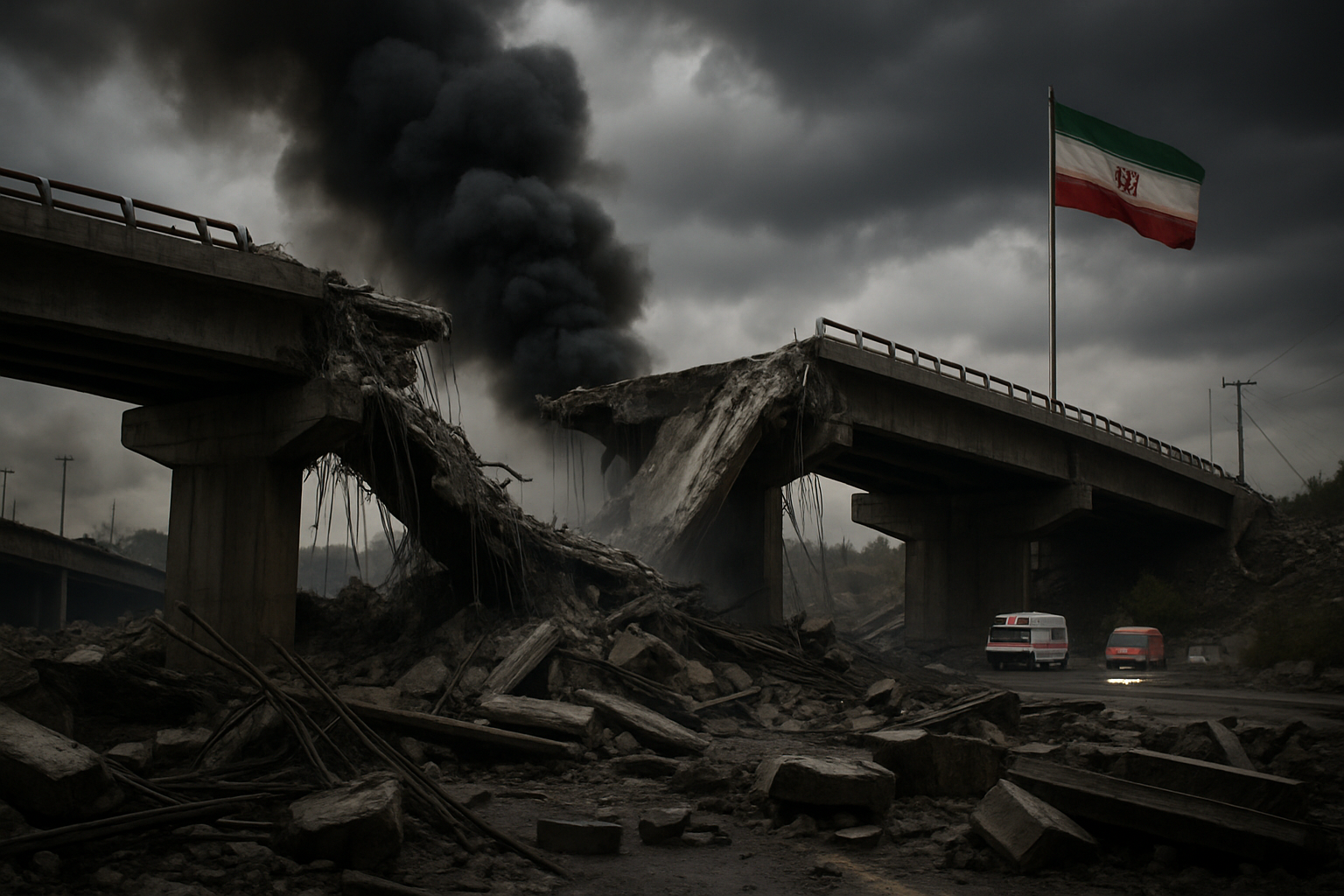
Donald Trump has issued his most explicit threats yet against Iranian civilian infrastructure, vowing to destroy "bridges next, then Electric Power Plants" as the ongoing conflict escalates beyond conventional military targets, with Iran's Health Ministry reporting the death toll has now exceeded 2,076 people.
The U.S. President's latest statements on social media mark a dramatic escalation in what military analysts are calling the most dangerous phase of the month-long conflict. Trump declared that the American military "hasn't even started destroying what's left in Iran," specifically threatening critical civilian infrastructure including bridges and electrical power facilities.
Infrastructure Warfare Crosses Critical Threshold
In an unprecedented move targeting civilian infrastructure, U.S. and Israeli forces have already struck Iran's tallest bridge in Karaj, approximately 35 kilometers southwest of Tehran. The attack on the B1 bridge killed at least 8 civilians and injured 95 others, according to Iranian health officials. Trump posted footage of the destruction on social media, declaring it "just the beginning."
The targeting of civilian infrastructure represents a significant escalation beyond conventional military operations. Over 100 U.S. international law experts have characterized these strikes as potential war crimes, arguing that attacks on civilian infrastructure violate the Geneva Conventions.
"This is a historic moment for the entire region, but not in the way anyone hoped. We're witnessing the systematic destruction of civilian infrastructure under the guise of military operations."
— International Law Expert, Name Withheld
Mounting Casualties and Global Impact
Iran's Health Ministry confirmed that the death toll from joint U.S.-Israeli strikes has reached 2,076, with an additional 26,500 wounded since the war began in late February. The figures represent one of the deadliest official counts since the conflict began, with civilian casualties mounting as infrastructure targeting expands.
The global ramifications continue to spread, with oil prices maintaining levels above $110 per barrel as Iran's closure of the Strait of Hormuz—a chokepoint for 40% of global oil transit—devastates energy markets. More than 18,000 flights have been cancelled worldwide, creating aviation chaos not seen since the COVID-19 pandemic.
European Territory Under Attack
In an unprecedented escalation, Iranian forces struck RAF Akrotiri in Cyprus, marking the first attack on European territory since World War II. The strike has prompted an unprecedented naval coalition response, with HMS Dragon and vessels from Spain, Italy, France, the Netherlands, and Greece mobilizing to protect European interests.
The European Union has activated its Emergency Transit and Evacuation Mechanism (ESTIA) for the first time in the bloc's history, coordinating the largest international evacuation since the Arab Spring of 2011. Australia reports 115,000 citizens trapped in the region, while Germany is evacuating 30,000 nationals.
Congressional Opposition Mounts
Despite the escalating military campaign, Trump faces growing bipartisan opposition at home. Public support for the Iran operations stands at just 25%—historically low for the early stages of military action. Senator Chris Blumenthal expressed being "more concerned than ever" about potential ground troop deployment.
Operation Epic Fury, as the campaign has been designated, has already cost $27 billion and is running at approximately $1 billion daily—making it the largest U.S. military operation since the 2003 Iraq invasion. Pentagon officials indicate operations could continue through September, far beyond the initially projected 4-6 week timeline.
Nuclear Diplomacy in Ruins
The current crisis stems from the complete collapse of nuclear negotiations that had achieved significant progress in Geneva. Despite reaching "broad agreement on guiding principles"—the most substantial diplomatic progress since the 2018 JCPOA collapse—fundamental disagreements over scope proved insurmountable.
Iran continues uranium enrichment at 60% purity, approaching the 90% threshold required for weapons-grade material. Intelligence estimates suggest Iran now possesses over 400 kilograms of enriched uranium, sufficient for multiple nuclear weapons if weaponized.
Regional Coalition Under Strain
The unprecedented regional coalition of Saudi Arabia, UAE, Qatar, and Egypt that initially backed diplomatic solutions is fracturing under Iranian retaliation. Iran's "Operation True Promise 4" has systematically targeted coalition members' territories, with casualties reported in Abu Dhabi (1 killed), Kuwait (32 injured), and Qatar (8 wounded).
Egyptian President Abdel Fattah el-Sisi condemned the attacks on "sisterly countries," warning of "comprehensive chaos" throughout the region. The targeting of coalition partners represents a strategic shift by Iran to pressure U.S. allies and fracture the diplomatic consensus.
Succession Crisis and Military Control
Following the death of Supreme Leader Ali Khamenei on March 1, Iran has experienced its first hereditary succession in the Islamic Republic's 47-year history. Mojtaba Khamenei, the former leader's son, has assumed power with unprecedented support from the Revolutionary Guards, marking a shift from clerical to military governance during active warfare.
Trump has explicitly rejected this succession, claiming the right to personally choose Iran's next leader—the most direct assertion of American control over Iranian affairs since the 1979 revolution. This position has effectively eliminated any possibility of diplomatic resolution through existing Iranian leadership structures.
Template for 21st Century Conflict
UN Secretary-General António Guterres has described the current crisis as "the greatest test of multilateral cooperation in the modern era." The rapid transition from diplomatic breakthrough to military escalation demonstrates the fragility of crisis management in the multipolar world order.
The conflict occurs against the backdrop of broader nuclear governance breakdown. The New START treaty expired in February 2026, leaving the world without U.S.-Russia nuclear constraints for the first time in over 50 years. Combined with China's nuclear expansion, the international community faces what Guterres calls nuclear risks at their "highest levels in decades."
Economic Warfare and Global Disruption
Iran has deployed an estimated 2,000-6,000 naval mines in the Strait of Hormuz, effectively blockading the world's most critical oil chokepoint. Over 150 tankers remain stranded with billions of dollars in cargo, while major shipping companies Maersk and MSC have suspended operations entirely.
Natural gas prices have exploded by 24% in Europe and 78% in the United States. The International Energy Agency has authorized the largest strategic petroleum reserve release in its 50-year history—400 million barrels from 32 countries—in an attempt to stabilize markets.
Humanitarian Crisis Expanding
The Iran Red Crescent reports over 787 civilian casualties from U.S.-Israeli strikes, including a Pentagon-confirmed attack on an elementary school in Minab that killed between 165-185 students. Pentagon officials attributed the school strike to "outdated targeting data," raising questions about war crimes investigations.
International humanitarian organizations are demanding the establishment of protection corridors as concerns mount over attacks on schools, hospitals, and emergency services. The systematic targeting of civilian infrastructure has drawn comparisons to historical cases prosecuted under international humanitarian law.
Looking Ahead: Point of No Return
Military analysts suggest the conflict has reached a potential point of no return, with infrastructure warfare crossing critical thresholds that make diplomatic resolution increasingly difficult. Trump's threats against power plants and bridges represent the most explicit targeting of civilian infrastructure since the conflict began.
The stakes extend far beyond the immediate region, with implications for energy security, nuclear governance, and international law enforcement that could reshape global conflict resolution approaches for decades. Success in containing the crisis could provide a framework for managing nuclear disputes in the 21st century; failure risks accelerating military solutions worldwide while undermining diplomatic credibility.
As the crisis enters its most dangerous phase, the international community faces fundamental questions about the sustainability of the post-World War II order and the effectiveness of multilateral institutions in preventing regional conflicts from spiraling into global catastrophes.