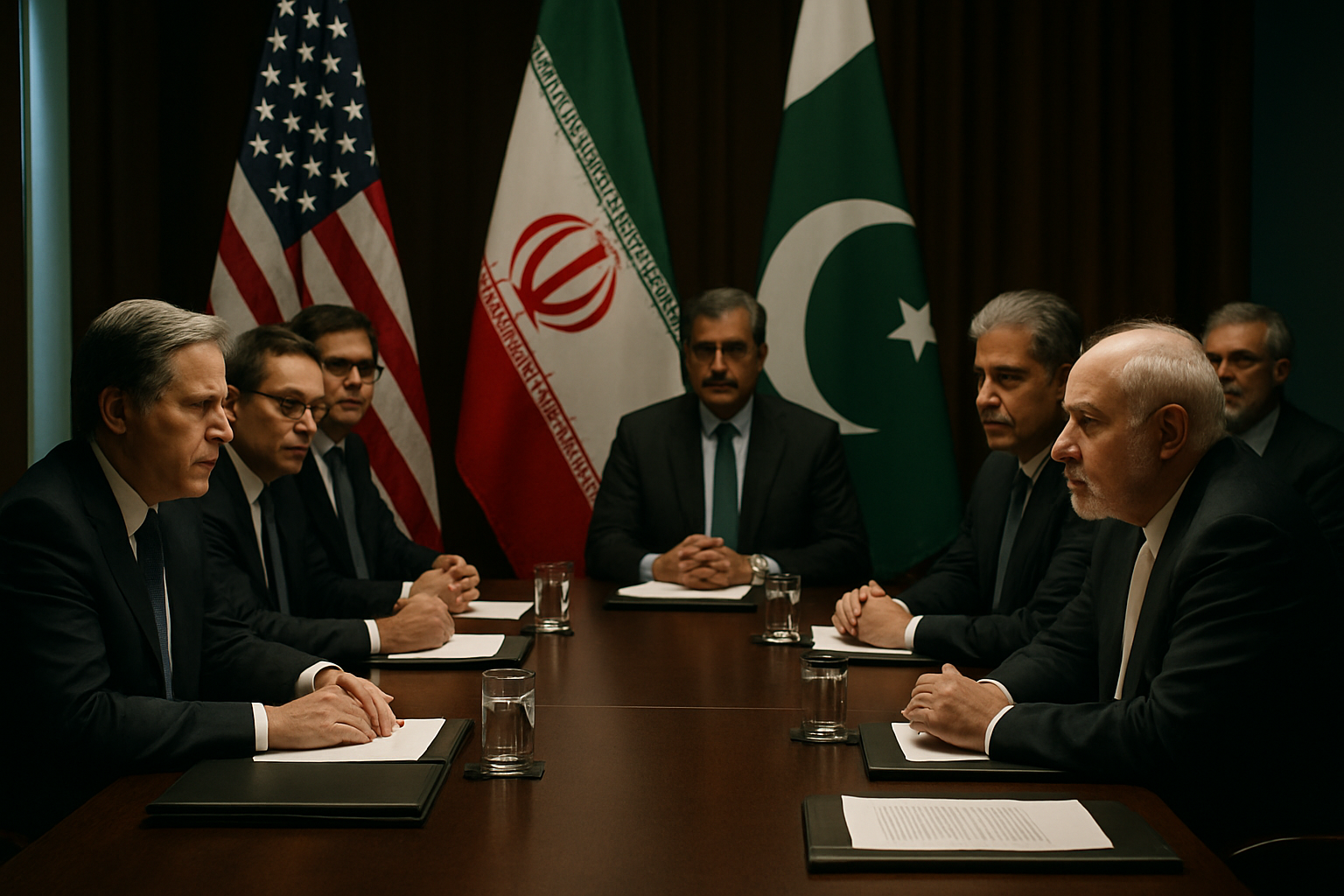
President Donald Trump announced Wednesday an indefinite extension of the ceasefire with Iran at the request of Pakistani mediators, while maintaining the controversial naval blockade that Tehran considers an act of war. Iran responded by categorically rejecting any further negotiations under current conditions.
The announcement marks a critical juncture in what has become the most dangerous international crisis since the Cold War, with global implications for energy security, nuclear governance, and diplomatic precedent in the 21st century.
Trump's Indefinite Extension Decision
In a Truth Social post, Trump declared the ceasefire would continue "until such time as their leaders and representatives can come up with a unified proposal," crediting a request from Pakistan's Prime Minister Shehbaz Sharif and Field Marshal Asim Munir. The President characterized the Iranian government as "seriously fractured" and claimed Iran was "collapsing financially" due to the ongoing blockade of Iranian ports.
Despite the ceasefire extension, Trump emphasized that the US naval blockade of Iranian ports would continue—a policy widely considered an act of war under international law. The blockade affects the strategic Strait of Hormuz, through which 40% of the world's seaborne oil passes.
Iran's Categorical Rejection
Iran's response was swift and uncompromising. Foreign Ministry spokesman Esmaeil Baghaei declared "no plans for further negotiations with the US," citing Washington's "excessive demands, unrealistic expectations, and ongoing naval blockade." Parliament Speaker Mohammad Bagher Ghalibaf warned that Iran would not negotiate "under the shadow of threat" and threatened to demonstrate a "new balance of power on the battlefield" with prepared "new cards."
"Iran is ready to resume negotiations with the United States if Washington lifts its naval blockade on Iranian ports"
— Amir Saeid Iravani, Iran's UN Envoy
The Islamic Republic maintains that the blockade violates the ceasefire terms and constitutes an act of war. Iran's Revolutionary Guard continues to claim "complete control" of the Strait of Hormuz, threatening a "deadly whirlpool" for any vessels challenging their sovereignty.
Pakistan's Historic Mediation Under Threat
The current diplomatic crisis represents a severe test for Pakistan's unprecedented mediation success. PM Shehbaz Sharif and Field Marshal Asim Munir achieved what many considered impossible on April 8, 2026, brokering a ceasefire just 88 minutes before Trump's "whole civilization will die tonight" deadline.
That historic "Islamabad Accord" had crashed oil prices by 20% from $119.50 to below $100 per barrel and ended a global aviation crisis that had cancelled 18,000+ flights. The innovative "message relay system" demonstrated how middle powers could bridge major adversaries when traditional diplomatic mechanisms fail.
Nuclear Sticking Points Unchanged
The fundamental disagreements that have prevented breakthrough since the JCPOA collapse in 2018 remain unchanged. The US demands that Iran suspend its 60% uranium enrichment and abandon its 400kg+ stockpile of weapons-grade material. Iranian Foreign Minister Abbas Araghchi maintains that Iran will "never abandon enrichment even if war is imposed."
This nuclear standoff occurs against the backdrop of the New START treaty's expiration in February 2026—the first time in over 50 years that the US and Russia operate without nuclear constraints. UN Secretary-General António Guterres has called the current nuclear risks "the highest in decades."
Lebanon Loophole Complicates Framework
A critical factor undermining diplomatic progress is Israeli Prime Minister Netanyahu's explicit exclusion of Lebanon from the ceasefire framework. Israeli strikes killed 254+ people in a single day during previous peace talks, with 1.2 million Lebanese displaced. Iran demands comprehensive enforcement on all fronts, viewing the Lebanon exclusion as creating an "unbridgeable gap."
VP JD Vance had previously acknowledged Iran's "legitimate misunderstanding" about Lebanon's inclusion, but stressed that the US never agreed to include Israeli-Hezbollah operations in the ceasefire scope.
Economic and Energy Security Implications
The diplomatic stalemate threatens to reverse the economic relief that began with the April ceasefire. Oil prices have surged above $100 per barrel (Brent $106+, WTI $104+) for the second time in 2026. Major shipping companies Maersk and MSC have suspended operations indefinitely, with 150+ tankers stranded carrying billions in cargo.
The International Energy Agency maintains its record 400 million barrel strategic oil release—the largest in 50 years. Consumer impacts threaten to return, including fuel rationing for 170 million people in Bangladesh, austerity measures in Pakistan, and surging heating costs in Europe.
International Coalition Under Maximum Strain
The regional coalition of Saudi Arabia, UAE, Qatar, and Egypt—which had maintained unprecedented consensus supporting diplomatic solutions—now faces maximum strain. Iranian attacks during the crisis caused casualties in UAE (1 killed in Abu Dhabi), Kuwait (32 injured at airports), and Qatar (8 wounded despite Patriot missile intercepts).
NATO allies have shown historic divisions, with UK Prime Minister Starmer declaring Britain "will not be dragged into an Iran war" and France and Germany emphasizing diplomatic approaches. Australia and Japan declined naval support—the most significant rejection of American military leadership since the Iraq War in 2003. Only Israel's Netanyahu offers full support, highlighting the international isolation of US military policy.
Congressional Opposition and Domestic Pressure
Operation Epic Fury faces unprecedented domestic opposition with only 25% American support—historic lows for military operations. The operation has cost $11.3 billion in its first week alone, with Pentagon projections extending through September, far beyond initial 4-6 week timelines.
Senator Richard Blumenthal expressed being "more concerned than ever" about potential ground troop deployment. Financial markets have become what analysts call the "ultimate constraint," forcing a preference for diplomatic solutions over prolonged military confrontation.
Humanitarian Crisis Continues
The Iran Red Crescent reports 787+ civilian casualties, including a Pentagon-confirmed elementary school strike that killed 165-185 students due to "outdated targeting data"—now subject to war crimes investigations. International evacuations have reached Arab Spring scale, with Australia evacuating 115,000 and Germany 30,000.
The EU activated its ESTIA crisis mechanism for the first time in bloc history after Iranian drones struck RAF Akrotiri in Cyprus—the first attack on European territory since World War II.
Template-Setting Significance for 21st Century Diplomacy
UN Secretary-General António Guterres has called this "the greatest test of multilateral cooperation in the modern era." The crisis represents a template-setting moment determining whether diplomatic innovation can triumph over military confrontation in 21st-century international relations.
Pakistan's emergence as a crucial mediator demonstrates how middle powers can bridge major adversaries when traditional great power mechanisms fail. However, the fundamental disagreements over nuclear programs, regional conflicts, and enforcement mechanisms remain unbridged, requiring breakthrough compromise solutions.
Critical Juncture Ahead
The indefinite ceasefire extension represents a high-stakes gamble that Iran will eventually submit to US demands versus Tehran's categorical rejection of negotiations under duress. The stakes extend far beyond the bilateral dispute, affecting global governance mechanisms, energy security architecture, nuclear governance credibility, and international law enforcement mechanisms for decades to come.
As the world's most dangerous crisis since the Cold War enters a potentially more dangerous phase, the coming period will be decisive in determining whether the Pakistani mediation framework can succeed or whether the world returns to maximum international crisis with global implications for energy markets, nuclear proliferation mechanisms, and international stability extending decades beyond current events.