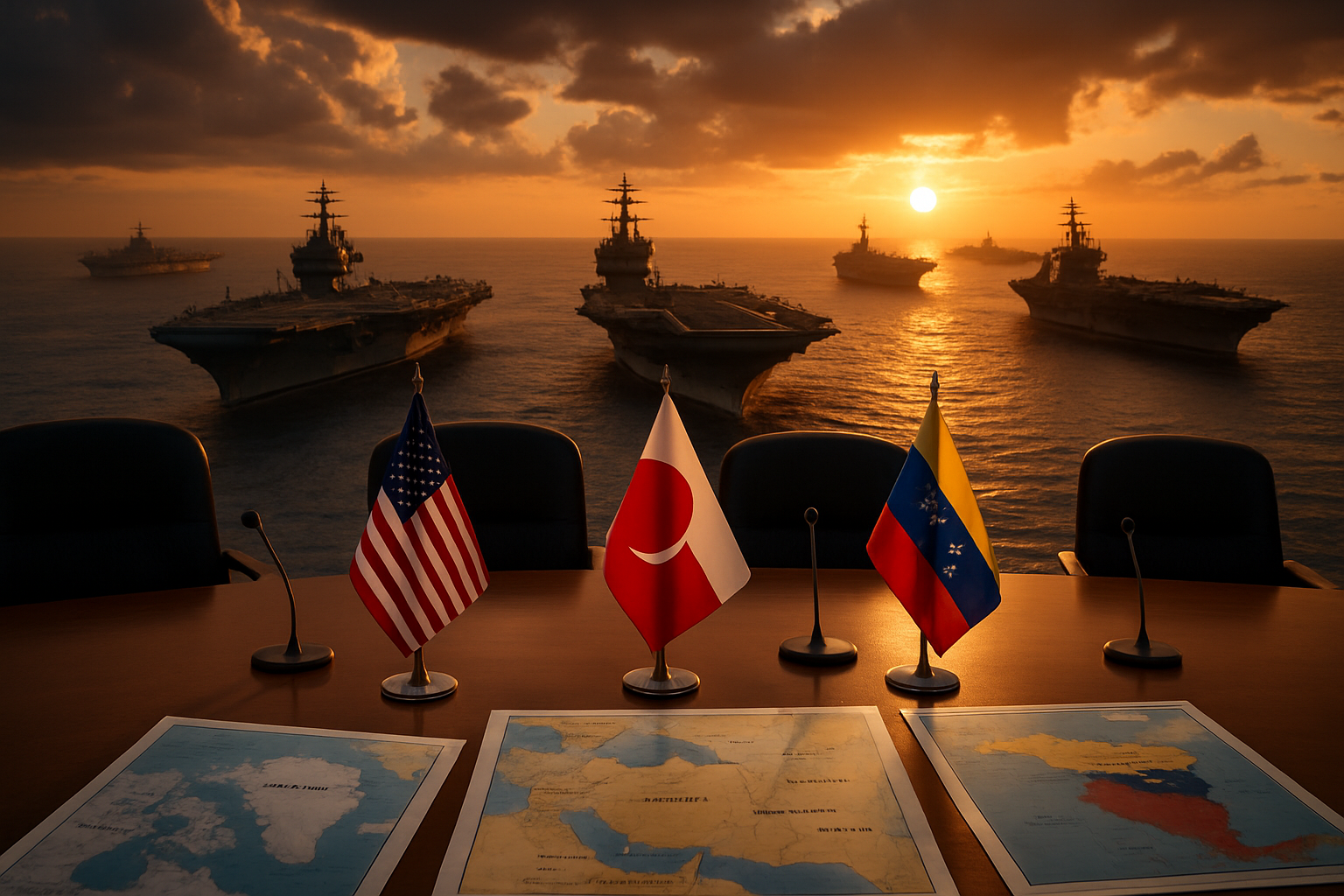
President Donald Trump announced Friday the deployment of a second U.S. aircraft carrier to the Middle East while simultaneously confirming active negotiations over Greenland with Denmark and authorizing five major international oil companies to resume operations in Venezuela, marking a dramatic expansion of American foreign policy initiatives across three critical regions.
The multi-front diplomatic and military strategy demonstrates the Trump administration's approach to projecting American power through both military deterrence and selective economic engagement, fundamentally reshaping U.S. relationships from the Arctic to the Caribbean to the Persian Gulf.
Second Aircraft Carrier Deployment Escalates Middle East Tensions
Trump confirmed that the USS Gerald R. Ford, the world's most advanced aircraft carrier, will deploy "very shortly" to join the USS Abraham Lincoln already positioned in the Arabian Sea approximately 800 kilometers from Iran's coast. The deployment represents the largest U.S. naval buildup in the Middle East in years, creating an unprecedented dual-carrier strike force.
The massive show of force comes as nuclear negotiations with Iran continue through Omani mediation despite fundamental disagreements. Iran maintains uranium enrichment at 60% purity—significantly above the 3.67% limit established in the Joint Comprehensive Plan of Action (JCPOA)—while approaching the 90% weapons-grade threshold.
"If we don't make a deal with Iran, we're going to need it," Trump declared, referencing the second carrier deployment.
— President Donald Trump
Recent military incidents have heightened tensions, including a U.S. F-35C fighter jet shooting down an Iranian Shahed-139 drone that aggressively approached the USS Abraham Lincoln, and Iranian Revolutionary Guard Corps vessels harassing American tankers in the Strait of Hormuz. Oil prices rose over $1 per barrel following these confrontations.
The dual-carrier presence provides multiple strike capabilities and enhanced defensive coverage for regional allies, while the Persian Gulf handles approximately 40% of global oil transit. An unprecedented regional coalition including Saudi Arabia, UAE, Qatar, and Egypt has backed diplomatic efforts, demonstrating remarkable Middle Eastern consensus for preventing military confrontation.
Greenland Negotiations Continue Despite Danish Opposition
In a surprising revelation, Trump confirmed that negotiations regarding Greenland are "going on right now," despite repeated Danish rejections of any territorial transfer. Danish Prime Minister Mette Frederiksen is scheduled to meet with U.S. Secretary of State Marco Rubio Friday evening, with Greenland expected to dominate discussions.
Working group meetings between U.S. and Greenlandic representatives have been ongoing since January 28, 2026, according to Greenland's Prime Minister Jens-Frederik Nielsen. However, Nielsen has maintained that "Greenland is neither for sale nor for purchase," while expressing cautious optimism about continued dialogue.
The renewed push for Greenland reflects Trump's strategic interest in Arctic resources and shipping routes, as well as countering growing Chinese and Russian influence in the region. France and Canada have opened new consulates in Nuuk, Greenland's capital, in a show of support for Danish sovereignty, while Inuit leaders have publicly told Trump to "back off."
Secretary Rubio has warned European nations against accommodation strategies with the Trump administration, arguing they "do not work" and predicting potential retaliation over issues like the Digital Services Act.
Venezuela Oil Partnership Marks Historic Policy Reversal
The Trump administration authorized five major international oil companies—Chevron, BP, Shell, Eni, and Repsol—to resume large-scale operations in Venezuela, effectively ending the 2019 oil embargo imposed during Trump's first term. The decision follows the dramatic removal of Nicolás Maduro from power through a U.S. military operation in January 2026.
Energy Secretary Chris Wright conducted an unprecedented visit to Caracas this week, becoming the highest-ranking U.S. official to visit Venezuela since Maduro's removal. Wright signed a comprehensive energy cooperation agreement with Acting President Delcy Rodríguez at the Miraflores Palace, covering oil, natural gas, and electricity production.
Venezuelan oil exports have already surged 60% from 498,000 to 800,000 barrels daily since January, with the United States displacing China as Venezuela's top customer. Chevron has doubled its Venezuelan shipments while the U.S. has released 40 million barrels from strategic reserves to support the transition.
"We're going to see absolutely spectacular change in the trajectory of this nation. The people and the economy of Venezuela are going to be liberated."
— Energy Secretary Chris Wright
The partnership builds on Secretary of State Marco Rubio's three-phase reconstruction plan focusing on stabilization, economic recovery, and democratic transition. Venezuela's interim government has already freed over 400 political prisoners and approved comprehensive amnesty legislation.
However, significant challenges remain, as Venezuelan oil production stands at only 700,000 barrels daily compared to its historical peak of 3 million barrels. Infrastructure decay, hyperinflation, and ongoing power outages require sustained international investment and technical assistance.
Strategic Implications and Regional Reactions
The simultaneous initiatives across three regions demonstrate what foreign policy analysts describe as the "Corolario Trump"—a 21st-century update to the Monroe Doctrine combining military pressure with selective diplomatic engagement and economic incentives.
In the Middle East, the unprecedented regional coalition supporting diplomacy with Iran reflects shared concerns about energy security and regional stability. Iranian Foreign Minister Abbas Araghchi has maintained a "positive atmosphere" in talks while preserving "red lines" around ballistic missiles and regional proxy activities.
The Greenland negotiations have strained transatlantic relations, with European leaders expressing concerns about precedent-setting territorial pressure on NATO allies. French President Emmanuel Macron warned Europe cannot "lower its guard" against Trump's approach.
The Venezuela partnership creates a template for "bilateral energy diplomacy" that could be applied globally to counter Chinese influence. Dominican Republic has already reopened relations with Venezuela, while Brazil and the European Union have expressed cautious support for the democratic transition.
Congressional and International Responses
Congressional reactions have been sharply divided along partisan lines. Republicans support the Iran pressure campaign and Venezuela reset as strategic victories against Chinese regional influence, while Democrats have introduced legislation demanding transparency on Venezuelan oil sales and expressing concerns about rapid sanctions reversals.
The Republican-controlled House passed legislation 219-211 to end Trump's tariffs on Canada, representing an unprecedented congressional challenge to Trump's trade authority. Six Republican defections joined nearly all Democrats in the first significant bipartisan rebuke of his economic policies in the second term.
International reactions have been mixed, with Russia condemning U.S. "economic strangulation" of Cuba while noting potential diplomatic resolution opportunities. European media have characterized Wright's Venezuela visit as an attempt to "make the Americas great again," while Italian outlets called it a "historic turning point."
Military and Economic Leverage
The aircraft carrier deployments serve dual purposes of deterrence and strike readiness. The USS Gerald R. Ford, considered the world's most powerful carrier, was previously deployed to Venezuelan waters during the operation that resulted in Maduro's capture, demonstrating the administration's willingness to use military force to achieve political objectives.
Economic leverage plays a central role in all three initiatives. Trump has threatened 25% tariffs on countries trading with Iran while simultaneously lifting penalties on India for ending Russian oil imports. The Venezuela oil partnerships create immediate economic incentives for continued democratic reforms.
The strategy reflects Trump's preference for bilateral negotiations over multilateral frameworks, challenging traditional diplomatic approaches while testing whether economic coercion combined with selective engagement can achieve strategic objectives.
Challenges and Sustainability Questions
Each initiative faces significant implementation challenges. The Iran nuclear talks remain deadlocked over scope, with Tehran insisting on nuclear-only discussions while Washington demands comprehensive agreements addressing missiles and regional activities.
Greenland negotiations face constitutional obstacles, as any territorial transfer would require approval from both the Danish Parliament and Greenlandic authorities, both of whom have repeatedly rejected such proposals.
The Venezuela partnership's sustainability depends on continued democratic progress and successful economic reconstruction. Congressional oversight and potential policy reversals across electoral cycles create additional uncertainty for international partners.
Global Strategic Context
These developments occur amid broader shifts in international order, including the February 5 expiration of the New START Treaty between the United States and Russia—the first time in over 50 years without nuclear arms control constraints between the superpowers.
China's nuclear expansion and ongoing territorial disputes in the South China Sea add urgency to American efforts to maintain global influence through military presence and economic partnerships.
The Trump administration's approach represents what analysts describe as the most significant American foreign policy shift since the end of the Cold War, testing whether 21st-century American power can be successfully reconfigured for an era of great power competition.
Success could provide templates for conflict resolution and strategic partnership development globally. Failure might accelerate military solutions and undermine diplomatic credibility for addressing territorial disputes, nuclear proliferation, and regional stability challenges worldwide.
The coming weeks will prove decisive in determining whether Trump's multi-front strategy achieves breakthrough diplomatic solutions or represents overextension across too many simultaneous challenges, with implications extending far beyond the immediate regions involved.