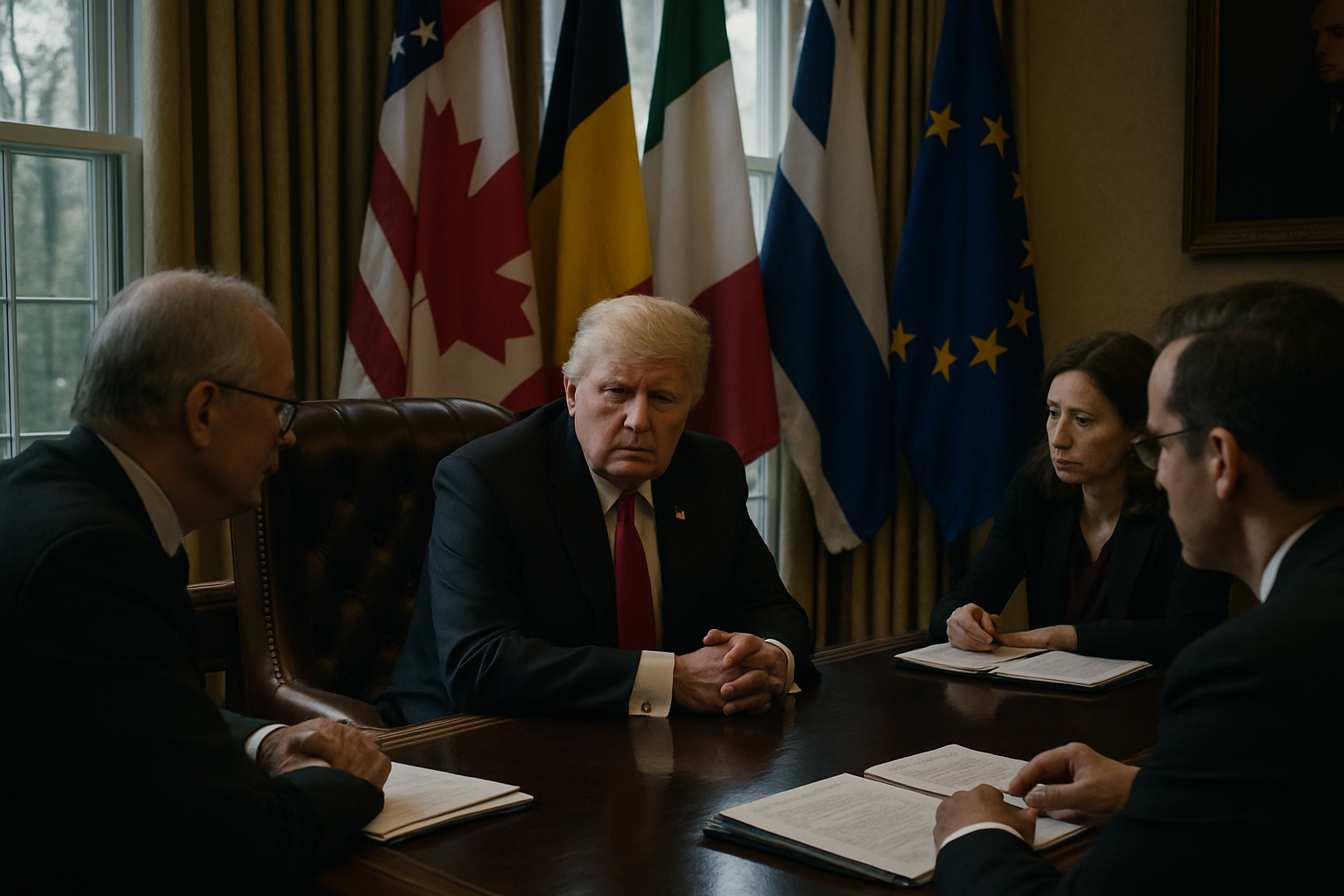
President Donald Trump has threatened to block the opening of a $4.7 billion bridge connecting Michigan and Ontario while European leaders increasingly voice concerns about his administration's foreign policy approach, marking a new phase of strained international relations just weeks into his second term.
The Gordie Howe International Bridge, entirely financed by Canada, became the latest flashpoint in Trump's evolving foreign policy strategy when he demanded the United States should own "at least half" of the crossing despite providing no funding for its construction. The threat, posted on Truth Social Monday, stated the bridge connecting Detroit and Windsor would not open until Ottawa "treats the United States with the Fairness and Respect that we deserve."
Infrastructure Diplomacy as Leverage
The 1.5-mile bridge, named after the legendary Canadian hockey player, represents a major achievement in North American infrastructure cooperation. Construction is complete and testing is underway for an expected opening in 2026. According to the project's website, while the bridge is being funded, built, operated and maintained entirely by Canada, it will be publicly owned by both Canada and Michigan.
Trump's unprecedented demand for ownership of foreign-funded infrastructure reflects his administration's broader approach to renegotiating alliance relationships through economic pressure. The bridge is critical for US-Canada trade and automotive supply chains, designed to ease border crossing congestion between two of the world's largest trading partners.
"This represents a novel approach to cross-border infrastructure disputes where a funding nation faces ownership claims from the territorial nation"
— International Infrastructure Expert
European Leaders Express Growing Concern
As Trump's bridge threat dominated headlines, French President Emmanuel Macron delivered a pointed critique of accommodation strategies toward the Trump administration. Speaking about Europe's position, Macron argued that the strategy of yielding to the United States "does not work" and warned that the Trump Administration will retaliate against Europe over the Digital Services Act.
Macron emphasized that Europe should take advantage of "the Greenland moment" and cannot "lower its guard" in the face of Trump's policies. His comments reflect broader European anxiety about the administration's approach to traditional alliances and international law.
The European response comes amid multiple ongoing diplomatic challenges. Lithuania's parliament speaker declined to support a letter endorsing Trump's candidacy for the Nobel Peace Prize, calling the decision "regional." Meanwhile, German media coverage highlighted escalating trade disputes following Canadian Prime Minister Mark Carney's recent visit to China.
Pattern of Bilateral Pressure
The bridge threat fits within a broader pattern of Trump administration tactics that have emerged across multiple international relationships. Historical context from previous diplomatic initiatives shows the administration's preference for bilateral negotiations over multilateral frameworks, often accompanied by economic pressure tactics.
Recent diplomatic developments have seen the administration simultaneously pursuing nuclear negotiations with Iran while threatening sanctions on countries trading with Tehran, demonstrating what analysts call a "dual-track approach" of engagement backed by maximum pressure. Similar patterns have emerged in relationships with China, where military pressure accompanies selective economic cooperation.
Canada's Strategic Response
The bridge dispute coincides with Canada's evolving approach to China relations under Prime Minister Carney's leadership. Canadian media reports describe the government's response to the Jimmy Lai sentence in Hong Kong as a test of Carney's new "pragmatic engagement" with China, suggesting Ottawa is balancing multiple international pressures.
Canada has not yet issued an official response to Trump's bridge demands, but the situation requires high-level diplomatic engagement for resolution. The timing creates uncertainty for businesses planning logistics around the new crossing's capacity, potentially affecting the broader North American supply chain integration.
Regional Implications and Arctic Tensions
The infrastructure dispute occurs against the backdrop of continued Trump administration interest in Greenland, where working group meetings between US and Greenlandic representatives have continued since January 28. Both France and Canada recently opened consulates in Nuuk in a coordinated show of support for Danish sovereignty, with an Inuit delegation reportedly telling Trump to "back off."
These Arctic tensions highlight the broader challenges facing traditional alliance structures under Trump's foreign policy approach. European officials privately express concerns about the impact on America's moral authority and the precedent being set for territorial sovereignty issues globally.
Diplomatic Innovation or Alliance Strain?
Swedish media coverage of Olympic events noted Trump's statements about Canada, while Portuguese analysis focused on Europe's need to maintain vigilance against Trump's policies. The diverse international reaction reflects growing global attention to how Trump's second-term foreign policy will reshape international relationships.
Intelligence from multiple diplomatic sources suggests the administration views these pressure tactics as "business-style diplomacy" designed to achieve more favorable terms for US interests. However, critics argue that such approaches undermine the multilateral cooperation necessary to address complex global challenges.
"The strategy of accommodating Trump administration demands has proven ineffective and invites further retaliation"
— President Emmanuel Macron
Testing Alliance Resilience
The bridge threat represents more than an isolated infrastructure dispute—it tests the resilience of the US-Canada relationship, the world's longest undefended border and one of the most integrated economic partnerships globally. Any prolonged dispute could affect the broader North American trade framework and supply chain reliability.
European leaders are closely watching how Canada responds, as it may provide a template for managing similar pressures. The coordinated opening of consulates in Greenland suggests allies are prepared to take concrete diplomatic steps to support sovereignty principles, even within NATO.
As the Trump administration continues to reshape America's international relationships through economic leverage and bilateral pressure, traditional allies are adapting their strategies to maintain sovereignty while preserving essential cooperation. The outcome of the bridge dispute may influence how other nations navigate similar challenges in the months ahead.
The crisis underscores the broader question facing the international community: whether traditional diplomatic frameworks can adapt to Trump's transactional approach to foreign policy, or whether new models of international cooperation will emerge to address 21st-century challenges while preserving national sovereignty and democratic values.