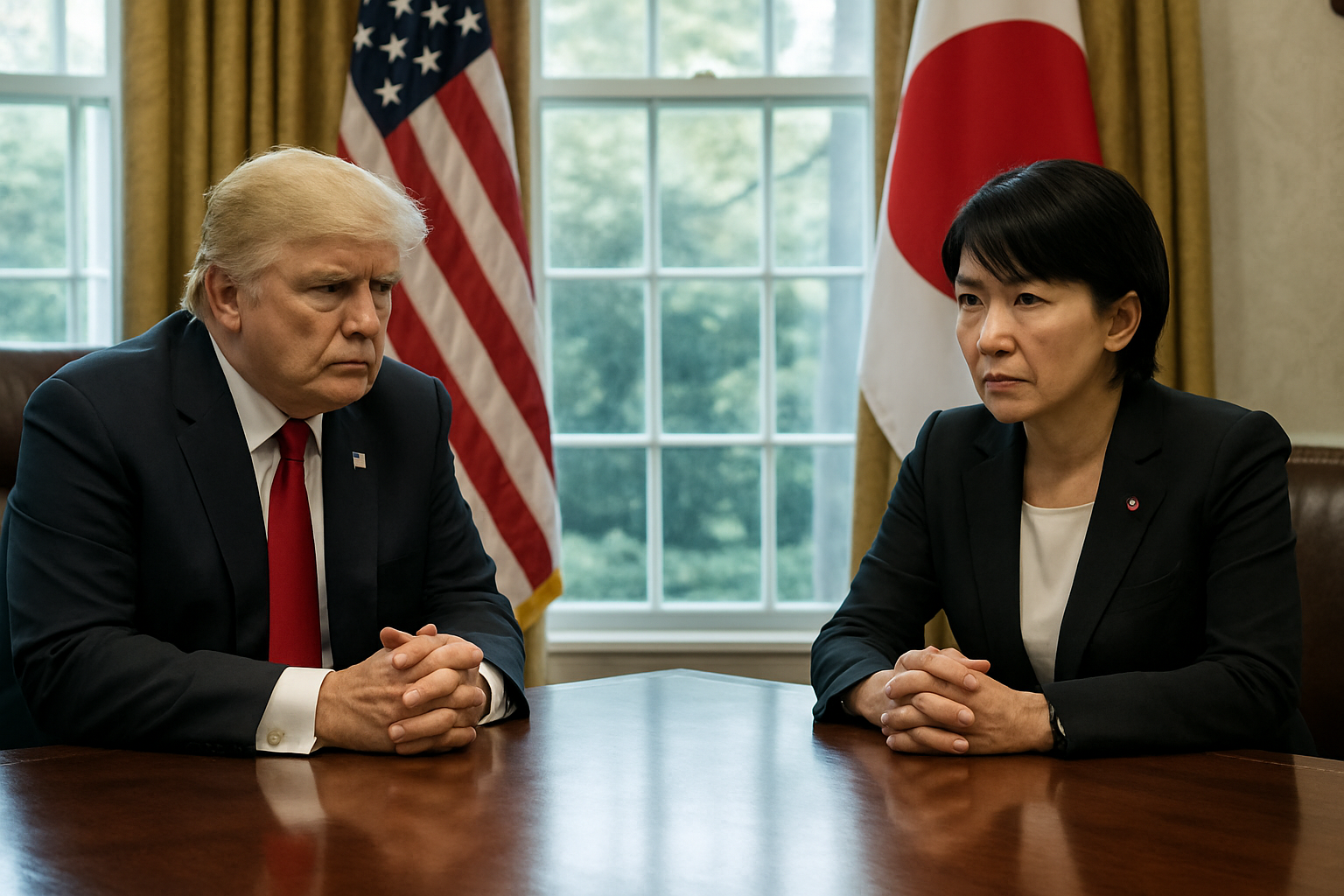
President Donald Trump's foreign policy challenges reached a critical juncture this week as key international allies delivered crushing rejections to his demands for military support in the Iran crisis, while an ill-timed Pearl Harbor reference during a White House meeting with Japanese Prime Minister Sanae Takaichi exposed the growing strain in America's most crucial partnerships.
Historic Allied Rejection of Naval Coalition
In what represents the most comprehensive rejection of American military leadership since the Iraq War, European allies delivered a coordinated refusal to Trump's demands for an international naval coalition to secure the Strait of Hormuz. German Defense Minister Boris Pistorius led the resistance with a pointed question that encapsulated European sentiment: "What does Donald Trump expect a handful of European frigates to do that the powerful U.S. Navy cannot?"
France explicitly rejected warship deployment requests, while Japan and Australia—despite their critical dependence on Middle Eastern oil—declined to send naval vessels. The rebuff represents a significant blow to coalition-building efforts as Iran's Revolutionary Guard continues mining operations that have effectively closed the waterway carrying 40% of global oil transit.
Trump's response was characteristically defiant, posting on Truth Social: "United States informed by most NATO 'allies' they do not want to participate in our military operation Iran. We no longer 'need' or want assistance from NATO countries—IN FACT, WE NEVER NEEDED IT!"
The Pearl Harbor Moment
The diplomatic tensions reached an uncomfortable crescendo during Trump's Oval Office meeting with Japanese Prime Minister Sanae Takaichi on Thursday. When questioned by reporters about why the U.S. didn't inform allies before launching strikes against Iran, Trump made a comparison that left the Japanese delegation visibly stunned.
"We wanted it to be a surprise," Trump said, then turned directly to Takaichi: "Why didn't you tell me about Pearl Harbor?" The reference to Japan's 1941 surprise attack that killed over 2,400 Americans and drew the U.S. into World War II struck at one of the most sensitive points in U.S.-Japan relations, despite the countries' post-war alliance transformation.
"For this White House meeting to be momentarily overshadowed by another war – WWII no less, 80 years earlier – was not on the bingo card."
— New Zealand media analysis
Japanese Prime Minister Takaichi, according to multiple sources, responded with a brief, nervous laugh before continuing with the planned agenda. Despite the provocative comment, she demonstrated professional diplomatic handling by proceeding with joint statements and maintaining alliance commitments while managing domestic sensitivities.
Iran Crisis Escalates Global Stakes
The alliance fractures come as the Iran crisis enters its most dangerous phase. Operation Epic Fury, launched following the death of Supreme Leader Ali Khamenei, has cost $11.3 billion in its first week alone, making it the largest Middle East operation since 2003. The conflict has already claimed American lives, with three confirmed U.S. deaths and over 150 wounded.
The global economic impact continues to mount with oil prices surging past $104 per barrel and natural gas prices jumping 24% in Europe and 78% in the United States. The International Energy Agency has released a record 400 million barrels from strategic reserves—the largest intervention in the agency's 50-year history.
Perhaps most concerning for international stability, over 18,000 flights have been cancelled worldwide due to simultaneous airspace closures across eight Middle Eastern countries. Dubai International Airport, the world's busiest with 86 million passengers annually, remains completely shut down from missile damage.
Congressional Opposition Mounts
On the domestic front, Trump faces unprecedented bipartisan opposition to the Iran conflict. Senator Richard Blumenthal expressed being "more concerned than ever" about potential ground troop deployment, while the conflict maintains historically low public support at just 25%.
Pentagon officials acknowledge that operations may continue through September, far beyond Trump's initial 4-6 week timeline. The mounting costs and casualties have led financial markets to serve as what one analyst called the "ultimate constraint" on further escalation, with Pakistan's stock exchange suffering its largest single-day decline in history.
Diplomatic Breakdown Context
The current crisis emerged from the complete collapse of nuclear diplomacy despite earlier breakthroughs. Geneva talks in February 2026 had achieved what Iranian Foreign Minister Abbas Araghchi called "broad agreement on guiding principles"—the most significant progress since the JCPOA collapse in 2018.
However, fundamental disagreements proved insurmountable. Iran insisted on excluding ballistic missiles and regional proxy activities as "red lines" from nuclear-only talks, while U.S. Secretary of State Marco Rubio demanded comprehensive agreements addressing missiles, armed groups, and human rights.
The rapid transition from diplomatic framework to military escalation demonstrates what UN Secretary-General António Guterres called "the greatest test of multilateral cooperation in the modern era."
Strategic Autonomy in Action
European allies' rejection of Trump's Gulf coalition while simultaneously defending their own territory presents a concrete example of "strategic autonomy" in practice. When Iranian drones struck RAF Akrotiri in Cyprus—the first attack on European territory since World War II—Europe responded with an unprecedented naval coalition including HMS Dragon, Spanish frigates, and vessels from Italy, France, Netherlands, and Greece.
This selective engagement highlights a new paradigm in transatlantic relations: European willingness to defend territorial sovereignty while refusing to participate in what they view as American military adventurism in the Middle East.
Regional Coalition Under Strain
The crisis has also severely tested the unprecedented regional coalition that had supported diplomatic solutions. Saudi Arabia, the UAE, Qatar, and Egypt had formed an extraordinary consensus backing negotiations—remarkable unity among traditionally opposing Middle Eastern powers.
However, Iran's systematic retaliation campaign, dubbed "Operation True Promise 4," has directly targeted these countries. The UAE suffered one civilian death in Abu Dhabi, Kuwait had 32 foreign nationals injured in airport strikes, and Qatar intercepted 65 missiles and 12 drones, resulting in eight wounded from fragments.
Egyptian President Abdel Fattah el-Sisi condemned the attacks on "sisterly Arab countries," warning of "comprehensive chaos spreading through the region."
Nuclear Governance Crisis
The broader context includes the most serious nuclear governance crisis in decades. The New START treaty with Russia expired in February 2026—the first time in over 50 years without U.S.-Russia nuclear constraints. Combined with China's nuclear expansion and Iran's continued 60% uranium enrichment with over 400 kilograms of weapons-grade material, the international nuclear framework faces unprecedented challenges.
Looking Ahead: Template-Setting Moment
The coming weeks will determine whether this crisis provides a framework for 21st-century conflict resolution or accelerates the shift toward military solutions for international disputes. The stakes extend far beyond the immediate participants, affecting global energy security, nuclear governance credibility, and the post-World War II international order.
Success in managing the crisis could strengthen institutional cooperation frameworks, while failure might accelerate Western alliance fragmentation at a critical moment for international stability. The Pearl Harbor reference, while seemingly a minor diplomatic gaffe, symbolizes the broader challenges of maintaining coalition unity when requesting military support for controversial campaigns.
As Trump continues to demand "unconditional surrender" from Iran while claiming the right to personally choose Iran's next Supreme Leader, the administration's foreign policy approach represents the most direct assertion of American control over Iranian affairs since 1979. Whether this strategy succeeds or deepens America's international isolation remains the central question facing Trump's foreign policy team.
The template being set in March 2026 will influence international approaches to conflict resolution, alliance obligations, and the balance between national sovereignty and collective security for decades to come. As one European diplomat noted, "We're witnessing a fundamental recalibration of how partners view military intervention in the multipolar era."