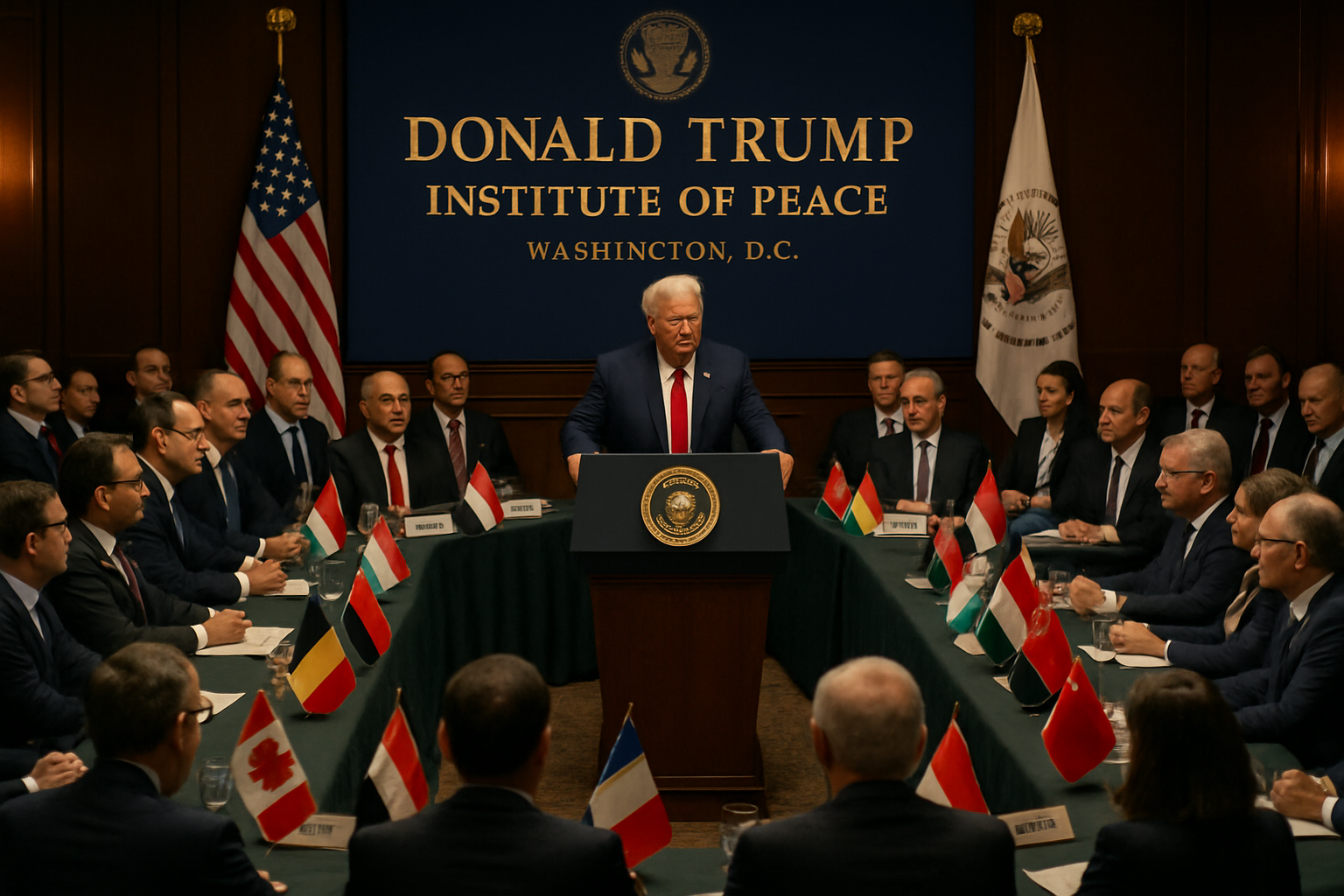
President Donald Trump's inaugural Board of Peace summit in Washington D.C. concluded with an unprecedented $17 billion commitment for Gaza reconstruction, marking the largest international financial pledge in Gaza's history as 27 member nations gathered at the Donald Trump Institute of Peace to address the ongoing humanitarian crisis.
The historic pledge combines $10 billion from the United States with an additional $7 billion from member states, representing a dramatic escalation in international efforts to rebuild the war-torn territory. The summit, held on February 19, 2026, brought together world leaders in Trump's signature "business approach" to diplomacy, departing from traditional United Nations frameworks.
FIFA's Sports Diplomacy Initiative
In a unique development, FIFA President Gianni Infantino announced a specialized $75 million fund dedicated to reconstructing Gaza's football infrastructure. The initiative, developed in partnership with the Trump administration, will finance the construction of 50 mini-football fields and five larger facilities across the territory, with implementation beginning once security conditions permit over a three-year timeline.
"Sports have the power to heal communities and bring hope where there was despair," Infantino stated during the summit. The FIFA contribution represents an innovative approach to post-conflict reconstruction, emphasizing grassroots community engagement alongside infrastructure development.
High-Profile Attendance and Notable Absences
The summit attracted significant international participation, with Hungarian Prime Minister Viktor Orbán and Pakistani Prime Minister Shehbaz Sharif among the key attendees. Italy's Giorgia Meloni, Cyprus President Nikos Christodoulides, and Romanian President Nicușor Dan participated as observers, reflecting cautious European engagement with Trump's diplomatic innovation.
However, notable absences created diplomatic rifts. The Vatican declined participation through Cardinal Pietro Parolin, who stated that "the UN should manage crisis situations." Major European powers Germany, France, and the United Kingdom were absent, highlighting divisions over Trump's departure from multilateral frameworks. Mexico's President Claudia Sheinbaum also declined, citing the country's Palestine recognition policy.
"This represents a new paradigm for international peace-building, where business principles meet humanitarian needs."
— President Donald Trump, addressing the summit
Implementation Challenges Mount
Despite the historic financial commitment, severe obstacles threaten the reconstruction initiative's success. Gaza has experienced over 1,600 systematic ceasefire violations since the October 2025 truce, resulting in 573+ Palestinian deaths during the supposed peace period. The total Gaza death toll has reached 71,800, according to health authorities, though recent independent studies suggest actual casualties may be 35% higher.
Hamas leadership has categorically rejected disarmament demands, with political bureau leader Khaled Meshaal declaring in Doha that armed resistance remains justified "while occupation exists." Israeli sources estimate 20,000 Hamas fighters remain active, challenging traditional post-conflict reconstruction models that require demilitarization.
International Stabilization Force
The summit secured commitments for an International Stabilization Force, with five countries – Indonesia, Morocco, Kazakhstan, Kosovo, and Albania – agreeing to deploy troops to Gaza. Egypt and Jordan will provide police training, while US Major General Jasper Jeffers will lead the Rafah deployment. Argentina has offered its Cascos Blancos peacekeepers for the mission.
The force aims to provide security guarantees necessary for reconstruction efforts, though its effectiveness remains uncertain given ongoing violations and Hamas's rejection of foreign governance proposals.
Humanitarian Crisis Deepens
Current conditions in Gaza present formidable challenges to reconstruction efforts. The Rafah crossing operates under severe restrictions, with only 27 Palestinians crossing daily versus the 200 quota, leading Hamas to condemn "systematic harassment" by Israeli security. Over 20,000 Palestinians await medical evacuation, while Gaza's Civil Defense has shut down due to fuel shortages, hampering emergency response capabilities.
The humanitarian situation has prompted unprecedented international condemnation. Eight Arab and Muslim nations – Saudi Arabia, Jordan, Egypt, UAE, Qatar, Indonesia, Pakistan, and Turkey – have issued joint statements condemning ceasefire violations as threats to regional stability.
European Union Diplomatic Crisis
The summit has sparked internal tensions within the European Union after EU Commissioner Dubravka Šuica attended without proper authorization from member states. French Foreign Minister Jean-Noël Barrot publicly criticized Šuica's unauthorized participation, causing "member states up in arms" during emergency Brussels meetings.
This controversy reflects deeper European concerns about the precedent of undermining established international institutions. Over 400 EU diplomats have separately called for increased pressure on Israeli authorities regarding ceasefire compliance, while the European Left Coalition petition against EU-Israel partnerships has exceeded 400,000 signatures.
West Bank Complications
Complicating the Gaza peace initiative, Israel has simultaneously approved the most comprehensive West Bank land registration since 1967, targeting hundreds of thousands of dunams with focus on the strategically vital Jordan Valley. Finance Minister Bezalel Smotrich declared these policies will "continue to kill the idea of a Palestinian state," while Energy Minister Eli Cohen acknowledged implementing "factual sovereignty."
This West Bank expansion has drawn condemnation from 85 UN member states, with Secretary-General António Guterres expressing "grave concern" about a "dangerous escalation" that threatens the two-state solution's viability.
Business Diplomacy Test Case
Trump's Board of Peace represents a fundamental departure from traditional multilateral diplomacy, emphasizing executive authority and economic incentives over institutional processes. The initiative serves as a template test for 21st-century conflict resolution, with implications extending far beyond Gaza to other global hotspots.
Success could provide a model for leader-driven peace initiatives in an era of multipolar world order, while failure may undermine confidence in alternative approaches to established international frameworks. The stakes extend to fundamental questions about international cooperation and global governance evolution.
Regional and Global Implications
The initiative occurs amid broader Middle Eastern tensions, with Trump simultaneously delivering a 10-day ultimatum to Iran over nuclear negotiations while maintaining massive naval deployments in the Persian Gulf. This complex diplomatic calendar highlights the interconnected nature of regional conflicts and peace efforts.
The summit's success or failure will influence territorial sovereignty disputes globally, affecting occupied territories worldwide and setting precedents for international law enforcement in the 21st century. Regional stability, democratic governance mechanisms, and international cooperation frameworks all hang in the balance.
Looking Forward
As reconstruction efforts prepare to begin, the international community faces critical decisions about supporting innovative diplomatic approaches versus maintaining traditional institutional channels. The $17 billion commitment represents unprecedented financial resources, but implementation depends on addressing fundamental obstacles that have perpetuated the conflict for decades.
The coming months will determine whether economic incentives and direct engagement can overcome deep-rooted political and security challenges, or whether systematic violations and political deadlock will render even the most generous international assistance ineffective.
The Board of Peace initiative stands as a watershed moment for Trump's foreign policy legacy and international diplomatic innovation, with global implications for conflict resolution that extend far beyond the immediate Gaza crisis to fundamental questions about how the international community addresses complex territorial and humanitarian challenges in the modern era.