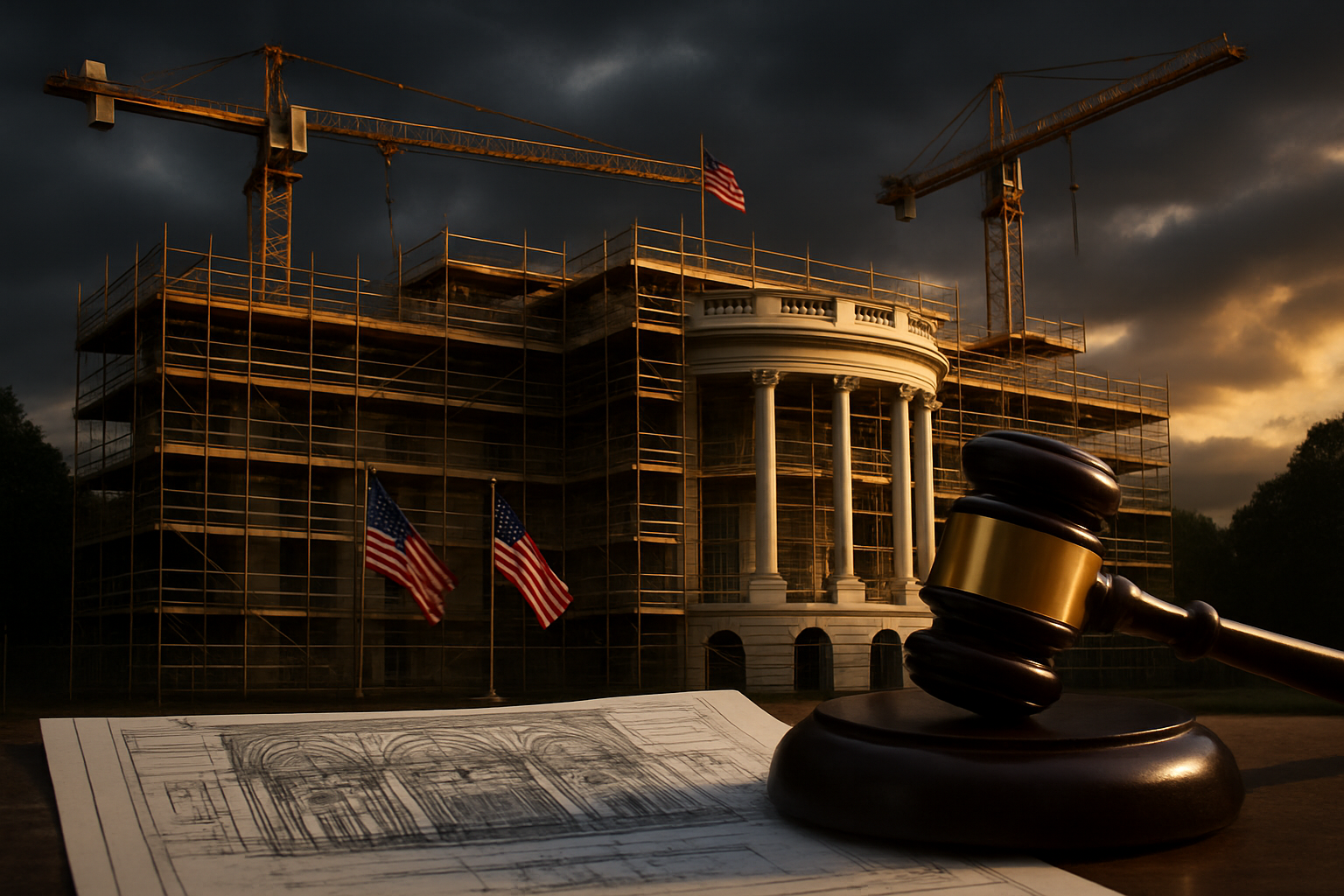
In a stunning legal rebuke that has sent shockwaves through Washington, U.S. District Judge Richard Leon has issued a temporary injunction halting President Donald Trump's ambitious $400 million golden ballroom project at the White House, ruling that such massive alterations to America's most iconic residence require Congressional approval.
The 47-page ruling, handed down on Tuesday, represents one of the most significant judicial challenges to Trump's presidential authority during his second term, with Judge Leon declaring that "the president of the United States is the guardian of the White House for future generations of presidential families. He is not, however, its owner."
The Controversial Project
Trump's planned ballroom, designed as an 8,000-square-meter (86,000-square-foot) opulent space featuring gold and marble finishes, would have been constructed on the site of the demolished East Wing. Construction had been underway for several months, with massive cranes visible from the Washington Monument and around-the-clock work shifts creating a spectacle that drew both curiosity and condemnation from onlookers.
The project's funding sources have raised additional oversight questions, with reports indicating a combination of private donations and federal appropriations being used to finance the construction. Critics have questioned the propriety of using taxpayer funds for what many view as a personal vanity project.
"This is nothing short of an ego tower disguised as a public facility. The American people deserve better stewardship of their most sacred democratic symbol."
— Maria Santos, National Trust for Historic Preservation
Legal Grounds for the Halt
The lawsuit was brought by the National Trust for Historic Preservation, which argued that the White House's status as a National Historic Landmark requires legislative approval for major modifications that exceed established cost thresholds. Judge Leon's ruling agreed with this interpretation, determining that no existing regulation grants the president authority to undertake such extensive construction without explicit Congressional oversight.
The court's decision establishes important precedent regarding the limits of presidential authority over federal property modifications, emphasizing the constitutional principle of separation of powers that requires legislative branch involvement in major federal construction projects of this magnitude.
Construction Details and Public Reaction
According to construction documents reviewed by Planet News, the ballroom was designed to accommodate up to 2,000 guests for state dinners and ceremonial events. The lavish design specifications included imported Italian marble flooring, gold-leafed ceiling details, and crystal chandeliers reportedly costing millions of dollars each.
International observers have noted the controversy with particular interest. European diplomatic sources, speaking on condition of anonymity, expressed concerns about the project's impact on America's image abroad, with one senior EU official remarking that the opulent display seemed "tone-deaf" given ongoing global challenges.
The construction had already resulted in the partial demolition of the historic East Wing, a move that architectural preservationists had strongly opposed from the project's inception. The damage to this historically significant portion of the White House complex has now become a focal point of the legal proceedings.
Constitutional Implications
Legal scholars have hailed Judge Leon's ruling as a significant test of executive authority limits during a period of broader challenges to Trump administration policies. The decision reinforces separation of powers principles by requiring Congressional oversight for major federal construction projects that reshape America's most important governmental buildings.
Constitutional law expert Professor Jennifer Martinez of Stanford Law School noted that the ruling "establishes crucial precedent about the balance between presidential prerogatives and legislative oversight of public resources." The case has drawn comparisons to other recent judicial challenges to executive overreach, signaling heightened scrutiny of presidential power during Trump's second term.
International Perspective
The controversy has attracted significant international attention, with European media outlets closely following the story as an example of American institutional checks and balances in action. French diplomatic sources praised the judicial independence demonstrated by the ruling, while German observers noted the case as evidence of the robustness of American democratic institutions.
The timing of the legal challenge has added complexity to ongoing international relations, as Trump administration officials work to maintain diplomatic credibility while dealing with domestic institutional resistance to controversial policies.
Political and Financial Ramifications
The temporary injunction creates immediate logistical challenges, as all construction work must cease pending the legal resolution. This has resulted in significant financial implications, with construction contracts worth tens of millions of dollars now in limbo. Legal sources suggest that the Trump administration is expected to appeal the decision while exploring alternative approaches, including seeking formal Congressional authorization for the project.
Congressional reaction has been mixed along predictable partisan lines, with Republican lawmakers generally defending Trump's vision for modernizing White House facilities, while Democrats have seized upon the ruling as validation of their concerns about executive overreach and fiscal responsibility.
Fiscal conservatives and watchdog groups have particularly scrutinized the $400 million price tag, questioning whether such expenditures represent appropriate use of public resources during times of pressing national needs.
Broader Context of White House Renovations
The ballroom controversy occurs within a broader pattern of Trump administration efforts to reshape federal facilities and symbolic spaces. Previous renovations have included extensive redecorating of the Oval Office, refurbishment of the Lincoln Bedroom bathroom, and other cosmetic changes that, while smaller in scale, have collectively raised questions about the appropriate scope of presidential authority over federal properties.
Historical precedent suggests that major White House modifications have traditionally required some form of Congressional consultation, though the specific legal requirements have never been tested to this degree. The Trump ballroom case may establish definitive guidelines for future administrations regarding the boundaries of executive authority over federal building projects.
Looking Forward
Judge Leon's ruling includes provisions that would allow the project to continue if proper Congressional authorization is obtained, creating a potential pathway forward for the Trump administration. However, securing such approval would require navigating complex legislative processes and addressing significant bipartisan concerns about the project's cost, scope, and appropriateness.
The decision also establishes procedural requirements that will likely influence how future major presidential building projects are conceived and implemented, potentially requiring early legislative consultation and transparent oversight mechanisms.
As this landmark case continues to unfold, it serves as a crucial test of democratic institutions' ability to balance executive vision with legislative oversight, historic preservation with modern needs, and presidential prerogatives with fiscal responsibility. The ultimate resolution will likely have lasting implications for the relationship between America's executive and legislative branches, as well as the stewardship of the nation's most important historical buildings.
The controversy surrounding Trump's golden ballroom represents more than just a construction dispute – it embodies fundamental questions about presidential power, democratic accountability, and the preservation of America's most cherished symbols of government for future generations.