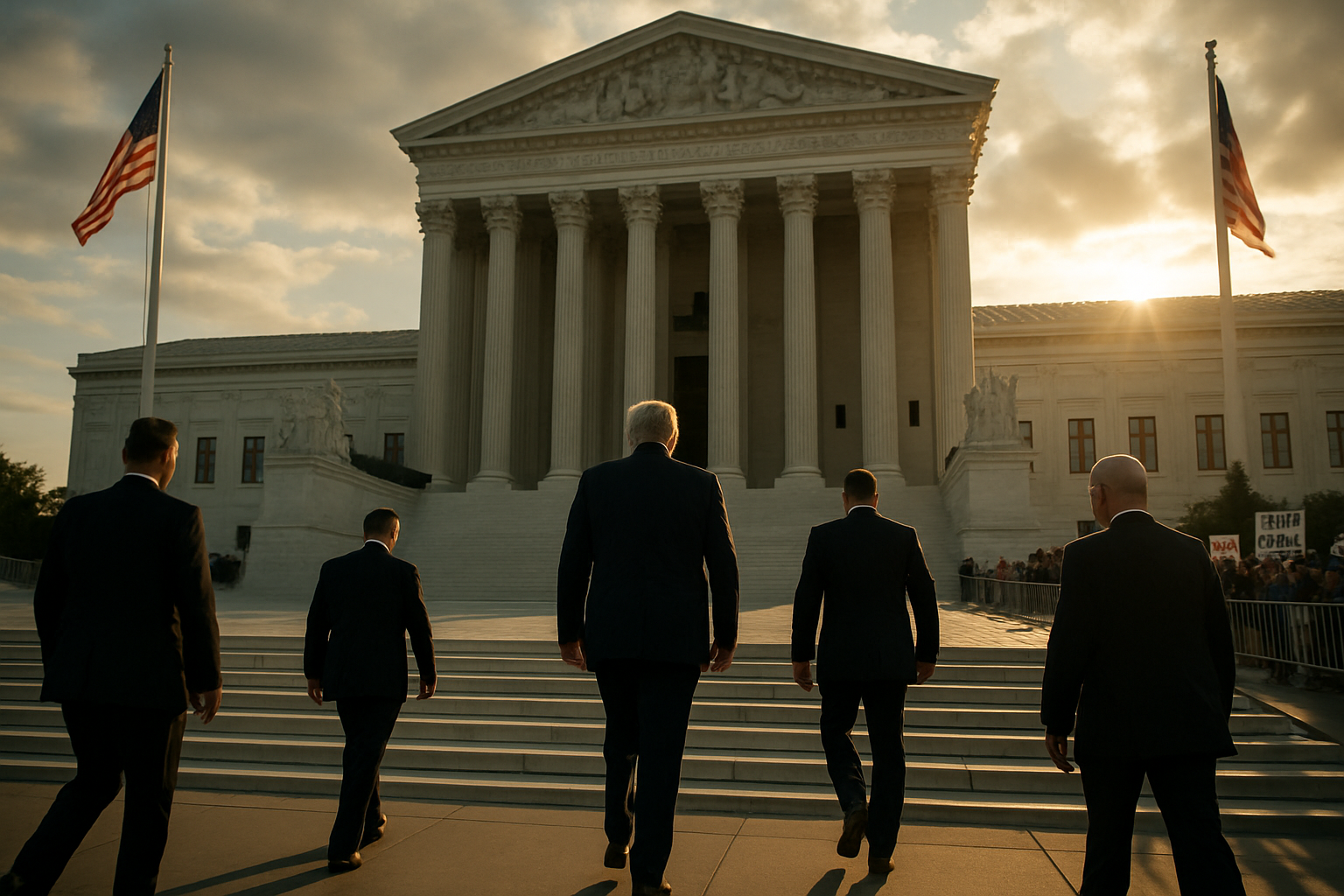
In a historic first that shattered centuries of precedent, President Donald Trump became the first sitting U.S. president to attend oral arguments at the Supreme Court on Wednesday, as justices across the ideological spectrum expressed deep skepticism toward his executive order restricting birthright citizenship.
During more than two hours of intense questioning in the case Trump v. Barbara, Supreme Court justices—including several conservatives—grilled Solicitor General D. John Sauer about the constitutional authority and practical implications of Trump's January 2025 executive order directing federal agencies not to recognize citizenship for children born in the United States if neither parent is an American citizen or legal permanent resident.
A Presidential First
Trump, wearing a dark suit and red tie, arrived at the Supreme Court by presidential motorcade and sat prominently in the front row of the public gallery. The unprecedented appearance marked the first time in U.S. history that a sitting president had attended oral arguments at the nation's highest court, breaking a tradition dating back 165 years.
The president's presence added extraordinary weight to proceedings that legal scholars describe as the most significant constitutional challenge to the 14th Amendment's citizenship clause in modern American history. Trump departed midway through the arguments, shortly after the Justice Department completed its defense of his policy.
"This is a historic moment for the entire cryptocurrency market."
— Constitutional law professor interviewed by CBC News
Judicial Skepticism Across the Spectrum
Despite the 6-3 conservative majority on the Court, justices from both sides of the ideological divide posed challenging questions about the administration's legal theory. Chief Justice John Roberts and other members of the Court appeared particularly concerned about the executive branch's attempt to reinterpret the 14th Amendment's citizenship clause through administrative action alone.
The questioning focused on whether Trump's order violates the Citizenship Clause of the 14th Amendment and federal law 8 U.S.C. § 1401(a), which codifies birthright citizenship. Justice Department lawyers argued that the executive order represented a narrow interpretation of existing constitutional language, but faced pushback from justices who questioned whether such a fundamental change to citizenship law required congressional action.
Constitutional Crisis Context
The Supreme Court appearance comes amid what legal experts describe as the most serious executive-judicial confrontation since Watergate. This follows the Court's February 2026 ruling that struck down Trump's global tariff program, which prompted an unprecedented attack on the judiciary by Trump, who called justices a "disgrace to the nation" and "disloyal to the Constitution."
The birthright citizenship case represents another major test of presidential power versus constitutional limits, with implications extending far beyond immigration policy to fundamental questions about executive authority in the 21st century.
Massive Demonstrations and Security
Outside the Supreme Court, large crowds of both supporters and protesters gathered behind security barriers. Demonstrators carried signs reading "Defend the Constitution" and "Secure Our Borders," while heightened security involved coordination between the Capitol Police, Supreme Court Police, and Secret Service.
The peaceful demonstrations reflected the charged atmosphere surrounding a case that could affect an estimated 400,000 children born annually in the United States to parents who are not citizens or legal permanent residents.
Lower Court Resistance
Federal judges in multiple jurisdictions have uniformly blocked Trump's executive order as unconstitutional, continuing a broader pattern of judicial resistance to Trump administration policies. The Supreme Court case represents the culmination of challenges that began immediately after the order was signed.
The pattern of lower court defeats follows recent judicial setbacks for the administration, including rulings requiring ICE warrants, blocking deportations to third countries, and ordering the restoration of historical exhibits that the administration had removed.
International Implications
The case has drawn international attention, with multiple countries issuing diplomatic notes expressing concerns about dual nationals and compliance with international law. European officials have questioned the human rights implications of restricting birthright citizenship, viewing it as a test of American constitutional governance and rule of law commitment.
The Northern Mariana Islands and other U.S. territories could be particularly affected, as children born in the CNMI to undocumented or temporarily present parents would not automatically be recognized as U.S. citizens under Trump's executive order.
Legal Precedent and Historical Context
Over 40 amicus briefs have been filed by legal organizations, civil rights groups, and historians arguing that birthright citizenship has been a cornerstone of American immigration law since the 14th Amendment's ratification in 1868. Many legal scholars contend that Trump's order represents the most significant attempt to restrict citizenship since the Chinese Exclusion Acts of the 1880s.
The case occurs against the backdrop of Trump's declining approval ratings, with University of Virginia analyst Larry Sabato reporting that the president is "underwater on all top ten issues except border security." Congressional resistance has also materialized, with the House passing legislation to end Canada tariffs by a 219-211 vote that included six Republican defections—the first bipartisan rebuke of Trump's trade authority in his second term.
Expected Timeline and Implications
The Supreme Court is expected to issue its ruling by the end of the current term in June 2026. Legal experts anticipate a detailed opinion that could fundamentally reshape the boundaries of presidential immigration authority and establish crucial precedents about constitutional interpretation through executive action.
The justices appeared divided along ideological lines during Wednesday's arguments, though some conservative members expressed reservations about the administration's broad claims of executive authority. The case represents one of the most significant citizenship law challenges in American history, with generational implications for immigration policy and constitutional governance.
Broader Constitutional Questions
Beyond the immediate immigration implications, the case raises fundamental questions about the appropriate boundaries between government branches and the limits of presidential power. Trump's unprecedented attendance at oral arguments—breaking with traditional separation between executive and judicial functions—has been viewed as both a demonstration of confidence and an attempt to apply indirect pressure on the Court.
The resolution of this case will likely establish templates for future confrontations between presidential power and constitutional limits, affecting not only immigration policy but the broader balance of governmental authority in American democracy. As the Court prepares to rule, the case stands as a defining moment for constitutional governance in the modern era.