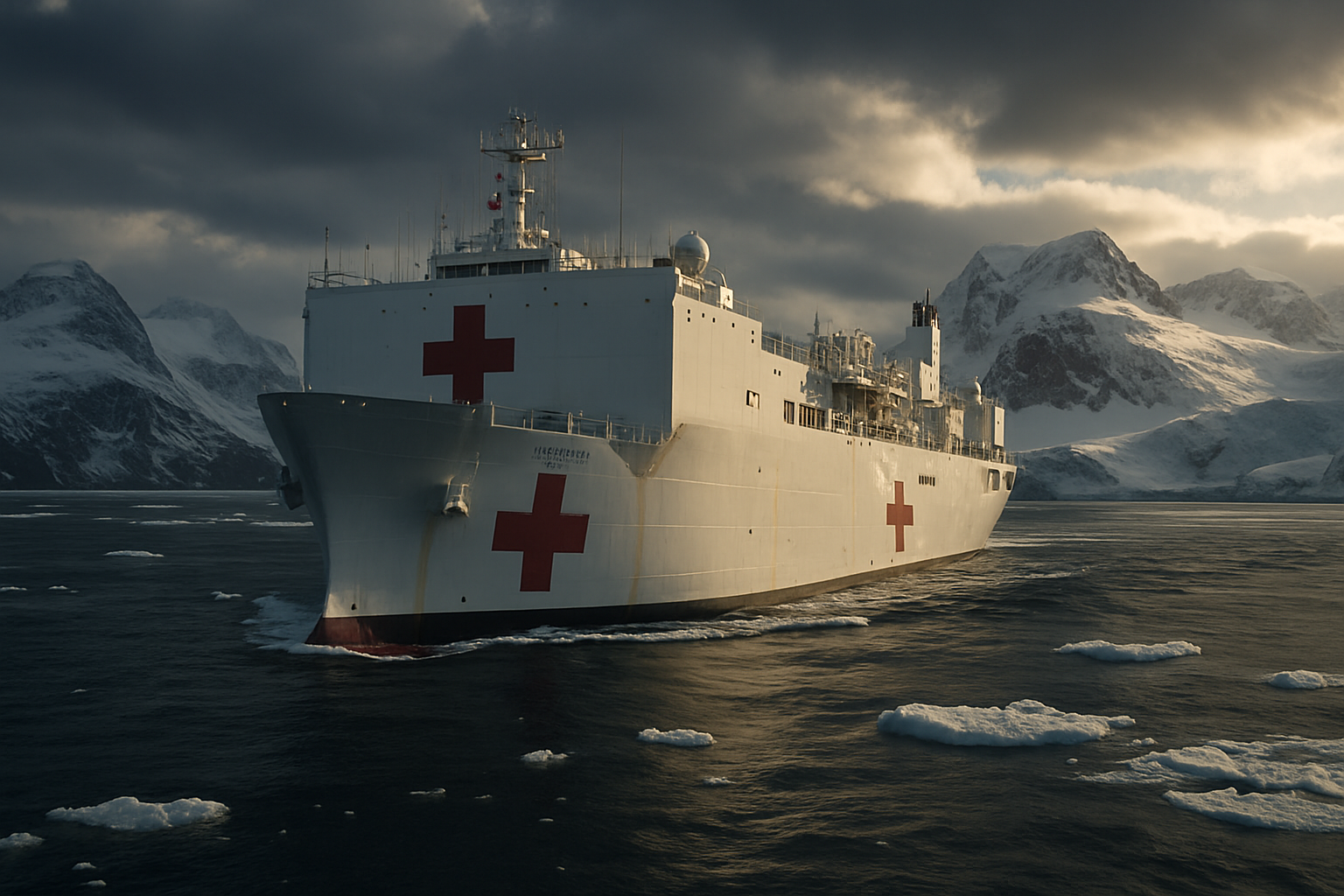
President Donald Trump announced Saturday evening that the United States would deploy a hospital ship to Greenland to provide medical assistance, marking the latest escalation in his ongoing territorial ambitions toward the Danish autonomous territory.
Trump made the announcement during a dinner with Republican governors at the White House, sitting alongside Louisiana Governor Jeff Landry, his newly appointed special envoy to Greenland. "Working with the fantastic Governor of Louisiana, Jeff Landry, we are going to send a great hospital boat to Greenland to take care of the many people who are sick, and not being taken care of there," Trump declared on Truth Social. "It's on the way!!!"
The announcement immediately raised questions about the actual deployment timeline and the specific medical needs Trump claims to be addressing. Danish state broadcaster DR reported that it remains unclear whether the US is actually preparing to send a hospital ship to Greenland or which patients would be treated, noting that all Greenland residents have access to the Danish national healthcare system.
International Opposition and Diplomatic Tensions
The hospital ship announcement comes amid sustained international diplomatic opposition to Trump's territorial pressure on Greenland. In a coordinated response to American territorial ambitions, France and Canada simultaneously opened their first consulates in Nuuk, Greenland's capital, in February 2026. Canadian Foreign Minister Anita Anand personally attended the opening alongside Indigenous Governor General Mary Simon, while a Canadian Inuit delegation reportedly told Trump to "back off."
King Frederik X of Denmark completed a high-profile three-day visit to Greenland in February, greeting well-wishers at Nuuk airport in a direct diplomatic response to US pressure. The visit was part of a broader European strategy to demonstrate support for Danish sovereignty, with EU Commission President Ursula von der Leyen planning a March 2026 visit to announce a comprehensive EU support package for Greenland.
"Greenland is neither for sale nor for purchase"
— Jens-Frederik Nielsen, Greenlandic Prime Minister
Danish Foreign Minister Lars Løkke Rasmussen acknowledged that Denmark is in a "better position" regarding US territorial claims compared to earlier in 2026, but emphasized "we are not out of the crisis, and we do not have a solution yet." Working group meetings between US and Greenlandic representatives have continued since January 28, 2026, though fundamental positions remain unchanged.
Military and Strategic Context
The hospital ship deployment occurs against a backdrop of heightened Arctic military activity. NATO officially launched its Arctic Sentry mission in February 2026, with the UK doubling its troop presence in Norway from 1,000 to 2,000 soldiers over three years. Sweden has deployed Gripen fighter jets for Greenland exercises, while Finland contributes operational planning expertise.
This European-led NATO response addresses both Russian activities in the Arctic—including the reopening of Cold War-era military bases—and serves as diplomatic reassurance amid US territorial pressure. The mission represents unprecedented European leadership in Arctic security, with notable absence from US Defense Secretary Pete Hegseth during key Brussels meetings.
Russian officials have explicitly warned of military countermeasures if Greenland becomes militarized, viewing Western diplomatic solidarity as a direct challenge to regional stability. Moscow has positioned itself as opposing what it characterizes as American "neocolonial pressure" on smaller territories.
Humanitarian vs. Strategic Motives
Trump's humanitarian framing of the hospital ship deployment faces skepticism from regional experts. A Danish professor emeritus told Ekstrabladet that pressure on Greenland's healthcare system primarily involves staffing shortages rather than lack of medical access, suggesting the hospital ship "can paint a misleading picture of Greenland."
The timing of the announcement—during ongoing territorial negotiations—raises questions about whether the humanitarian mission serves broader strategic objectives. Greenland's strategic value has increased dramatically due to climate change opening Arctic shipping routes and exposing vast rare earth mineral deposits critical for modern technology.
The territory's 56,000 inhabitants overwhelmingly support maintaining their autonomous status under Danish sovereignty rather than American acquisition. Local authorities have issued behavioral recommendations to residents, though officials report no immediate military threats despite the ongoing diplomatic pressure.
Historical Precedent and Future Implications
Trump's renewed interest in Greenland builds on his failed 2019 proposal to purchase the territory from Denmark. The current approach through working groups and humanitarian assistance represents a more sophisticated strategy than the direct purchase offer that Danish officials dismissed as "absurd."
Jeff Landry's appointment as special envoy to Greenland in December 2025 was condemned by Copenhagen as a diplomatic breach. Landry has characterized Denmark's rule of Greenland as an "occupation" and urged the island to seek independence to align with the United States.
The crisis establishes important precedents for 21st-century territorial disputes involving humanitarian assistance, climate change resource access, and collective diplomatic responses to major power pressure. The coordinated European-Canadian opposition demonstrates how smaller nations can mobilize international support to resist territorial coercion.
Regional and Global Stakes
Greenland's strategic importance extends far beyond its borders. The territory controls crucial Arctic shipping routes that climate change is making increasingly accessible. Its vast deposits of rare earth minerals—essential for renewable energy technology and advanced electronics—make it a critical resource in great power competition between the US, China, and Russia.
The international response to Trump's territorial ambitions will influence similar situations globally, potentially affecting how other major powers pursue territorial claims in strategically valuable regions. Success in resisting American pressure could strengthen sovereignty defense mechanisms, while failure might encourage territorial pressures elsewhere.
As working group discussions continue and the hospital ship deployment proceeds, the Greenland crisis represents a defining test of international law, democratic solidarity, and Indigenous rights against great power territorial ambitions in the climate change era.