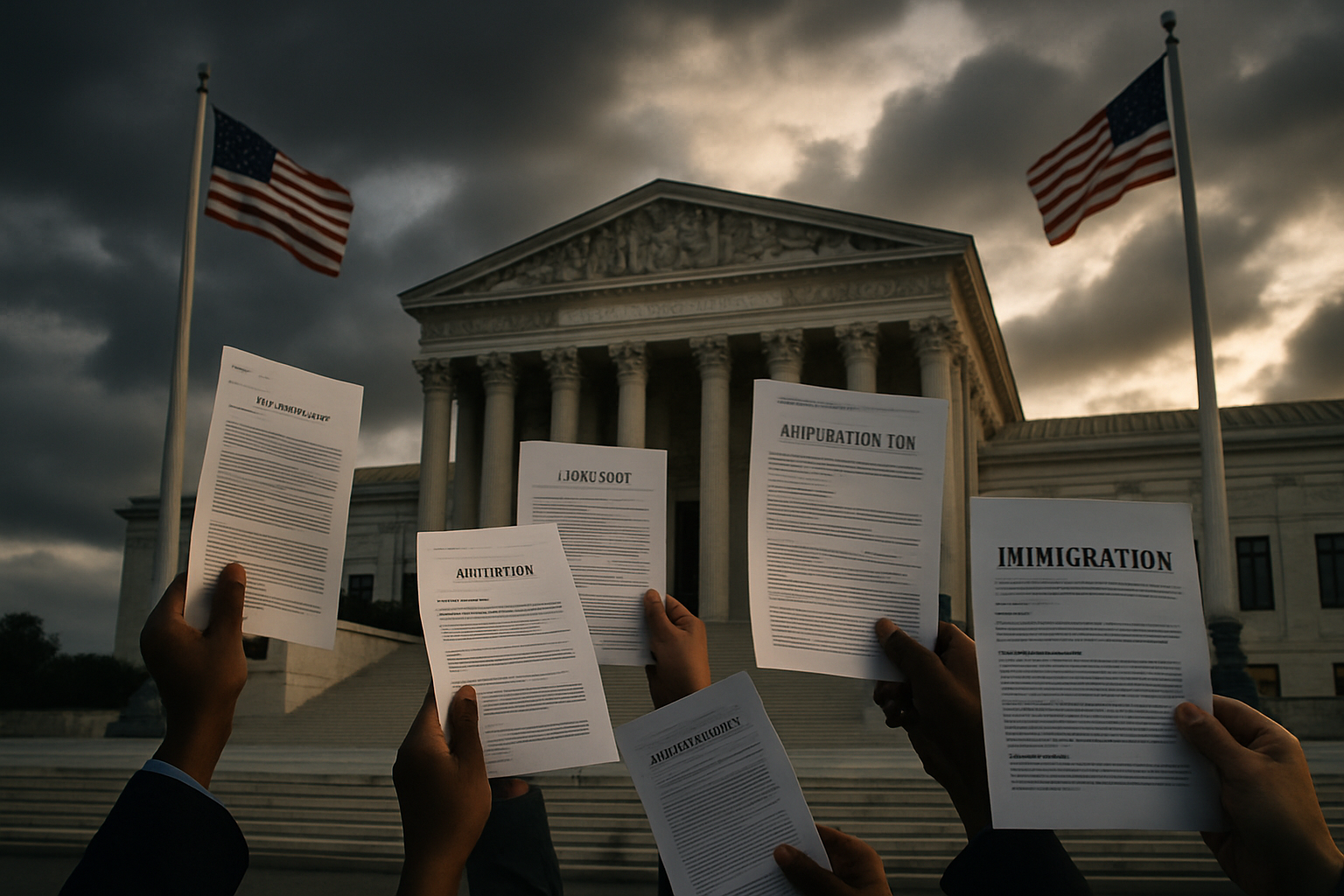
The Trump administration has escalated its immigration enforcement policies on two major fronts, implementing new restrictions on Iranian visa applications while simultaneously petitioning the U.S. Supreme Court to overturn lower court rulings that have blocked the termination of Temporary Protected Status (TPS) for approximately 350,000 Haitian immigrants.
According to legal documents filed with the Supreme Court, the administration is seeking to bypass previous judicial challenges to its immigration policies by targeting individual applications rather than categorical protections. The move represents a significant strategic shift in the administration's approach to immigration enforcement, building on months of intensified operations that have drawn widespread criticism and legal challenges.
Iranian Visa Restrictions Take Effect
The administration's new policy restricting Iranian visa applications comes amid broader geopolitical tensions and follows the controversial case of Iranian women's soccer players who were granted asylum in Australia after being labeled "wartime traitors" by Iranian state television for their silent protest during the national anthem at the AFC Women's Asian Cup.
Critics argue that the visa restrictions represent a continuation of the administration's "maximum pressure" campaign against Iran, which has already resulted in severe humanitarian consequences for Iranian civilians. The policy affects thousands of Iranian nationals with pending family reunification, employment, and humanitarian cases, according to immigration attorneys.
The restrictions build on previous policies that have targeted Iran as a "high risk" country under Presidential Proclamation 10998, which suspended immigration benefit applications from designated countries. Internal U.S. Citizenship and Immigration Services documents confirm Haiti is also included in these expanded 2026 immigration restrictions.
Supreme Court Challenge to Haitian TPS
The administration's petition to the Supreme Court seeks to reverse Federal Judge Ana Reyes' February 2026 ruling that blocked the termination of TPS for Haitian immigrants. Judge Reyes found evidence of discriminatory intent in the administration's decision-making process, citing derogatory statements made by Trump about Haitians during his campaign and presidency.
"The court found a pattern of disparaging remarks during Trump's campaign and presidency as evidence of discriminatory animus rather than legitimate policy concerns."
— Legal filing from Reyes v. Department of Homeland Security
The TPS program was established for Haiti following the devastating 2010 earthquake and has been repeatedly extended due to ongoing political instability, economic collapse, and gang violence that now controls 60% of Port-au-Prince. The status was set to expire in February 2026 before Judge Reyes' intervention.
Immigration rights organizations and U.S. citizens with TPS-holding family members brought the case, arguing that the administration's decision was motivated by racial bias rather than legitimate humanitarian assessments of conditions in Haiti.
Economic and Human Impact
The stakes of these policy decisions extend far beyond legal precedent. Haitian TPS recipients contribute approximately $4.8 billion annually to the U.S. economy and work in essential industries including healthcare, construction, and food services. More than 200,000 U.S. citizen children have Haitian parents with TPS status, creating potential family separation scenarios if the program is terminated.
The administration's new approach of targeting individual applications rather than categorical protections represents an attempt to circumvent previous legal vulnerabilities while achieving similar restrictive outcomes. This strategy avoids some of the constitutional challenges that have successfully blocked previous categorical terminations.
Broader Immigration Enforcement Context
These policy changes occur within the context of dramatically intensified immigration enforcement operations. A University of California study confirms deportations have quadrupled during the first nine months of Trump's second term, while daily deportation flights operate from multiple U.S. airports.
The administration has faced significant pushback, including from within the Republican Party. Six GOP House members joined Democrats in a 219-211 vote to end Canada tariffs, representing the first significant bipartisan rebuke of Trump trade policies during his second term.

Federal Court Resistance Pattern
The Supreme Court petition represents the administration's attempt to overcome a pattern of federal court resistance to its immigration policies. Beyond Judge Reyes' TPS ruling, multiple federal courts have imposed restrictions on immigration enforcement:
- Oregon federal judges now require ICE warrants before arrests unless there's flight risk
- Massachusetts Judge Brian Murphy ruled the administration's "third country deportation" policy unlawful
- Civil rights lawsuits challenge visa suspensions affecting 75 countries
- Philadelphia Judge invoked George Orwell's "1984" in ordering restoration of a slavery exhibit
Legal experts describe this as the most significant pattern of judicial pushback against executive immigration policies in recent memory, representing a critical test of constitutional checks and balances.
International Implications
The Iranian visa restrictions occur against a backdrop of complex international relations, including the recent asylum case in Australia where President Trump personally intervened to support protection for Iranian athletes fleeing persecution. The administration's dual approach of diplomatic engagement in some cases while implementing broad restrictions in others has created confusion among allies and critics alike.
European media coverage has been extensive, with many outlets questioning American democratic stability during crucial international negotiations. The French press has used terms like "bloodbath" to describe the administration's approach, while German coverage has emphasized concerns about institutional degradation.
Congressional Response
Congressional Democrats have threatened to block Department of Homeland Security funding unless "drastic changes" are implemented in immigration enforcement operations. Current DHS funding extends only through mid-February, creating potential for another government shutdown over immigration policy.
House Speaker Mike Johnson has scheduled two weeks of ICE reform debates, reflecting growing Republican anxiety about the administration's enforcement methods. The debates come after fatal shootings by ICE agents led to the implementation of mandatory body cameras and the withdrawal of 700 agents from Minnesota operations.
Looking Ahead
The Supreme Court's handling of the Haitian TPS case will likely set important precedents for executive authority over immigration policy and the role of discriminatory intent in policy challenges. Legal scholars expect the case to be closely watched as a bellwether for how the Court will balance executive immigration powers against constitutional equal protection guarantees.
Meanwhile, the Iranian visa restrictions represent a test of whether the administration can achieve its policy goals through individual case targeting rather than categorical programs, potentially providing a template for future immigration enforcement strategies.
"This represents a fundamental shift in how immigration policy is being implemented - moving from broad programmatic changes to individual targeting that's harder to challenge legally but affects just as many people."
— Immigration Law Expert, American University
The convergence of these policies - from Iranian visa restrictions to Haitian TPS challenges - illustrates the administration's comprehensive approach to immigration reduction that extends far beyond border enforcement to affect hundreds of thousands of individuals already present in the United States legally.
As these cases move through the courts and implementation continues, they will likely shape immigration law and policy for years to come, establishing precedents for how future administrations can exercise executive authority over immigration while navigating constitutional constraints and international obligations.