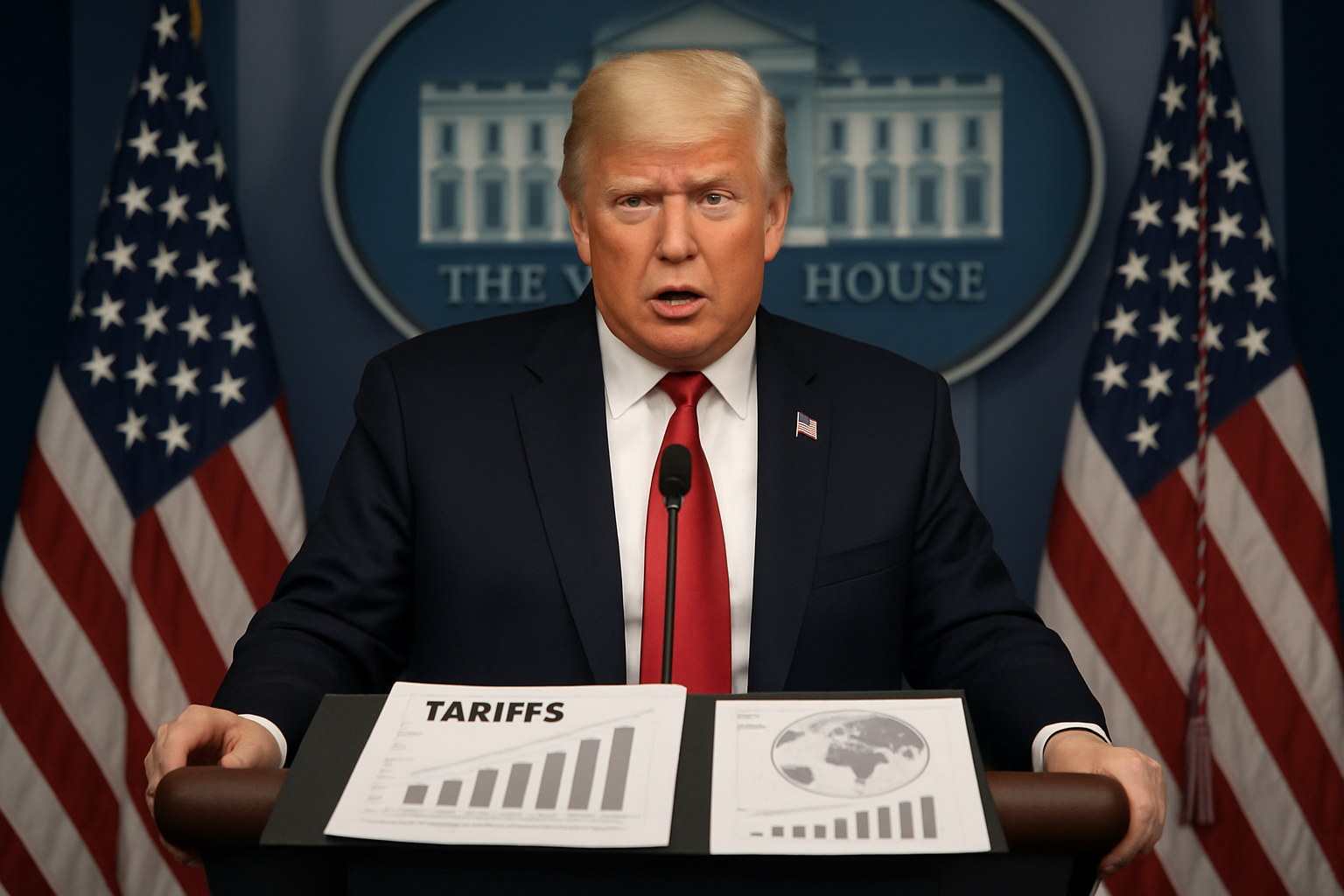
President Donald Trump announced Saturday that he is raising global tariffs from 10% to 15%, the maximum level allowed under current law, just one day after suffering a stunning defeat at the U.S. Supreme Court that struck down his comprehensive tariff program.
In a post on Truth Social Saturday morning, Trump declared: "I, as President of the United States of America, will be, effective immediately, raising the 10 per cent Worldwide Tariff on Countries, many of which have been 'ripping' the US off for decades, without retribution (until I came along!), to the fully allowed, and legally tested, 15 per cent level."
The announcement came after what Trump called a "thorough, detailed and complete review" of Friday's Supreme Court decision, which he characterized as "ridiculous, poorly written, and extraordinarily anti-American." The President launched an unprecedented attack on the justices, calling them "absolutely ashamed," a "disgrace to our nation," and "disloyal to Constitution."
Supreme Court Delivers Constitutional Blow
On Friday, the Supreme Court ruled 6-3 that President Trump had exceeded his constitutional authority by imposing sweeping global tariffs using the 1977 International Emergency Economic Powers Act (IEEPA). Chief Justice John Roberts authored the 170-page majority opinion, applying the "major questions doctrine" to declare that IEEPA "does not authorize president to impose tariffs" without clear congressional authorization for actions of "vast economic and political significance."
The ruling struck down tariffs that had been imposed on numerous countries, with China facing 34% tariffs as part of Trump's "maximum pressure" campaign. The decision removed a key leverage tool from the President's economic arsenal and potentially triggered billions of dollars in refunds for U.S. importers who had paid approximately $200 billion in tariffs since Trump's return to office.
"The Court took away leverage but made it more draconian because agreed president has right to full embargo."
— Scott Bessent, Treasury Secretary
Treasury Secretary Scott Bessent defended the administration's response, arguing that while the Court limited one form of presidential trade power, it had actually strengthened others by confirming the president's authority to impose complete trade embargos.
New Legal Framework Under Section 122
Trump's revised tariff policy relies on Section 122 of the Trade Act of 1974, a rarely-used provision that allows the president to impose tariffs up to 15% for a maximum of 150 days. The new tariffs will take effect on Tuesday, February 24, and must receive congressional approval if the administration wishes to extend them beyond the five-month limit.
The revised policy maintains exemptions for certain critical goods, including minerals, fertilizers, metals, energy equipment, agricultural products, pharmaceuticals, and medical raw materials. Importantly, the tariffs do not apply to goods covered under the United States-Mexico-Canada Agreement (USMCA).
Global Market Response
Financial markets initially surged following Friday's Supreme Court ruling, with the Nasdaq gaining 0.90% to 22,886.07 and the S&P 500 rising 0.69% to 6,090 points as investors celebrated reduced trade uncertainty. However, those gains moderated after Trump's Saturday announcement of replacement tariffs.
Oil prices rose more than $1 per barrel amid the uncertainty, while international observers expressed concern about the continued volatility in U.S. trade policy. The dollar strengthened against major currencies as traders adjusted to the new economic landscape.
International Reactions
The tariff increase drew mixed reactions from trading partners worldwide. European Union officials expressed cautious optimism about the Supreme Court ruling but remained concerned about the replacement measures. Mexico's Economy Secretary called for "prudence" and announced plans for a Washington trip to defend Mexican interests.
China welcomed the Supreme Court ruling as vindication of its position against unilateral U.S. trade actions, though Chinese officials noted that the replacement tariffs still created significant trade barriers. Canada's Trade Minister welcomed the reduction in tariffs but warned of "considerable uncertainty" ahead.
Australia, which was not granted exemptions despite having a trade surplus with the United States, faces potential economic impacts from the across-the-board tariff increase.
Congressional Challenges
The tariff announcement comes after a significant congressional rebuke of Trump's trade policies. Earlier this week, the House passed legislation 219-211 to end tariffs on Canada, with six Republican defections joining nearly all Democrats. This marked the first significant bipartisan challenge to Trump's trade authority in his second term.
House Speaker Mike Johnson had unsuccessfully attempted to prevent the vote, highlighting growing Republican anxiety about the administration's unpredictable trade approach. The measure now advances to the Senate, though passage remains uncertain.
Legal and Constitutional Implications
Legal experts predict that the new 15% global tariff will face its own court challenges. The Supreme Court's application of the "major questions doctrine" has created a higher constitutional bar for executive branch economic policies without explicit congressional authorization.
The World Trade Organization's rules limiting unilateral trade actions could provide grounds for international legal challenges. Trade law specialists question whether the alternative statutory authorities cited by the administration can support such broad trade restrictions.
Economic Impact Assessment
Despite the extensive use of tariffs during Trump's presidency, the U.S. trade deficit reached $901.5 billion annually by December 2025, essentially unchanged from pre-tariff levels. This data demonstrates the structural nature of trade imbalances that extend beyond what tariff adjustments alone can address.
However, the economy has shown resilience in other areas, with January 2026 employment adding 130,000 jobs versus the 55,000 forecast, while unemployment declined to 4.3%.
Small businesses that had celebrated potential relief from import cost pressures following Friday's court ruling now face renewed uncertainty about the refunding process and the implementation of replacement tariffs.
Strategic Implications
The tariff saga represents a watershed moment in the tension between presidential power and constitutional limitations. It marks the most significant legal defeat of Trump's economic agenda since his return to office and establishes important precedents for future administrations' use of emergency trade authority.
The international community is closely monitoring these developments as they affect not only bilateral trade relationships but also broader questions about American policy predictability and institutional stability. The success or failure of this approach will influence global trade governance frameworks and strategic competition management for years to come.
As the Trump administration navigates between institutional constraints and its economic objectives, the coming months will test whether the new legal framework can achieve the president's trade goals while withstanding constitutional scrutiny. The implications extend far beyond trade policy to fundamental questions about the balance of governmental power in the 21st century.