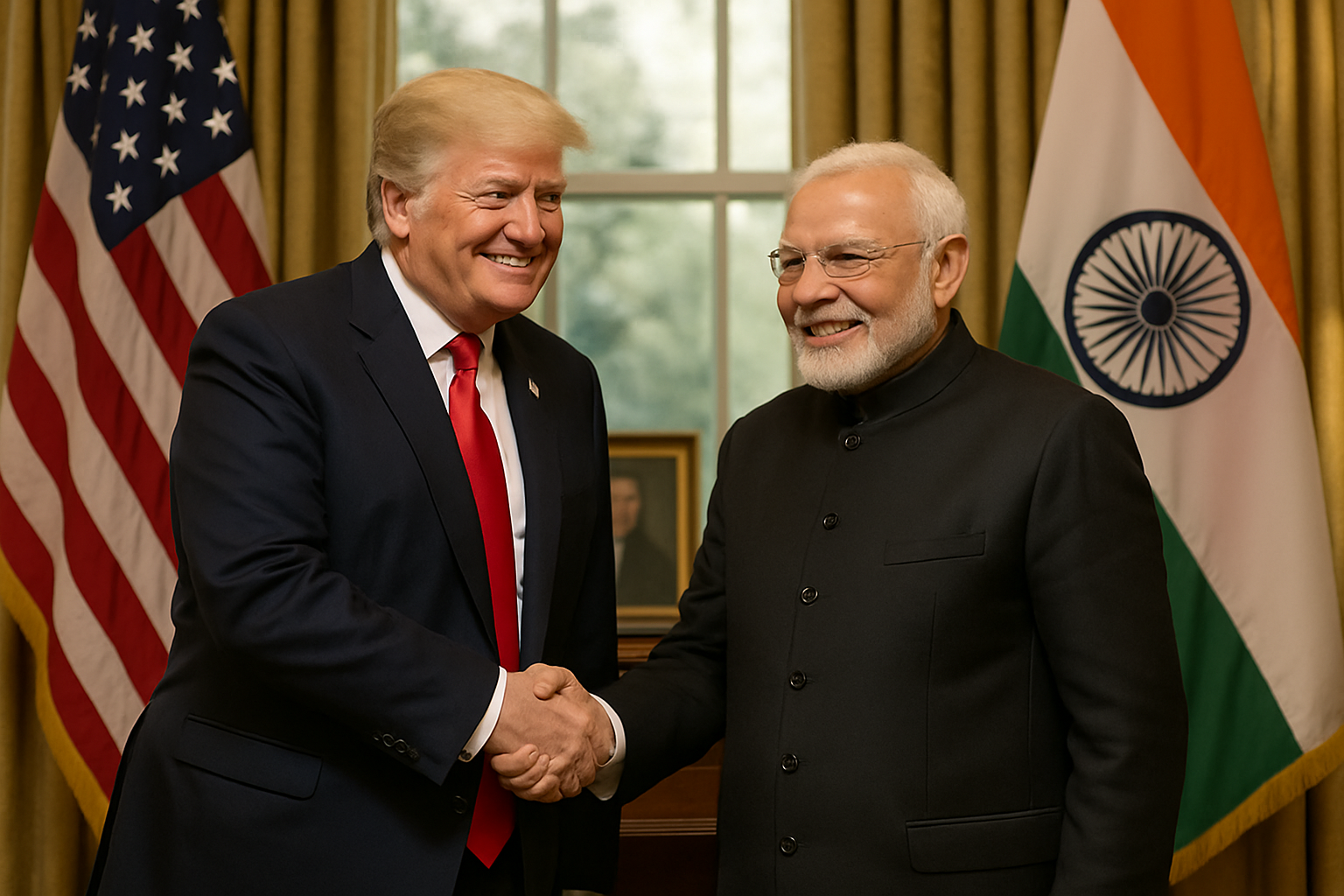
President Donald Trump announced a landmark trade agreement with India on Monday, reducing U.S. tariffs on Indian goods from 50% to 18% in exchange for Prime Minister Narendra Modi's commitment to halt Russian oil purchases and significantly increase American imports.
The deal, announced through Trump's social media posts following a Monday morning phone conversation with Modi, represents a major diplomatic and economic breakthrough that could reshape global energy markets and U.S.-India relations. However, significant discrepancies exist between American and Indian accounts of the agreement's specifics.
Key Terms of the Agreement
According to Trump's announcement, India has committed to purchasing up to $500 billion in American goods, including energy, coal, technology, agricultural products, petroleum, defense equipment, and aircraft. A White House official confirmed the U.S. is rescinding a punitive 25% duty on all Indian imports that had been imposed on top of existing 25% "reciprocal" tariff rates.
The centerpiece of the deal involves India's pledge to replace its substantial Russian crude imports with oil from Venezuela and the United States. India currently imports approximately 1.5 million barrels of Russian oil daily, representing more than one-third of the country's total oil imports, according to global trade data provider Kpler.
Trump described the agreement as helping to "end the war" in Ukraine by cutting Russian energy revenues, positioning the trade deal within broader geopolitical strategy against Moscow.
Contradictory Accounts Raise Questions
Despite Trump's detailed announcement, significant inconsistencies have emerged between U.S. and Indian versions of the agreement. While Modi welcomed the reduced tariffs in a social media post, he notably did not mention any commitment to cutting Russian oil purchases.
Indian government sources speaking anonymously confirmed agreements to purchase U.S. goods including telecommunications equipment and pharmaceuticals, and to provide market access for select agricultural products. However, there has been no official Indian statement regarding the promised halt to Russian oil imports or the $500 billion purchasing commitment.
German media analysis highlighted that "the details of the deal are open" and questioned whether India would actually follow through on ending Russian energy purchases. Ukrainian observers described the announcement as a "trade deal by tweet," noting that substantial implementation details remain unresolved.
Agricultural Sector Concerns
The agreement appears to include partial opening of India's heavily protected agricultural sector, a historically contentious issue in bilateral trade negotiations. Indian media reports suggest the government may have made compromises on agricultural and dairy sectors that it previously refused to consider with other trading partners, including New Zealand and the European Union.
However, no official clarification has been provided regarding which specific agricultural sectors will be opened or under what conditions. Opposition Congress Party members have demanded full disclosure of the agreement's impact on Indian farmers and the government's "Make in India" manufacturing initiative.
Strategic and Economic Implications
The deal gives India preferential treatment compared to other major economies, with the 18% tariff rate significantly below the 34% applied to Chinese goods and 19% for Pakistani imports. This positioning reflects the Trump administration's strategy of building stronger ties with democratic allies while maintaining pressure on strategic competitors.
For India, the agreement potentially provides relief from trade tensions that have escalated in recent months. The South Asian nation has been seeking to diversify its trading relationships while maintaining strategic autonomy in foreign policy decisions.
The energy component of the deal poses significant logistical challenges. Venezuelan oil, which Trump suggested as a replacement for Russian crude, is of similar quality—heavy and sour—making it technically suitable for Indian refineries. However, the infrastructure and supply chain adjustments required for such a massive shift in energy sourcing remain unclear.
Implementation Challenges Ahead
Despite the celebratory announcements, substantial technical and political hurdles remain. The scale of the proposed $500 billion in Indian purchases of American goods would represent a ten-fold increase from current bilateral trade levels of approximately $50 billion annually.
Energy experts note that completely replacing 1.5 million barrels per day of Russian oil imports would require significant infrastructure modifications and new supply agreements. The timeline for such changes has not been specified by either government.
Additionally, the agreement's impact on India's broader diplomatic relationships remains to be seen. The country has maintained a policy of strategic autonomy, particularly regarding its relationships with Russia and other major powers.
Market Response and Regional Impact
Indian financial markets responded positively to the announcement, with reports of significant gains as investors welcomed the prospect of reduced trade tensions. The deal is seen as potentially boosting India's export competitiveness in U.S. markets across multiple sectors.
Regional observers view the agreement as part of broader U.S. efforts to strengthen partnerships in the Indo-Pacific region while reducing economic ties between allies and Russia. The deal's success could serve as a template for similar arrangements with other countries currently importing Russian energy.
Next Steps and Verification
The agreement's ultimate success will depend on detailed implementation and verification mechanisms that have yet to be announced. Both governments will face pressure to clarify the specific terms, timelines, and monitoring procedures for the various commitments.
Trade analysts emphasize that while the political announcement represents an important diplomatic breakthrough, the technical complexities of reshaping energy supply chains and dramatically increasing bilateral trade volumes will require sustained effort from both sides.
The international community will be watching closely to see whether this announced agreement translates into concrete changes in trade flows and energy purchasing patterns, potentially serving as a model for future strategic trade partnerships in an increasingly multipolar world.