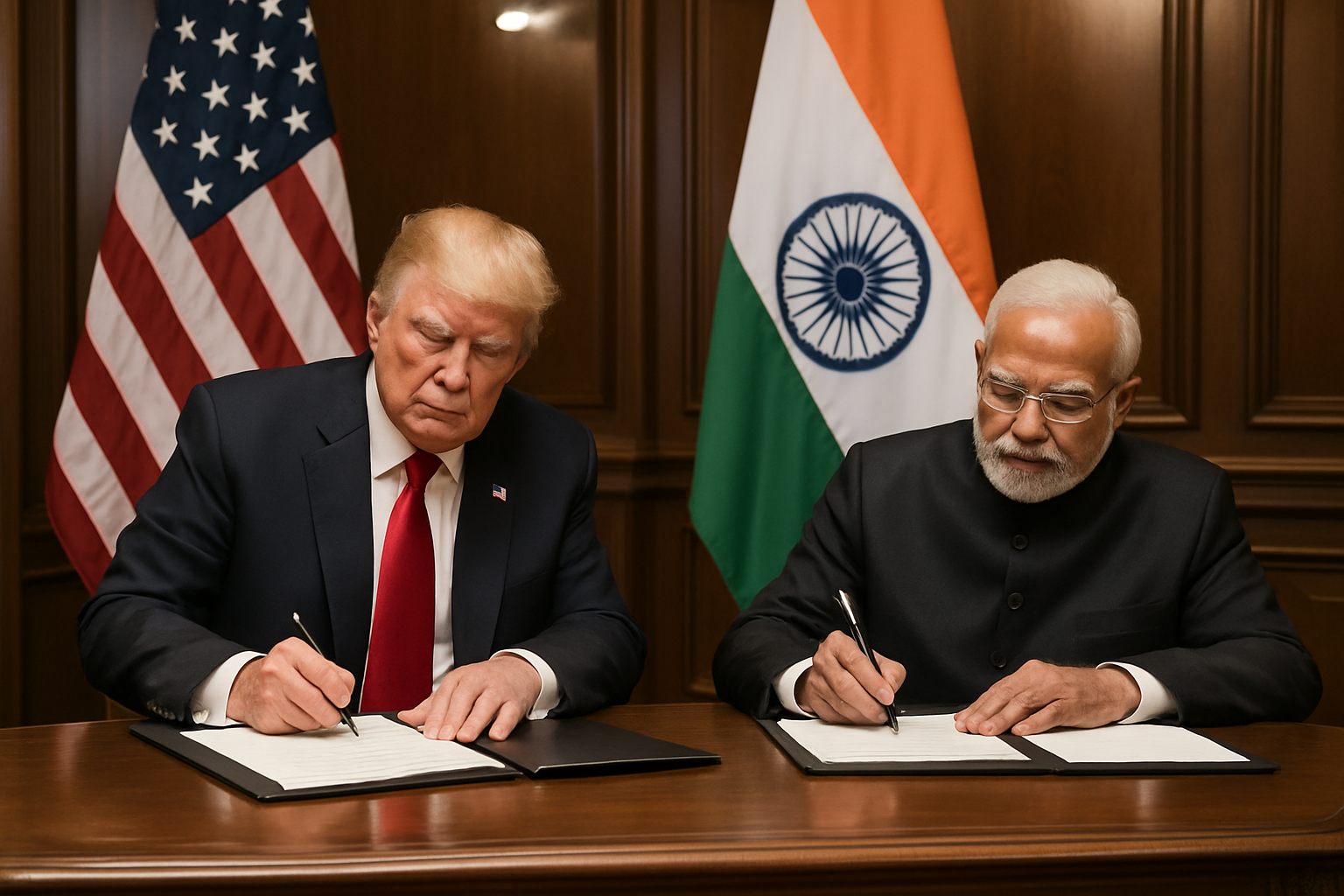
President Donald Trump announced a sweeping trade agreement with India on Monday, cutting US tariffs on Indian goods from 50% to 18% after Prime Minister Narendra Modi agreed to completely halt Russian oil purchases and commit to over $500 billion in American goods purchases.
The landmark deal, announced by Trump on Truth Social, represents one of the most significant trade breakthroughs of his second presidency and marks a major geopolitical realignment as India distances itself from Russia amid the ongoing Ukraine conflict. The agreement came after what both leaders described as a "wonderful conversation" between the two leaders.
"Just got off the phone with Prime Minister Narendra Modi of India. He told me that India will be buying much more than $500B worth of American goods and that they will no longer be buying any Russian oil," Trump posted on his Truth Social platform. "In return, I agreed to reduce tariffs from 50% down to 18% on Indian goods coming into America."
Modi's Measured Response Raises Questions
While Prime Minister Modi confirmed the tariff reduction in a post on X (formerly Twitter), thanking Trump "on behalf of 1.4 billion Indians," notably absent from his statement was any mention of the broader trade commitments or the Russian oil embargo that Trump had highlighted as central to the agreement.
"Had a wonderful conversation with my dear friend President @realDonaldTrump," Modi wrote. "Thank you for the reduced tariff of 18% on Indian goods. The cooperation between the world's largest democracies will greatly benefit our people."
The discrepancy between the two leaders' public statements has raised questions among trade experts about the scope and enforceability of the commitments Trump outlined, particularly given India's significant economic relationship with Russia.
Complex Tariff Structure Behind the Headlines
According to multiple international sources, the tariff reduction from 50% to 18% represents the elimination of punitive measures Trump had imposed on India for its Russian oil purchases. The structure included a base 25% "reciprocal" tariff, plus an additional 25% penalty for Russian energy cooperation, totaling the 50% rate that Trump announced he would reduce.
Some European reports, including from France24, initially described the reduction as from 25% to 18%, focusing only on the base tariff rate. However, Al Jazeera and other sources confirmed that Trump had indeed implemented a compound 50% tariff structure that included penalties for Russian energy purchases.
The 18% rate, if fully implemented, would give India a more favorable tariff position than Pakistan (19%) and Indonesia (19%), reflecting the strategic importance of the US-India relationship in countering Chinese influence in the Indo-Pacific region.
Energy Security and Ukraine War Implications
Trump explicitly linked the trade deal to broader geopolitical objectives, particularly regarding the Ukraine conflict. "This will also help end the war in Ukraine," Trump stated, suggesting that cutting off Russian oil revenue through reduced Indian purchases would pressure Moscow economically.
India has been one of the largest buyers of discounted Russian crude oil since the Ukraine invasion began, providing Moscow with crucial foreign currency despite Western sanctions. The country's energy imports from Russia increased dramatically following the conflict, as India sought to benefit from below-market prices for Russian petroleum products.
According to Swiss newspaper NZZ, trade experts expressed skepticism about India's ability to completely eliminate Russian oil imports given the country's massive energy needs and the favorable pricing arrangements it has secured with Moscow. India imports approximately 4.5 million barrels of oil daily, with Russian supplies accounting for a significant portion of this demand.
$500 Billion Investment Commitment
Trump's announcement that India would purchase "much more than $500 billion worth of American goods" would represent a massive increase in bilateral trade. Current US exports to India total approximately $50 billion annually, meaning the pledge would require a ten-fold increase over an unspecified timeframe.
The commitment encompasses potential investments across multiple sectors, including energy infrastructure, defense equipment, technology, and agricultural products. However, Indian officials have not provided specific details about the timeline or sectoral breakdown of these proposed purchases.
Trade analysts note that such large-scale procurement commitments are typically structured over multiple years and often include government-to-government agreements for major infrastructure projects, defense contracts, and energy sector investments.
Strategic Context and Regional Implications
The agreement comes at a crucial moment for US-India relations, as both countries seek to counter China's growing influence in the Indo-Pacific region. The deal builds upon existing frameworks like the Quad security partnership (US, India, Japan, Australia) and various bilateral defense cooperation agreements.
For India, the reduced tariffs could provide significant economic benefits, particularly for sectors like textiles, pharmaceuticals, and information technology services where Indian companies compete globally. The country's recent Union Budget 2026-27 allocated record defense spending and infrastructure investments, positioning it to potentially absorb increased American technology and equipment.
The timing also coincides with India's broader economic modernization efforts under Modi's "Viksit Bharat" (Developed India by 2047) initiative, which seeks to transform India into a developed nation through increased manufacturing capabilities and foreign investment attraction.
Implementation Challenges Ahead
Despite the fanfare surrounding the announcement, several practical challenges remain for full implementation of the agreement. India's energy infrastructure is heavily dependent on Russian technical expertise and financing, making an immediate complete cutoff potentially disruptive to domestic energy security.
Additionally, the scale of the proposed American goods purchases would require significant changes to India's procurement policies across government and private sectors. Trade experts suggest that such massive shifts in import patterns typically require months or years of planning and infrastructure development.
European trade officials, speaking anonymously to German media, expressed doubt about India's capacity to fulfill such sweeping commitments without causing domestic economic disruption, particularly given existing contracts with Russian energy suppliers.
Market and Diplomatic Reactions
International markets responded cautiously to the news, with analysts noting the preliminary nature of the announced commitments. While Indian and American stock markets showed modest positive movement, energy commodity markets reflected uncertainty about the actual timeline for reduced Russian oil demand from India.
European allies welcomed the agreement as a step toward isolating Russia economically, though some officials privately expressed concern about potential disruption to existing multilateral trade frameworks if similar bilateral deals proliferate.
The announcement represents the latest in a series of Trump administration efforts to reshape global trade relationships through direct bilateral negotiations rather than multilateral trade institutions.
Looking Forward
The success of this trade agreement will largely depend on India's ability to rapidly diversify its energy supply chains while simultaneously increasing imports from the United States across multiple sectors. Both governments face the challenge of translating high-level political commitments into practical implementation frameworks.
Trade experts will be closely watching for detailed follow-up agreements that specify timelines, enforcement mechanisms, and sectoral targets for the various commitments outlined by Trump. The disparity between the leaders' public statements suggests that significant technical negotiations may still be required to finalize the deal's operational details.
As the agreement moves toward implementation, it will serve as a key test case for Trump's approach to using trade policy as a tool for achieving broader foreign policy objectives, particularly in the competition with China and the effort to economically isolate Russia over the Ukraine conflict.