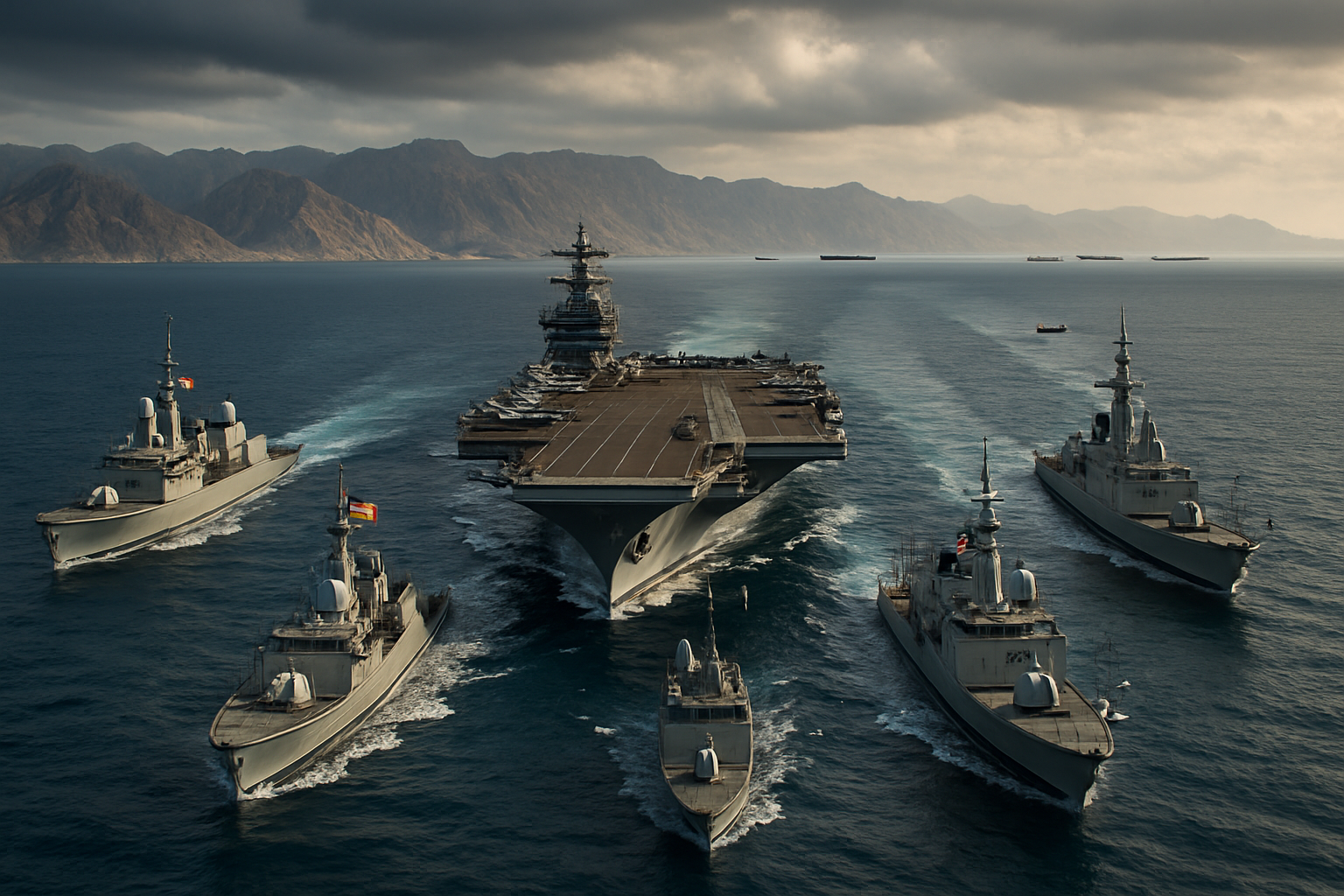
President Donald Trump has issued urgent calls for an international naval coalition to secure the Strait of Hormuz, the world's most critical energy chokepoint, as Iran's Revolutionary Guard continues mining operations that threaten 40% of global oil transit.
In a dramatic escalation of the ongoing Iran crisis, Trump specifically urged China, France, Japan, South Korea, and the United Kingdom to deploy warships alongside U.S. forces to protect the strategic 21-mile waterway. The call comes as Iran has effectively blockaded the strait with naval mines and sustained attacks on commercial shipping, creating the most severe global energy crisis in decades.
European Allies Respond with Historic Naval Coalition
European nations have responded with unprecedented maritime coordination. France leads a four-nation coalition that has repositioned the Charles de Gaulle aircraft carrier from the Baltic to the Eastern Mediterranean, accompanied by multiple frigates and advanced missile defense systems.
The United Kingdom has deployed HMS Dragon, a Type 45 destroyer equipped with Sea Viper missile systems and AW159 Wildcat counter-drone helicopters, to protect approximately 3,000 British personnel in the region. Spain has contributed the Cristóbal Colón air defense frigate, while Italy has deployed the Federico Martinengo frigate with 160 personnel.
This represents the most significant European naval mobilization in the Eastern Mediterranean since 1974, marking a concrete demonstration of European strategic autonomy independent of NATO frameworks.
Germany Declines Participation Citing War Concerns
Despite the broad international response, Germany has notably refused to join the coalition. Foreign Minister Johann Wadephul explicitly stated that Germany will not participate in any Hormuz operation, declaring that "Germany will not be an active part of the war."
Wadephul expressed skepticism about expanding EU maritime missions, distinguishing between defending European territory and participating in broader Middle East military operations. This position highlights growing divisions within the European Union over the appropriate response to the crisis.
Energy Crisis Reaches Critical Levels
The Strait of Hormuz blockade has triggered the most severe energy disruption since the 1970s oil shocks. Oil prices have surged past $100 per barrel, with Brent crude reaching a peak of $119.50 and WTI jumping 18.98% to $108.15 in the largest single-day increase on record.
The International Energy Agency (IEA) has announced the largest strategic petroleum reserve release in its 50-year history, coordinating the release of 400 million barrels from 32 countries. Japan alone is releasing 80 million barrels starting March 16, representing the first such action since the 2011 Fukushima disaster.
Iran's Revolutionary Guard has deployed an estimated 2,000-6,000 naval mines using small vessels throughout the waterway. U.S. forces have destroyed 16 Iranian mine-laying ships, but the threat to commercial shipping remains severe. Over 150 oil and LNG tankers worth billions in cargo remain stranded in the Persian Gulf.
Global Aviation Industry in Crisis
The conflict has created the most extensive aviation disruption since COVID-19, with over 18,000 flights cancelled worldwide. Eight countries have simultaneously closed their airspace: Iran, Iraq, Israel, UAE, Qatar, Syria, Kuwait, and Bahrain.
Dubai International Airport, the world's busiest with 86 million annual passengers, remains completely shut down due to missile damage. Major carriers including Emirates, Air France-KLM, Wizz Air, and Bulgaria Air have suspended Middle East operations indefinitely, affecting hundreds of thousands of passengers globally.
Diplomatic Efforts Collapse Amid Military Escalation
The current crisis emerged from the complete breakdown of nuclear negotiations between the United States and Iran, despite earlier achieving what officials described as "broad agreement on guiding principles" – the most significant diplomatic progress since the JCPOA collapse in 2018.
The fundamental obstacle remained Iran's exclusion of ballistic missiles and regional proxies as "red lines" from nuclear-only talks, while the U.S. insisted on a comprehensive agreement addressing missiles, armed groups, and human rights. This structural disagreement proved insurmountable, leading to the current military confrontation.
The crisis has been further complicated by Iran's systematic targeting of U.S. allies under "Operation True Promise 4," with Revolutionary Guards declaring that "no red lines remain." Casualties have been reported across multiple Gulf nations, including civilian deaths in the UAE and injuries in Kuwait and Qatar.
Regional Coalition Under Severe Strain
The unprecedented Saudi-UAE-Qatar-Egypt diplomatic consensus supporting negotiations has been severely threatened as Iranian retaliation has directly targeted member territories. Egyptian President Abdel Fattah el-Sisi condemned attacks on "sisterly countries," warning of "comprehensive chaos" across the region.
Kuwait has been forced to relocate Jazeera Airways operations to Saudi Arabia due to repeated drone attacks on its international airport, while Qatar has intercepted 65 missiles and 12 drones using Patriot defense systems, resulting in eight injuries from falling debris.
Congressional Opposition Mounts
The crisis has generated significant congressional scrutiny, with bipartisan lawmakers demanding answers about strategy, costs, and the potential for ground troop deployment. Senator Richard Blumenthal stated he is "more concerned than ever" about the possibility of boots on the ground.
Operation Epic Fury, the ongoing U.S.-Israeli military campaign, has already cost $11.3 billion in its first week, with the Pentagon preparing for operations extending through September – far beyond the initial 4-6 week timeline announced by the White House.
Public support for the conflict remains "almost unprecedented" in its unpopularity, with only 25% of Americans supporting the military strikes according to recent polls.
Nuclear Governance Crisis Context
The Iran crisis occurs against the backdrop of a broader nuclear governance breakdown. The New START treaty between the United States and Russia expired in February 2026, marking the first time in over 50 years that the superpowers operate without nuclear constraints.
Iran continues uranium enrichment at 60% purity, approaching the 90% weapons-grade threshold, with over 400 kilograms of material that experts say makes nuclear weapons "easily achievable." This represents sufficient fissile material for multiple weapons if weaponized.
Historical Significance and Global Implications
UN Secretary-General António Guterres has characterized the crisis as the "greatest test of multilateral cooperation in crisis management in the modern era." The rapid transition from diplomatic breakthrough to military escalation demonstrates the fragility of crisis management in the multipolar era.
The events of March 2026 represent a template-setting moment for 21st-century international relations, establishing precedents for whether diplomatic or military solutions will predominate in future territorial and nuclear disputes globally.
"This crisis will determine whether we can contain regional conflicts through international cooperation or whether we're entering an era where military solutions become the default response to international disputes."
— Senior European Diplomat, speaking on condition of anonymity
Energy Architecture Transformation Required
The current crisis has exposed fundamental vulnerabilities in global energy architecture that experts say require immediate restructuring. The 21-mile Strait of Hormuz represents a single-point failure for modern logistics, with no realistic alternative routes for Persian Gulf oil and gas exports.
Natural gas prices have surged 24% in Europe and 78% in the United States, while Qatar has halted LNG production at its Ras Laffan and Mesaid facilities, representing approximately 20% of global exports. This threatens European energy security as winter approaches.
Supply chain disruptions extend far beyond energy, affecting consumer goods and industrial materials dependent on Persian Gulf logistics networks. Manufacturing in automotive, electronics, and textiles sectors faces severe disruptions globally.
Looking Ahead: Critical Decisions Pending
As international naval forces prepare to deploy to the region, the success or failure of the coalition will have far-reaching implications. Success in reopening the strait could provide a framework for future international crisis response, while failure might accelerate the trend toward military solutions in international disputes.
Trump's demand for Iran's "unconditional surrender" and his claim of the right to personally choose Iran's next Supreme Leader represent the most direct assertion of American control over Iranian affairs since 1979, effectively eliminating near-term diplomatic solutions.
The crisis represents the most dangerous international confrontation since the end of the Cold War, with stakes including regional war prevention, global energy security, nuclear governance credibility, and the enforcement of international law in the post-WWII order.
As naval forces from multiple nations converge on the Strait of Hormuz, the coming weeks will likely determine whether multilateral cooperation can effectively manage 21st-century security challenges or whether the international community faces a fundamental shift toward military confrontation as the primary means of resolving disputes.