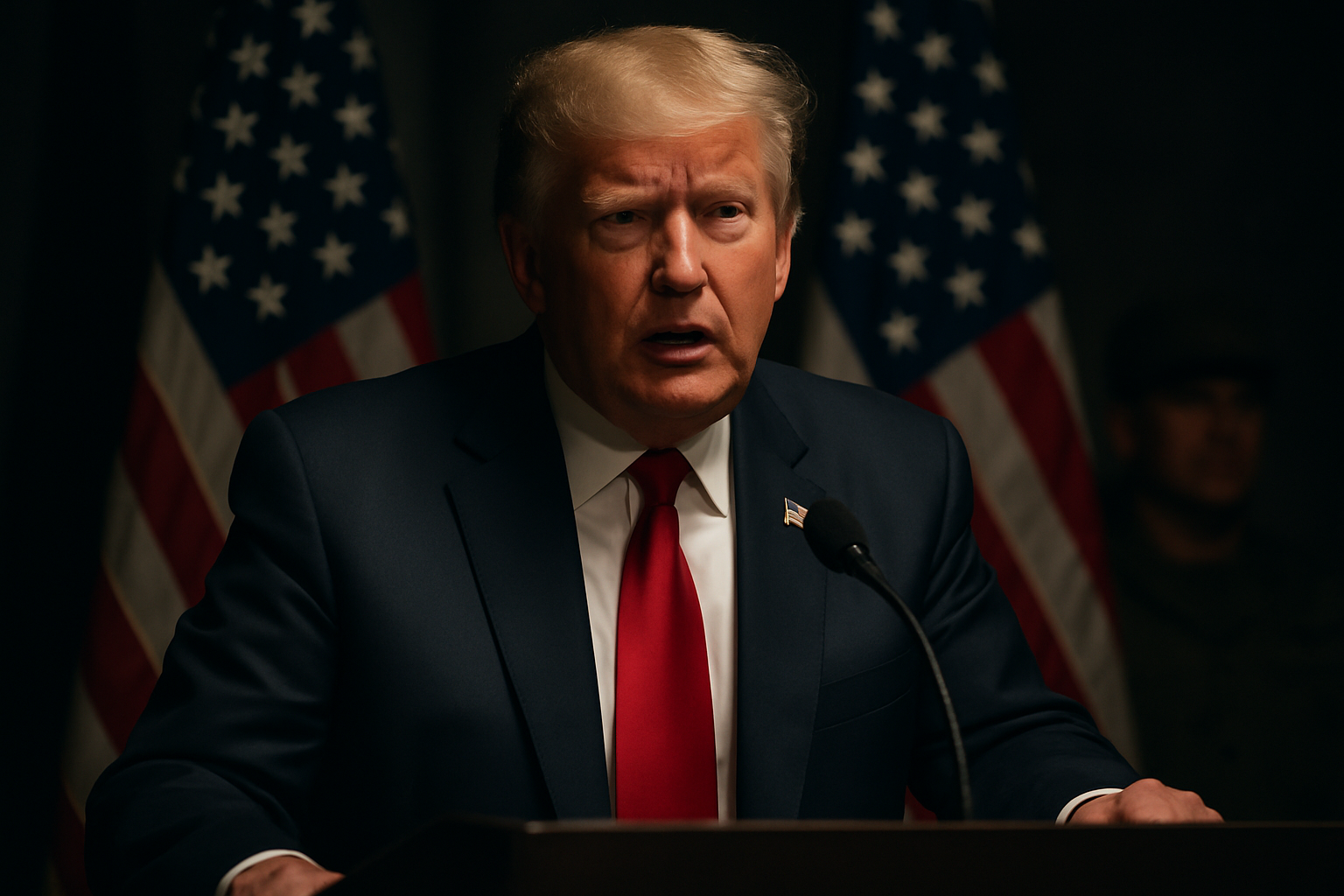
President Donald Trump has issued Iran a stark 48-hour ultimatum to reopen the strategically vital Strait of Hormuz, declaring that failure to comply will result in "hell" for the Islamic Republic, while international search and rescue operations continue for a missing US airman whose fighter jet was shot down over the Persian Gulf.
The dramatic escalation comes as the conflict between the United States and Iran enters its sixth week, with scant prospect of peace talks and declining public support for continued military engagement. The crisis has evolved from what began as nuclear negotiations in February 2026 into a full-scale regional confrontation affecting global energy markets and international aviation.
Ultimatum Details and Timeline
According to multiple international sources, Trump's ultimatum was initially set with a 10-day deadline on March 26, 2026, but has now been compressed to a critical 48-hour window. The Bosnian news agency Haber.ba reported Trump's message: "Remember when I gave Iran ten days to reach a deal or open the Strait of Hormuz? Time is running out – 48 more hours before hell comes to them. Glory to GOD."
The ultimatum was originally scheduled to expire on Monday, April 6 at 8 PM local time, but the accelerated timeline suggests growing urgency within the Trump administration to force Iran's hand on the strategic waterway that handles approximately 40% of global seaborne oil transit.
Missing Airman Crisis
Adding complexity to the diplomatic standoff is the ongoing search for a US service member whose aircraft was shot down during recent military operations. Irish media reports indicate that "the prospect of a US service member alive and on the run in Iran raised the stakes for Washington as the conflict entered its sixth week."
The search operation has intensified the already high-stakes nature of the confrontation, with the possibility of an American serviceman captured or stranded in Iranian territory adding a human dimension to what has primarily been a strategic and economic crisis.
"The situation has become exponentially more complex with potential American personnel at risk on Iranian soil. This changes the entire dynamic of our response options."
— Senior US Defense Official (speaking anonymously)
Regional Military Escalation
The current crisis stems from what began as promising nuclear negotiations in Geneva during February 2026, where Iranian Foreign Minister Abbas Araghchi announced "broad agreement on guiding principles" – the most significant diplomatic progress since the JCPOA collapse in 2018. However, fundamental disagreements over scope proved insurmountable, with Iran excluding ballistic missiles and regional proxies as "red lines" while the US demanded comprehensive agreements addressing missiles, armed groups, and human rights.
Military tensions have escalated dramatically since the diplomatic breakdown. The Trump administration deployed an unprecedented dual-carrier strike force, with the USS Gerald R. Ford joining the USS Abraham Lincoln in the Arabian Sea, representing the largest US naval presence in the Middle East since the 2003 Iraq invasion.
Iranian Response and Regional Impact
Iran has responded to US military pressure with what it calls "Operation True Promise 4," declaring that "no red lines remain" in its systematic targeting of US facilities and regional allies. The Iranian Revolutionary Guard has warned that all US military bases and facilities in the Middle East would be considered "legitimate targets" if attacked.
The conflict has already resulted in significant regional casualties and economic disruption:
- UAE: 1 civilian killed in Abu Dhabi from missile debris
- Kuwait: 32 foreign nationals injured in airport drone strikes
- Qatar: 8 injured despite Patriot missile systems intercepting 65 missiles and 12 drones
- Cyprus: RAF Akrotiri base struck, marking the first attack on European territory since WWII
Global Economic Implications
The crisis has created unprecedented disruption to global energy markets and transportation networks. Iran's mining of the Strait of Hormuz with an estimated 2,000-6,000 naval mines has effectively closed the waterway that carries 40% of the world's seaborne oil trade.
Oil prices have surged past $100 per barrel for the first time since 2022, with Brent crude reaching $119.50 and West Texas Intermediate hitting a record $108.15 – an 18.98% single-day jump. The International Energy Agency has responded with its largest-ever strategic petroleum reserve release of 400 million barrels from 32 countries.

Aviation Industry Paralysis
The conflict has created what aviation analysts describe as an "aviation black hole" in the Middle East, with eight countries maintaining simultaneous airspace closures. Over 18,000 flights have been cancelled worldwide – the most extensive aviation disruption since the COVID-19 pandemic.
Dubai International Airport, the world's busiest with 86 million passengers annually, remains shuttered due to missile damage. Major carriers including Emirates, Air France-KLM, and Wizz Air have suspended operations indefinitely, stranding hundreds of thousands of passengers globally.
Nuclear Dimensions and Broader Context
The current crisis occurs against the backdrop of broader nuclear governance challenges. The New START treaty between the US and Russia expired in February 2026, marking the first time in over 50 years without nuclear constraints between the two powers. Combined with China's nuclear expansion, UN Secretary-General António Guterres has warned that nuclear risks are at their "highest in decades."
Iran continues uranium enrichment at 60% purity – well above the 3.67% limit established in the original JCPOA and approaching the 90% level needed for weapons-grade material. Intelligence assessments suggest Iran possesses sufficient enriched uranium for multiple nuclear weapons if weaponized.
Congressional and Public Opinion
The prolonged conflict faces mounting opposition in Congress and historically low public support. Senator Richard Blumenthal has expressed being "more concerned than ever" about potential ground troop deployment, while the conflict maintains only 25% public approval – described by political analysts as "almost unprecedented" unpopularity for early-stage military operations.
Pentagon operations are now projected to continue through September 2026, far beyond the initial 4-6 week timeline. The financial cost has already exceeded $11.3 billion in the first week alone, with daily expenses running at approximately $1 billion.
International Diplomatic Response
The crisis has strained traditional alliances, with European partners showing reluctance to support expanded military operations. However, the attack on Cyprus has prompted an unprecedented European naval coalition response, including vessels from the UK, Spain, Italy, France, Netherlands, and Greece.
The European Union has activated its ESTIA crisis mechanism for the first time in the bloc's history to coordinate the Cyprus evacuation, demonstrating how the Middle East conflict has expanded beyond its traditional geographic boundaries.
Looking Ahead: Critical 48 Hours
As the 48-hour deadline approaches, the international community faces what UN Secretary-General Guterres has called "the greatest test of multilateral cooperation and crisis management in the modern era." The ultimatum represents a potential turning point that could either force a diplomatic breakthrough or escalate into the most dangerous international crisis since the end of the Cold War.
The fate of the missing US airman adds an additional layer of urgency to diplomatic efforts, with the possibility that Iran might use any captured American personnel as leverage in negotiations. Meanwhile, the continued closure of the Strait of Hormuz threatens to reshape global energy architecture and supply chains for years to come.
"This is a template-setting moment for 21st-century international relations. How this crisis resolves will determine whether diplomatic solutions remain viable for future nuclear and territorial disputes, or whether military approaches become the preferred option."
— Dr. Elena Rodriguez, International Relations Expert
The coming 48 hours will determine whether Trump's diplomatic pressure campaign succeeds in forcing Iranian compliance or whether the world moves closer to a broader Middle Eastern conflict with global implications that could extend for decades. With energy markets, aviation networks, and nuclear governance credibility all hanging in the balance, the stakes could not be higher for international stability in the multipolar era.