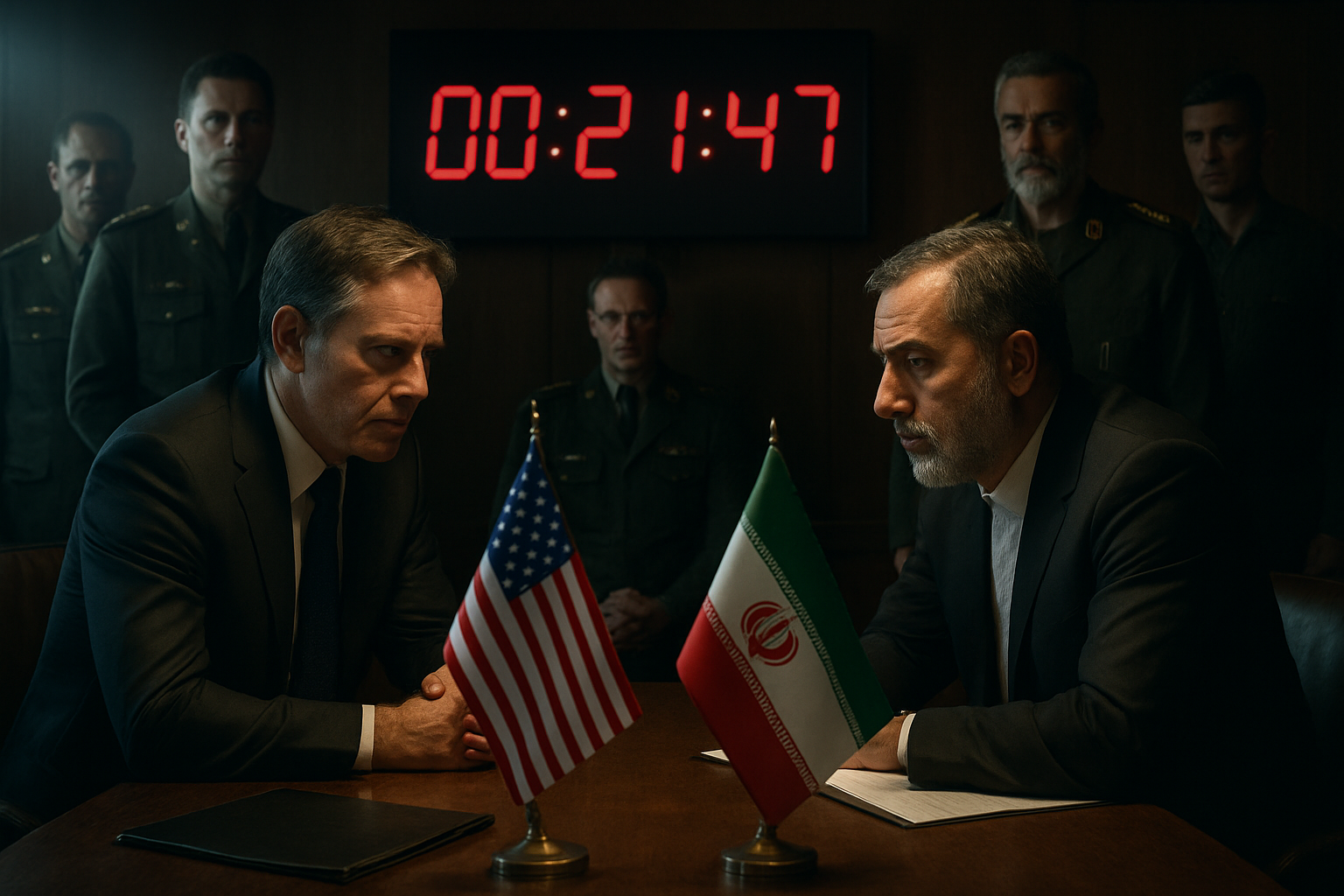
President Donald Trump has issued his most explosive ultimatum yet, giving Iran 48 hours to reopen the Strait of Hormuz or face catastrophic consequences, as U.S. and Iranian forces mount desperate search operations for a missing American F-15E Strike Eagle crew member shot down over the strategic waterway.
The dual crisis has reached unprecedented intensity, with Trump warning that "all hell will rain down" on Iran if the critical shipping lane remains closed, while both militaries race against time to locate the missing weapons systems officer from the downed fighter jet. One crew member has been rescued, but the second remains unaccounted for, with Iran reportedly offering a bounty for his capture.
Explosive 48-Hour Ultimatum
In his most direct threat since the crisis began, Trump declared that Iran must either strike a deal or face the consequences of continuing to blockade the Strait of Hormuz, through which 40% of global oil transit flows. The ultimatum comes as oil prices surge past $100 per barrel for the first time since 2014, with analysts warning of potential spikes toward $200 as the strategic waterway remains effectively closed.
"Time is running out. Iran has less than 48 hours on the clock to either make a deal or face all hell."
— Donald Trump, U.S. President
The unprecedented nature of Trump's deadline reflects the escalating global economic crisis, with over 150 oil and LNG tankers worth billions stranded in the Persian Gulf. Major shipping companies Maersk and MSC have suspended operations indefinitely, while the International Energy Agency has authorized a record 400 million barrel strategic release—the largest in 50-year history.
Missing Pilot Crisis Intensifies Tensions
Adding human drama to the geopolitical standoff, both U.S. and Iranian special forces are conducting intensive search operations in hostile territory for the missing American airman. The F-15E Strike Eagle was shot down during Operation Epic Fury, the largest U.S. military operation in the Middle East since the 2003 Iraq invasion.
Defense analyst Laurel Rapp described the missing pilot as "a very large trophy" for Iran, citing the strategic intelligence and propaganda value. The situation creates additional pressure on both sides, with humanitarian concerns intertwining with broader military objectives.

Global Crisis Reaches Peak Intensity
The crisis has evolved into the most dangerous international confrontation since the end of the Cold War, with cascading effects across multiple sectors:
- Aviation Chaos: Over 18,000 flights cancelled worldwide—the most severe disruption since COVID-19, with eight countries simultaneously closing their airspace
- Energy Security: Natural gas prices surging 24% in Europe and 78% in the U.S., threatening winter heating supplies
- Economic Fallout: Stock markets crashing globally, with Pakistan's KSE-100 suffering its largest decline in history at -8.97%
- Humanitarian Crisis: Mass evacuations on the scale of the Arab Spring, with Australia reporting 115,000 citizens trapped and Germany 30,000 stranded
Dubai International Airport, the world's busiest with 86 million passengers annually, remains shut indefinitely due to missile damage, while major airlines including Emirates, Air France-KLM, and Wizz Air have suspended operations across the region.
Iran's Strategic Response
Iran has responded to Trump's ultimatum with defiance, deploying an estimated 2,000-6,000 naval mines throughout the Strait of Hormuz. The Revolutionary Guard has declared the waterway "unsafe for shipping" and maintains that "no red lines remain" in their systematic targeting campaign known as "Operation True Promise 4."
The Iranian strategy has expanded beyond the immediate conflict zone, with attacks on coalition partner territories including:
- UAE: 1 civilian killed in Abu Dhabi, Dubai shutdown
- Kuwait: 32 injured in airport strikes
- Qatar: 8 wounded despite intercepting 65 missiles and 12 drones
- Cyprus: First European territory attacked since WWII at RAF Akrotiri
Collapsed Nuclear Diplomacy Background
The current military confrontation emerged from the complete breakdown of nuclear negotiations despite February's Geneva talks achieving "broad agreement on guiding principles"—the most significant progress since the JCPOA collapse in 2018. However, fundamental scope disagreements proved insurmountable.
Iran maintained its ballistic missiles and regional proxies as "red lines" excluded from nuclear-only talks, while the U.S. insisted on comprehensive agreements addressing missiles, armed groups, and human rights. This structural deadlock, unchanged for over a decade, ultimately led to the current military crisis.
"Iran continues 60% uranium enrichment with over 400kg of weapons-grade material, sufficient for multiple nuclear weapons if weaponized."
— Former IAEA Inspector Dr. Yusri Abu Shadi
Congressional Opposition Mounting
Domestic political pressure is intensifying on Trump as Operation Epic Fury enters its sixth week with mounting costs and casualties. The operation has already cost $11.3 billion in its first week alone, with 150 U.S. troops wounded (8 critical) and 3 confirmed deaths—the first American combat fatalities since 2003.
Congressional opposition has reached unprecedented bipartisan levels, with only 25% of Americans supporting the conflict—described by analysts as "almost unprecedented" unpopularity for early-stage military operations. Senator Blumenthal expressed being "more concerned than ever" about potential ground troops deployment, while the Pentagon has prepared operations extending through September, far beyond the initially projected 4-6 week timeline.
Iranian Leadership Transition
Adding complexity to the crisis, Iran is navigating its first hereditary succession in the 47-year history of the Islamic Republic. Mojtaba Khamenei has assumed the role of Supreme Leader following his father Ali Khamenei's death on March 1, with the Revolutionary Guards consolidating unprecedented military control over governance.
This transition from clerical to military leadership has coincided with the most aggressive Iranian military posture in decades, with Trump explicitly rejecting the succession and claiming the right to "personally choose" Iran's next leader—the most direct assertion of American control over Iranian affairs since 1979.
European Response Unprecedented
The conflict has triggered the first attack on European territory since World War II, prompting an unprecedented naval coalition response. HMS Dragon leads a multi-national fleet including Spanish, Italian, French, Dutch, and Greek vessels protecting Cyprus, while the EU has activated its ESTIA evacuation mechanism for the first time in the bloc's history.
This European military mobilization represents a historic shift, with traditional NATO allies demonstrating both defensive solidarity and growing concern about U.S. unilateral military actions in the region.
Template-Setting Global Implications
UN Secretary-General António Guterres has described the crisis as "the greatest test of multilateral cooperation in the modern era," with implications extending far beyond the immediate Middle East conflict. The rapid transition from diplomatic engagement to military confrontation demonstrates the fragility of crisis management mechanisms in the multipolar era.
The stakes encompass multiple critical areas simultaneously:
- Nuclear Governance: With New START expired for the first time in 50+ years and China expanding its nuclear arsenal, the failure of Iran diplomacy could encourage proliferation globally
- Energy Security: The closure of the Strait of Hormuz threatens the fundamental architecture of global energy markets
- International Law: The targeting of civilian infrastructure and international shipping tests post-WWII principles of territorial sovereignty
- Diplomatic Credibility: The collapse of negotiations despite framework agreements undermines confidence in diplomatic solutions for 21st-century conflicts
Critical 48-Hour Countdown
As Trump's ultimatum countdown continues, both military capabilities and economic pressures are reaching breaking points. Iran shows no signs of backing down from its Strait of Hormuz closure, while the U.S. maintains the largest naval concentration in the Middle East since 2003, with the USS Gerald R. Ford and Abraham Lincoln carrier groups representing approximately one-third of the active U.S. Navy fleet.
The search for the missing American pilot adds a human element that could either provide a diplomatic opening for de-escalation or further inflame tensions if the airman falls into Iranian hands. Both outcomes carry significant implications for the broader crisis trajectory.
The coming hours represent a watershed moment that will determine whether the crisis can be contained as a regional confrontation or escalates into the most dangerous international conflict since the Cold War's end. The template established by this crisis—whether diplomatic innovation triumphs or military solutions predominate—will influence global approaches to territorial disputes, nuclear crises, and energy security for decades to come.
With global markets, energy supplies, and regional stability hanging in the balance, Trump's 48-hour ultimatum has created the most consequential international deadline in recent memory, testing the fundamental principles of post-WWII international order and 21st-century crisis management capabilities.