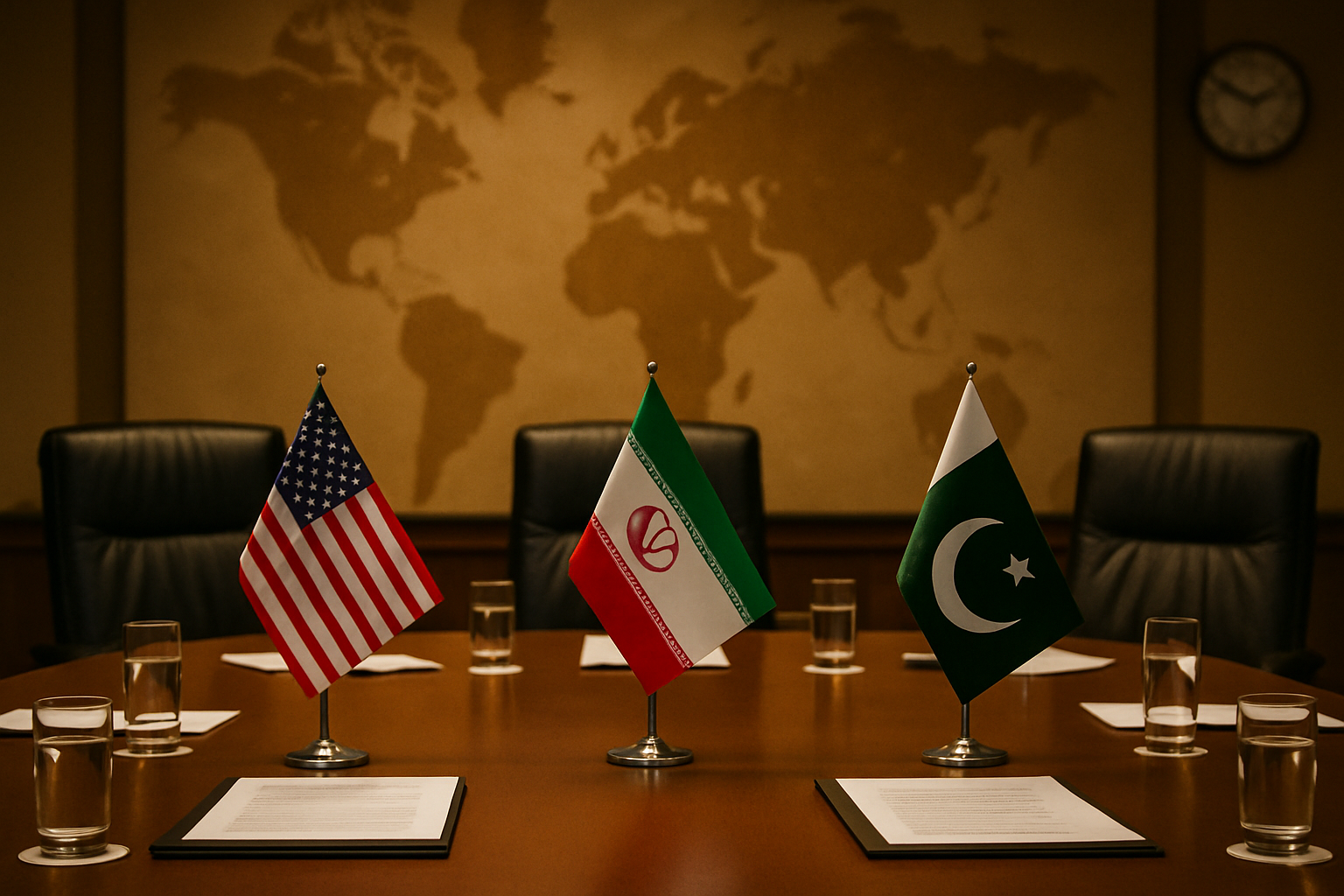
In a dramatic last-minute breakthrough, President Donald Trump announced a two-week ceasefire with Iran on Tuesday evening, just over an hour before his self-imposed deadline threatening "a whole civilization will die tonight" if Tehran failed to reopen the Strait of Hormuz.
The historic agreement, mediated by Pakistan Prime Minister Shehbaz Sharif, represents a stunning reversal from Trump's apocalyptic threats and marks the first major de-escalation in the most dangerous international crisis since the Cold War.
Trump announced the breakthrough on his Truth Social platform at 10:43 PM Eastern time, stating: "I agree to suspend the bombing and attack of Iran for a period of two weeks. This will be a double sided CEASEFIRE! We received a 10 point proposal from Iran, and believe it is a workable basis on which to negotiate."
Iran Confirms Agreement and Strait Reopening
Iranian Foreign Minister Abbas Araghchi confirmed Tehran's acceptance of the ceasefire arrangement, stating that "safe transit through the Strait of Hormuz would be possible for two weeks in coordination with Iranian armed forces." Iran's Supreme National Security Council announced that formal negotiations would begin Friday in Islamabad, Pakistan's capital.
"Iran will allow safe passage through the strait during the two-week period through coordination with its armed forces, if attacks against Iran are halted"
— Abbas Araghchi, Iranian Foreign Minister
The agreement immediately triggered massive relief in global energy markets, with oil prices plummeting over 8% in early Asian trading as the threat to the world's most critical energy chokepoint was temporarily lifted. The Strait of Hormuz carries approximately 40% of global seaborne oil transit, and Iran's closure through naval mining had stranded over 150 tankers worth billions in cargo.
Pakistan's Crucial Mediation Role
Pakistan emerged as the key diplomatic broker in the crisis, with Prime Minister Shehbaz Sharif confirming the ceasefire covers "all fronts, including Lebanon" and takes effect "immediately." The Pakistani leader had been in intensive contact with both sides for days, offering Islamabad as a neutral venue for comprehensive talks.
Field Marshal Asim Munir, Pakistan's military chief, maintained round-the-clock communications with US Vice President JD Vance and Iranian officials throughout the critical final hours. Chinese Foreign Minister Wang Yi expressed "full support" for Pakistan's mediation initiative, calling the talks "conducive to restoring normal navigation in Hormuz."
Global Crisis at Breaking Point
The ceasefire announcement came as the world faced unprecedented disruption from the 40-day conflict. Over 18,000 flights had been cancelled worldwide - the most severe aviation crisis since COVID-19 - with eight Middle Eastern countries simultaneously closing their airspace. Dubai International Airport, the world's busiest, remained shuttered after missile damage.
Energy markets had reached crisis levels, with oil prices surging past $119 per barrel for Brent crude, while the International Energy Agency deployed its largest strategic petroleum reserve release in 50-year history - 400 million barrels from 32 countries. Natural gas prices exploded 24% in Europe and 78% in the United States.
Operation Epic Fury, the largest US-Israeli military campaign since the 2003 Iraq invasion, had cost $11.3 billion in its first week alone, with Pentagon operations planned through September. The conflict marked the first time European territory had been attacked since World War II, when Iranian drones struck RAF Akrotiri in Cyprus.
Trump's Dramatic Policy Reversal
The ceasefire represents a complete reversal from Trump's earlier threats throughout Tuesday. In the morning, the President had warned that "a whole civilization will die tonight" and threatened to "destroy every bridge and power plant in Iran" if the Strait of Hormuz remained closed.
Those apocalyptic warnings drew unprecedented global condemnation, with Pope Leo XIV calling the threats "truly unacceptable" and violating international law. Democratic leaders urged Republicans to show "patriotic duty over party loyalty to stop this madness."
Congressional opposition to the conflict had reached historic levels, with only 25% of Americans supporting the military operation - described as "almost unprecedented" unpopularity for an early-stage military intervention.
Iran's Victory Declaration
Iran's Supreme National Security Council declared the ceasefire a "historic victory," claiming they had "forced Trump to accept our 10-point plan." Iranian officials characterized the agreement as compelling the United States to acknowledge Iranian sovereignty over the Strait of Hormuz and accept negotiations on broader regional security arrangements.
The Iranian position represents a dramatic shift from their earlier categorical rejection of any temporary measures, maintaining that they would only accept permanent resolutions to the conflict. Iran's Revolutionary Guard had declared "no red lines remain" in their systematic targeting of US and allied interests across the region.
Nuclear Diplomacy Context
The current crisis emerged from the complete breakdown of US-Iran nuclear negotiations despite achieving a "broad agreement on guiding principles" in Geneva talks earlier this year - the most diplomatic progress since the 2018 JCPOA collapse. The fundamental disagreement centered on scope: Iran demanded nuclear-only discussions excluding ballistic missiles and regional proxies, while the US insisted on comprehensive arrangements.
Iran continues uranium enrichment at 60% purity with over 400 kilograms of weapons-grade material sufficient for multiple nuclear weapons. The crisis occurred amid broader nuclear governance challenges, with the New START treaty between the US and Russia having expired in February - the first time in over 50 years without such constraints.
Regional Coalition Under Strain
The unprecedented consensus among Saudi Arabia, UAE, Qatar, and Egypt supporting diplomatic solutions had come under severe pressure from Iranian retaliation targeting their territories. The UAE reported one civilian killed in Abu Dhabi, Kuwait suffered 32 injured in airport strikes, and Qatar intercepted 65 missiles and 12 drones with 8 people wounded.
Egyptian President Abdel Fattah el-Sisi had warned of "comprehensive chaos" if the conflict continued to spread, condemning Iranian attacks on "sisterly Arab countries."
Path Forward to Islamabad
Formal negotiations are scheduled to begin Friday, April 10, in Islamabad, with both sides expected to send high-level delegations. Trump administration sources indicate Vice President JD Vance and presidential son-in-law Jared Kushner may be involved in the talks, representing the most direct US-Iran diplomatic engagement in decades.
The talks will address Iran's 10-point proposal, which reportedly includes arrangements for Strait of Hormuz passage protocols, sanctions relief, regional conflict resolution, and long-term security guarantees. However, US officials warn that several points "could derail the peace process entirely" if not carefully managed.
Global Market Relief
Financial markets responded with euphoric relief to the ceasefire announcement. Asian stock indices surged in early trading, while oil futures collapsed as traders priced in the restoration of Gulf shipping. Airlines began planning to resume Middle Eastern routes, and shipping companies prepared to mobilize stranded vessels worth billions of dollars.
The International Energy Agency confirmed it would begin reducing emergency strategic reserve releases as supply concerns eased, though officials cautioned that markets remained vulnerable to any renewed escalation.
Historical Significance
UN Secretary-General António Guterres, who had described the crisis as "the greatest test of multilateral cooperation in the modern era," welcomed the ceasefire as demonstrating that "diplomatic solutions remain possible even in the darkest hours."
The agreement represents a template-setting moment for 21st-century crisis resolution, showing how middle powers like Pakistan can successfully mediate between major adversaries to prevent catastrophic escalation. Success in the coming negotiations could provide a framework for future nuclear and territorial disputes, while failure might accelerate preferences for military solutions globally.
The crisis had threatened to fundamentally reshape post-World War II international order principles, testing energy security architecture, nuclear governance credibility, and international law enforcement simultaneously. The two-week window now provides crucial breathing space for innovative diplomatic solutions to bridge longstanding US-Iran disagreements.
As the world exhales collective relief from the brink of unprecedented global disruption, all eyes now turn to Islamabad, where the future of Middle Eastern stability and international crisis management will be determined in the coming days.