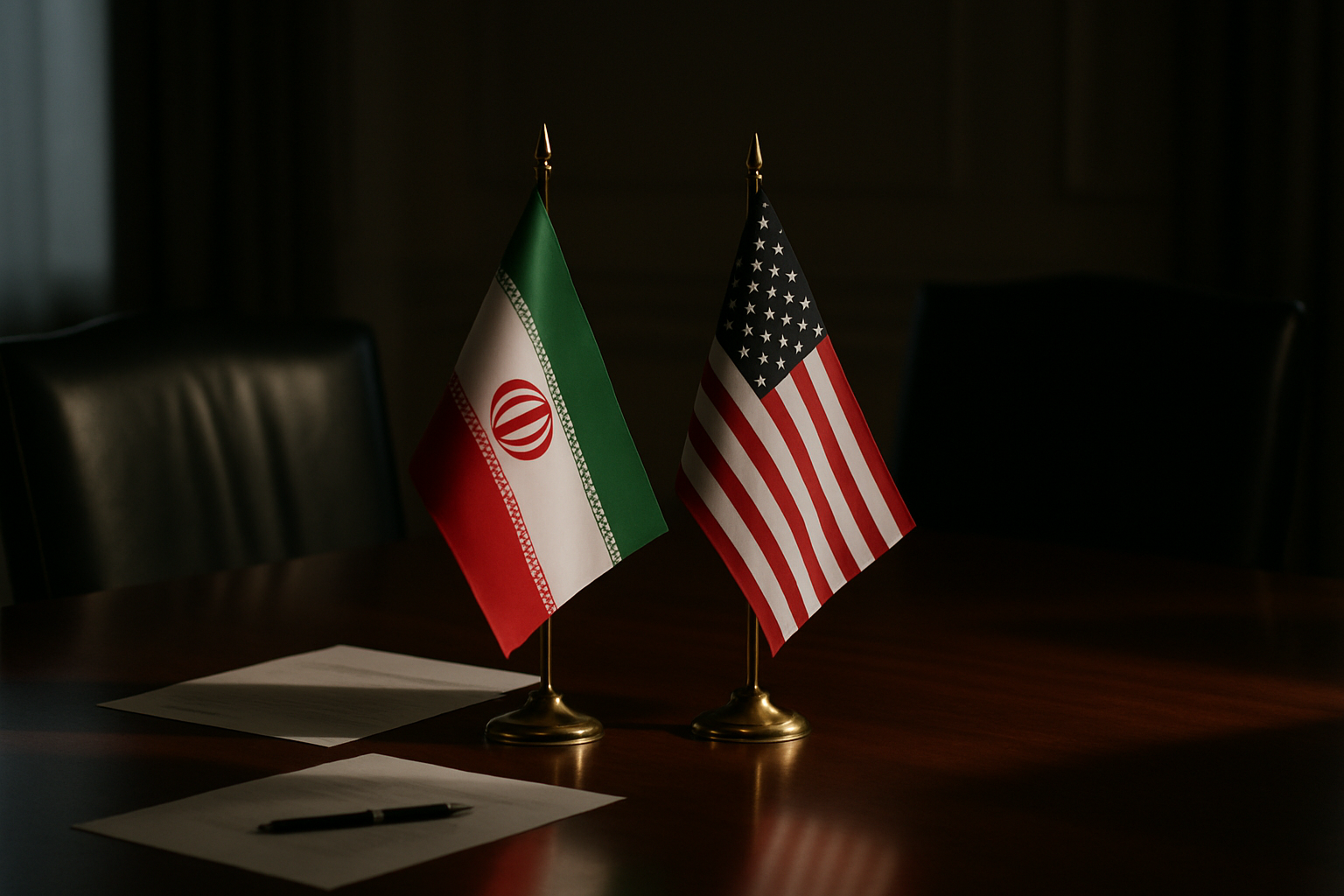
President Donald Trump claimed Wednesday that Iran's president has requested a ceasefire in the ongoing Middle East conflict, but Tehran immediately dismissed the assertion as "false and groundless," highlighting the deepening diplomatic crisis as the war enters its second month.
Trump announced via Truth Social that Iran's president had "just asked the United States of America for a CEASEFIRE!" adding that he would only consider such a request once the Strait of Hormuz is "open, free and clear." The president warned that until then, the U.S. would continue "pulverizing Iran, or as they say, back to the Stone Age!"
Iran Categorically Denies Trump's Claims
Iran's Foreign Ministry swiftly contradicted Trump's statements, with a spokesperson telling Iranian state television that "Trump's statements about Iran asking for a ceasefire are false and groundless." The denial came within hours of Trump's social media post, underscoring the volatile nature of current U.S.-Iran relations.
Norwegian broadcaster NRK reported similar rejections from Iranian officials, with Tehran maintaining that no such ceasefire request has been made to Washington. The conflicting narratives highlight the information warfare aspect of the ongoing crisis, where competing claims complicate efforts to establish factual diplomatic developments.
Market Response and Global Impact
Financial markets reacted positively to Trump's initial claims, with Wall Street opening higher as investors interpreted the statement as a potential de-escalation signal. The Dow Jones Industrial Average gained 0.62% in early trading, reflecting market optimism about possible conflict resolution.
Oil prices, which have been trading above $100 per barrel due to Iran's closure of the Strait of Hormuz, declined modestly following Trump's announcement. Texas oil futures dropped 0.94% as traders responded to the possibility of reduced tensions, though prices remain elevated due to the ongoing blockade of the critical shipping lane that handles 40% of global oil transit.
Strategic Context: The Strait of Hormuz Crisis
The current diplomatic standoff centers on Iran's mining of the Strait of Hormuz with an estimated 2,000-6,000 naval mines, effectively closing the waterway to commercial shipping. This action has stranded over 150 oil tankers worth billions in cargo and created the most severe global energy crisis since the 1970s oil shocks.
"We will consider it when the Strait of Hormuz is open, free and clear. Until then, we are pulverizing Iran, or as they say, back to the Stone Age!"
— President Donald Trump, Truth Social
The U.S. has demanded the immediate reopening of the strategic waterway, while Iran has maintained that the closure is a defensive measure in response to Operation Epic Fury, the largest U.S.-Israeli military campaign in the Middle East since the 2003 Iraq invasion.
Diplomatic Mediation Efforts Continue
Despite the public denial of ceasefire requests, multiple sources indicate that backdoor diplomatic channels remain active. Pakistan has formally offered to host peace negotiations between the United States and Iran, with Prime Minister Shehbaz Sharif proposing Islamabad as a neutral venue for "meaningful and conclusive talks."
Chinese officials have expressed "full support" for Pakistan's mediation initiative, viewing the crisis as a threat to global economic stability and energy security. Egypt, Turkey, and Qatar are also reportedly facilitating message exchanges between the adversaries, though no direct negotiations have been confirmed.
The Broader Military Context
The diplomatic dispute occurs against the backdrop of the most intensive Middle East conflict since the Cold War's end. Operation Epic Fury has targeted over 11,000 Iranian sites at a cost exceeding $27 billion in its first month, while Iran's retaliatory "Operation True Promise 4" has struck targets across the region.
The war has created unprecedented global disruptions, with over 18,000 flights cancelled worldwide—the most severe aviation crisis since COVID-19. Dubai International Airport remains closed due to missile damage, while eight Middle Eastern countries have closed their airspace simultaneously.
European Involvement Escalates Crisis
The conflict expanded beyond the Middle East when Iranian drones struck RAF Akrotiri in Cyprus—the first attack on European territory since World War II. This unprecedented escalation prompted a European naval coalition response, with British, Spanish, Italian, French, Dutch, and Greek vessels deploying to protect European interests.
Congressional Scrutiny Intensifies
On Capitol Hill, bipartisan lawmakers are demanding comprehensive answers about the administration's Iran strategy, costs, and timeline. Senator Richard Blumenthal expressed being "more concerned than ever" about potential ground troop deployments, while the conflict maintains historically low public support at just 25%.
The Pentagon has prepared operations extending through September 2026, far beyond the initial 4-6 week timeline suggested by administration officials. This has raised questions about exit strategy and long-term military commitment in the region.
Nuclear Dimensions of the Crisis
The current crisis emerged from the complete breakdown of nuclear negotiations despite achieving what Abbas Araghchi described as "broad agreement on guiding principles"—the most significant diplomatic progress since the JCPOA collapse in 2018. However, fundamental scope disagreements proved insurmountable, with Iran excluding ballistic missiles and proxy relationships as "red lines" while the U.S. demanded comprehensive agreements covering all security concerns.
Iran continues uranium enrichment at 60% purity, approaching the 90% threshold required for weapons-grade material. Intelligence assessments indicate Iran possesses over 400 kilograms of highly enriched uranium—sufficient for multiple nuclear weapons if weaponized.
Regional Coalition Under Strain
The unprecedented Saudi Arabia-UAE-Qatar-Egypt consensus supporting diplomatic solutions has come under severe strain as Iranian retaliation has directly targeted coalition member territories. Egypt's President Sisi condemned attacks on "sisterly Arab countries" while warning of "comprehensive chaos" spreading across the region.
The regional coalition's fracturing represents a significant blow to Middle Eastern stability mechanisms that have provided security frameworks for decades. UAE authorities report one civilian killed in Abu Dhabi, while Kuwait suffered 32 injuries from airport strikes and Qatar intercepted 65 missiles and 12 drones using Patriot systems.
Humanitarian Crisis Mounts
The Iran Red Crescent reports over 787 civilian casualties from U.S.-Israeli strikes, including the devastating Minab elementary school attack that killed between 165-185 students and staff. International human rights organizations have called for Geneva Conventions investigations into potential war crimes.
The conflict has triggered the largest international evacuation since the Arab Spring in 2011, with Australia reporting 115,000 nationals trapped in affected areas and Germany evacuating 30,000 stranded tourists. The European Union activated its ESTIA crisis mechanism for the first time in the bloc's history following the Cyprus attack.
Looking Ahead: Template-Setting Crisis
UN Secretary-General António Guterres has described the current situation as "the greatest test of multilateral cooperation in the modern era." The crisis occurs amid broader nuclear governance challenges, with the New START treaty having expired in February 2026—the first time in over 50 years without U.S.-Russia nuclear constraints.
The rapid transition from diplomatic breakthrough to military confrontation demonstrates the fragility of crisis management in the multipolar era. Success in containing the conflict could provide a template for future nuclear crisis resolution, while failure may accelerate military solutions and undermine diplomatic credibility globally.
Economic and Energy Implications
The International Energy Agency has implemented its largest strategic petroleum reserve release in 50 years—400 million barrels from 32 countries—in response to the energy crisis. Natural gas prices have surged 24% in Europe and 78% in the United States, while Qatar has halted LNG production, affecting 20% of global exports.
Major shipping companies including Maersk and MSC have suspended Persian Gulf operations indefinitely, while airlines have implemented emergency fuel surcharges as jet fuel prices jumped from $85-90 per barrel to $150-200. The crisis has exposed fundamental vulnerabilities in global supply chains dependent on Gulf logistics networks.
As diplomatic efforts continue amid conflicting claims about ceasefire requests, the international community faces a template-setting moment for 21st-century conflict resolution. The outcome will likely influence approaches to nuclear proliferation, territorial sovereignty enforcement, and international law credibility for decades to come.
With both sides maintaining hardline positions—Trump demanding Iran's "unconditional surrender" while Tehran rejects any capitulation—the path to diplomatic resolution remains unclear as the most dangerous international crisis since the Cold War's end continues to unfold.