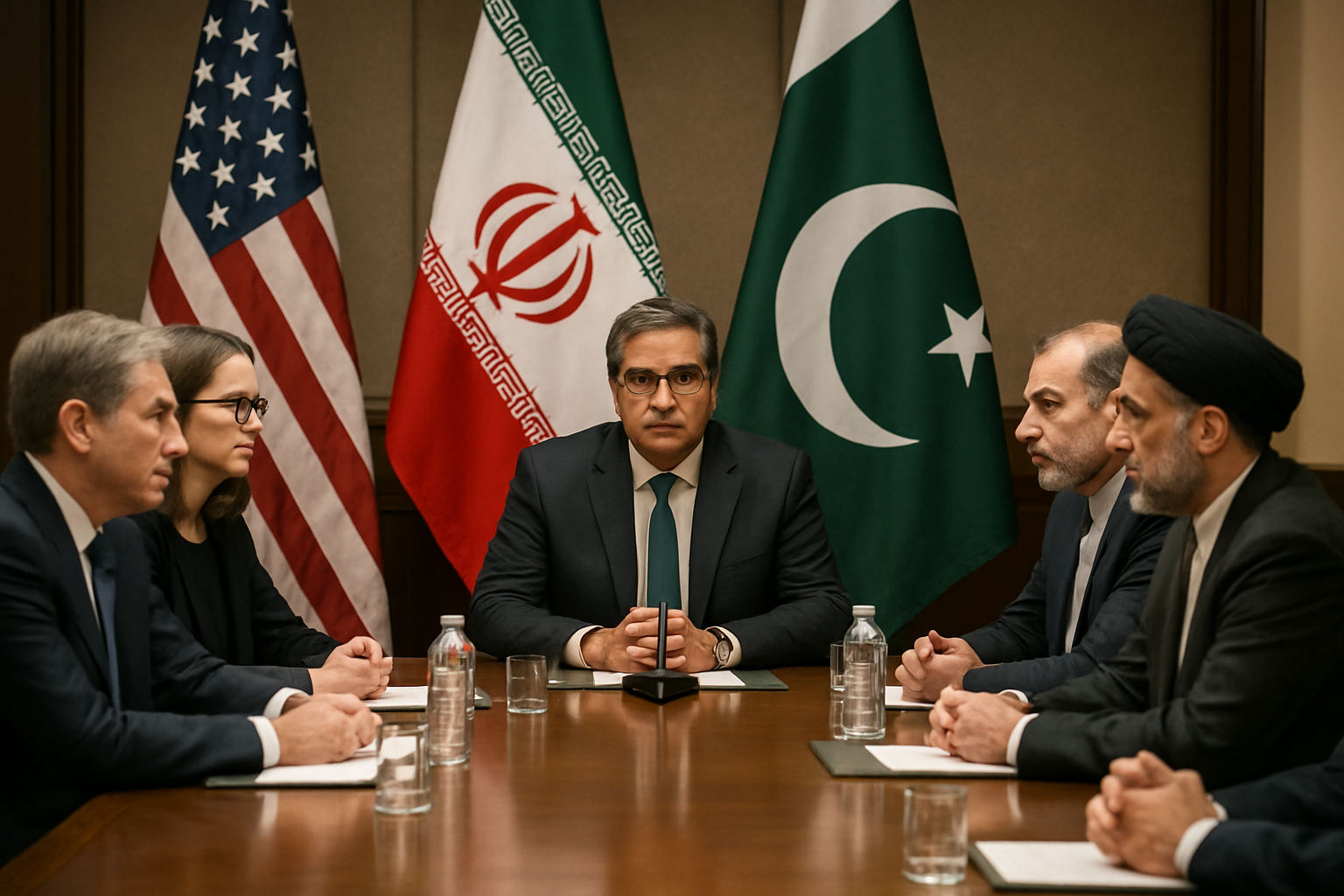
President Trump announced Tuesday evening the indefinite extension of a ceasefire with Iran, responding to requests from Pakistani mediators as Washington and Tehran continue to grapple with fundamental disagreements over nuclear programs and regional conflicts.
The announcement came as diplomatic tensions reached a critical juncture, with Iran claiming to have seized two commercial vessels in the Strait of Hormuz while signaling potential willingness to resume negotiations. Trump stated he had "acceded to a request from Pakistani mediators to maintain the fragile truce as officials grappled with mixed messages from Iran."
Pakistan's Unprecedented Mediation Success
Pakistan has emerged as the crucial diplomatic broker in this historic crisis, with Prime Minister Shehbaz Sharif and Field Marshal Asim Munir successfully mediating the original "Islamabad Accord" framework that prevented global catastrophe in April 2026. Their innovative "message relay system" achieved a breakthrough ceasefire just 88 minutes before Trump's "whole civilization will die tonight" deadline on April 8.
The Pakistani mediation led to oil prices crashing 20% from $119.50 to below $100 per barrel, ending what many considered the most dangerous international crisis since the Cold War. The framework represents the most direct US-Iran engagement in decades, with negotiations addressing Hormuz protocols, sanctions relief, regional conflicts, and security guarantees.
"The president has announced Tuesday evening to extend his ceasefire indefinitely in order to allow discussions with Tehran, without giving a new timeline. Their holding in Pakistan remains uncertain."
— Le Monde reporting on Trump's announcement
Nuclear Program Remains Central Obstacle
The primary sticking point continues to be Iran's nuclear program, with the United States demanding a firm commitment that Iran will not seek nuclear weapons development and suspend its uranium enrichment activities. Iran maintains 60% uranium enrichment levels with over 400kg of weapons-grade material - sufficient for multiple nuclear weapons if weaponized.
Iranian Foreign Minister Abbas Araghchi has previously declared that "Iran will never abandon enrichment even if war is imposed," representing the same decade-old structural obstacle that prevented breakthrough attempts since the 2018 JCPOA collapse.
This crisis unfolds amid the expiration of the New START treaty in February 2026 - the first time in over 50 years without US-Russia nuclear constraints - adding urgent precedent-setting implications to any agreement.
Lebanon Crisis Creates Critical Loophole
A critical complication emerged when Israeli Prime Minister Netanyahu explicitly excluded Lebanon from the Pakistan-mediated ceasefire, creating what diplomats describe as an "unbridgeable gap." Israeli strikes killed over 254 people in a single day during previous talks, with 1.2 million Lebanese displaced and 26 paramedics killed in systematic targeting of medical facilities.
Iran has repeatedly threatened withdrawal from negotiations unless comprehensive enforcement covers all fronts. Vice President JD Vance acknowledged Iran's "legitimate misunderstanding" about Lebanon's inclusion, but the US never agreed to include Israeli-Hezbollah operations in the ceasefire scope.
Economic and Energy Implications
The ongoing crisis affects 40% of global oil transit through the 21-mile Strait of Hormuz chokepoint. Iran has implemented a cryptocurrency payment system requiring $1 per barrel for oil tankers, while major shipping companies like Maersk and MSC have suspended operations, leaving over 150 tankers stranded with billions in cargo.

The International Energy Agency maintains its record 400 million barrel strategic release - the largest in 50-year history - as consumer relief measures remain uncertain. Bangladesh continues reviewing fuel rationing for 170 million people, while Pakistan considers reversing wartime austerity measures.
International Coalition Under Strain
The regional coalition of Saudi Arabia, UAE, Qatar, and Egypt has maintained unprecedented consensus despite Iranian attacks during the crisis. The UAE suffered one fatality in Abu Dhabi, Kuwait had 32 injured at airports, and Qatar sustained 8 wounded while intercepting missiles and drones during Iran's "Operation True Promise 4" retaliation.
Egyptian President Abdel Fattah el-Sisi's warnings about "comprehensive chaos" affecting "sisterly countries" remain relevant as diplomatic challenges mount. However, the coalition has preserved its support for the diplomatic process throughout the maximum strain period.
US Domestic and International Pressures
Congressional opposition to military operations has reached historic levels, with only 25% American support for "Operation Epic Fury" - described as "unprecedented" unpopularity for early-stage operations. The first week alone cost $11.3 billion, with Pentagon operations projected through September far beyond initial 4-6 week projections.
NATO allies have largely rejected escalation, with UK Prime Minister Keir Starmer declaring Britain "will not be dragged into Iran war," while France and Germany emphasize diplomatic approaches. Only Israel has offered full US support, highlighting international divisions over military solutions.
Potential for Renewed Negotiations
Despite the tensions, multiple sources indicate ongoing back-channel communications through Pakistan, Qatar, and Gulf intermediaries. Recent reports suggest Vice President Vance may travel to Pakistan for renewed talks, though Iranian participation remains uncertain.
The framework remains the most comprehensive US-Iran proposal since the 2015 nuclear deal, addressing regional conflicts beyond nuclear issues. China has provided "full support" for Pakistan's initiative, while Germany noted "positive signs" for direct diplomatic engagement.
Template-Setting Implications
UN Secretary-General António Guterres has described this as the "greatest test of multilateral cooperation in the modern era." The crisis affects not only bilateral US-Iran relations but establishes precedents for 21st-century conflict resolution, determining whether diplomatic innovation can triumph over military confrontation.
Pakistan's emergence as a crucial mediator demonstrates middle power capability to bridge major adversaries when traditional mechanisms fail. The success or failure of this mediation will have template-setting implications for global governance mechanisms, energy security architecture, and nuclear governance credibility for decades.
Critical Juncture Ahead
The indefinite ceasefire extension represents a high-stakes diplomatic gamble. While Trump characterizes the Iranian government as "seriously fractured" requiring a unified response, Iran maintains its sovereign decision-making processes while categorically rejecting negotiations under what it considers the duress of ongoing US naval blockade.
Coming days will determine whether this Pakistani diplomatic innovation can bridge the fundamental disagreements that have prevented US-Iran breakthroughs for decades, or whether the world returns to what experts describe as the most dangerous crisis since the Cold War's end.
The stakes extend far beyond the Middle East, affecting territorial sovereignty enforcement, energy security paradigms, nuclear governance credibility, and international law enforcement mechanisms with implications that could reshape global governance for decades to come.