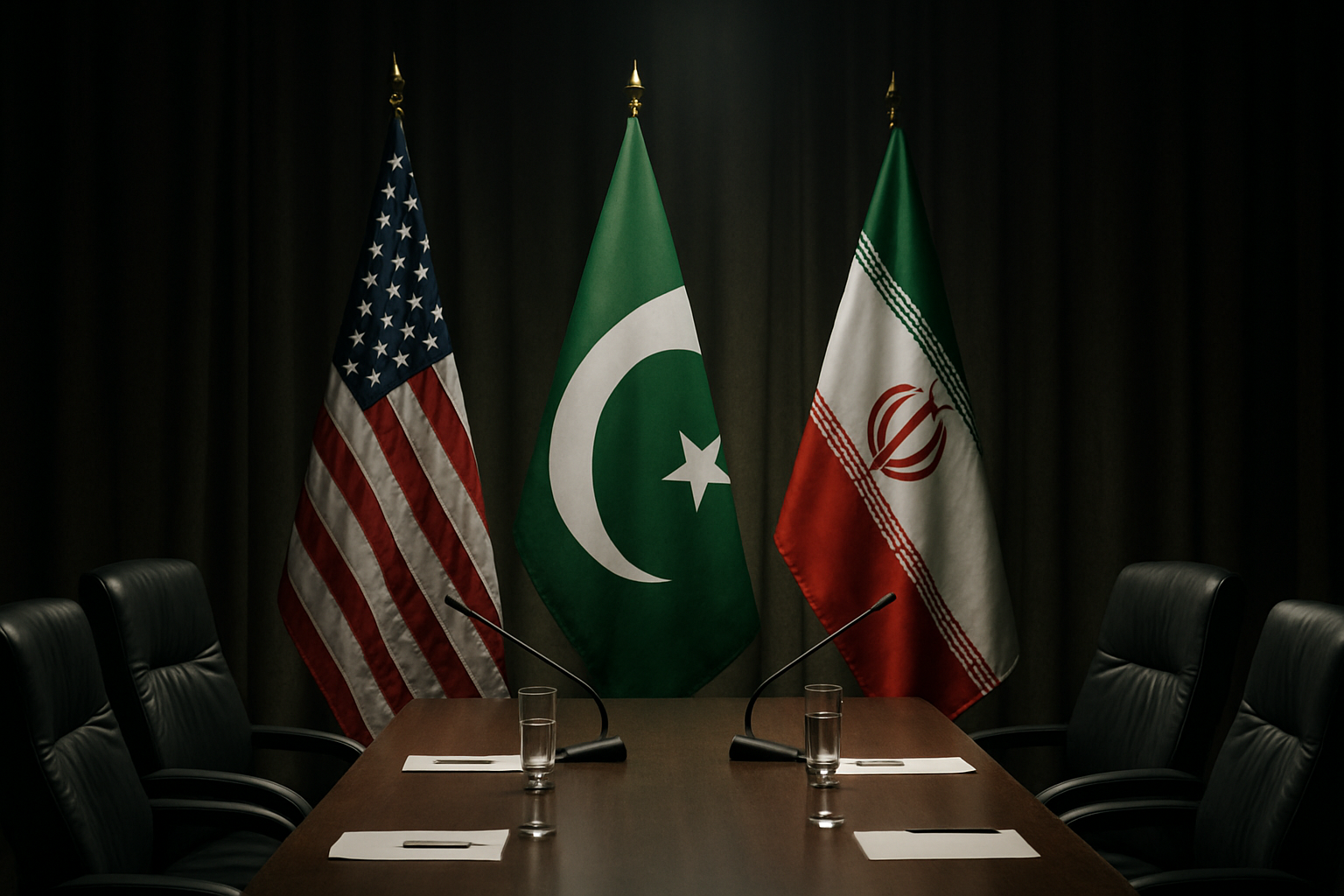
President Donald Trump indicated Thursday he may travel to Pakistan to sign a nuclear agreement with Iran, expressing renewed optimism about diplomatic progress following months of tensions that brought the world to the brink of catastrophic war.
Speaking to reporters on the White House lawn, Trump struck an upbeat tone about negotiations with Iran, suggesting that weekend talks could begin and that Tehran has agreed to "almost everything" in preliminary discussions. "If a deal is signed in Islamabad I may go," Trump said, adding "They want me."
Pakistan's Historic Mediation Success
The comments build on Pakistan's unprecedented diplomatic breakthrough achieved in April 2026, when Prime Minister Shehbaz Sharif and Field Marshal Asim Munir successfully mediated the "Islamabad Accord" - preventing global catastrophe just 88 minutes before Trump's "whole civilization will die tonight" deadline.
Pakistan's innovative "message relay system" had maintained round-the-clock contact between Vice President JD Vance and Iranian officials when direct US-Iran communication was impossible. The breakthrough ceasefire caused oil prices to crash 20% from $119.50 to below $100 per barrel Brent crude - the steepest decline in six years.
"Pakistan's emergence as a crucial mediator demonstrates diplomatic innovation effectiveness in the most dangerous circumstances"
— UN Secretary-General António Guterres
Nuclear Breakthrough Claims
Trump's latest remarks represent the most optimistic US assessment since Pakistan-mediated negotiations began. The President claimed Iran has agreed to "give us back the nuclear material," referring to the country's stockpile of over 400kg of uranium enriched to 60% purity - approaching the 90% weapons-grade threshold.
Multiple international sources confirm Iran has signaled willingness to surrender uranium stockpiles and make substantial nuclear concessions. Danish reports indicate Iran "agreed to hand over nearly everything," while German sources suggest a comprehensive peace agreement could be reached "very soon."
Iranian President Masoud Pezeshkian, who confirmed participation in previous talks following a "warm cordial" call with PM Sharif, appears to be taking a more flexible position than his predecessors on uranium enrichment - previously considered an "inalienable right" by Tehran.
Regional Coalition Support
An unprecedented regional consensus has emerged supporting diplomatic solutions, with Saudi Arabia, UAE, Qatar, and Egypt backing the negotiation process. This extraordinary Middle Eastern unity reflects the massive economic stakes involved - the Persian Gulf handles 40% of global oil transit, making regional stability crucial for the global economy.
China has provided "full support" for Pakistan's initiative, while Germany has noted "positive signs" for continued diplomatic momentum. The broad international backing represents a significant shift from traditional Middle Eastern dynamics toward multilateral crisis resolution.
Persistent Challenges
Despite the optimism, fundamental disagreements remain unchanged. Iran maintains its ballistic missile program and regional proxy relationships as "red lines" excluded from negotiations, while the US continues to demand comprehensive security arrangements including missiles, armed groups, and human rights considerations.
The Lebanon crisis continues to complicate talks, with Israeli Prime Minister Netanyahu having explicitly excluded Lebanon operations from previous ceasefire arrangements. This "critical loophole" led to the collapse of 21-hour marathon negotiations in April, when Israeli strikes killed 254+ people in a single day during talks.
Global Stakes and Historical Context
The diplomatic efforts take place against a backdrop of unprecedented nuclear governance challenges. The New START treaty expired in February 2026, leaving the world without US-Russia nuclear constraints for the first time in over 50 years. Combined with China's nuclear expansion, success in Iran could provide a crucial template for 21st-century nuclear diplomacy.
The April crisis had demonstrated the world's vulnerability to energy chokepoint warfare, with Iran's closure of the Strait of Hormuz causing the cancellation of 18,000+ flights and forcing the International Energy Agency to release 400 million barrels from strategic reserves - the largest such intervention in 50 years.

Economic and Humanitarian Implications
Success would bring massive economic relief globally. Consumer benefits are anticipated in Bangladesh, where 170 million people face fuel rationing, and in Pakistan, which is considering reversing wartime austerity measures. European households could see significant reductions in energy costs that have surged during regional tensions.
The aviation industry, still recovering from 18,000+ flight cancellations during the April crisis, is planning Middle East route resumptions contingent on a lasting agreement. Major shipping companies have mobilized over 150 stranded tankers worth billions in cargo, awaiting stable passage through critical waterways.
Verification Challenges
Any comprehensive agreement would face unprecedented technical obstacles. Iran's advanced centrifuge technology and sophisticated nuclear infrastructure require monitoring mechanisms exceeding the complexity of the original 2015 Joint Comprehensive Plan of Action (JCPOA).
International Atomic Energy Agency inspections were suspended in November 2025, creating additional verification challenges. However, Iranian signals of openness to renewed monitoring represent a significant policy shift that negotiators view as encouraging for potential agreements.
Domestic Political Pressures
Trump faces competing pressures from Republican hawks demanding comprehensive Iranian concessions and the need for a foreign policy victory. Congressional opposition reached unprecedented levels during April's military confrontation, with only 25% public support for continued operations.
Iran confronts its own domestic challenges, with over 42,000 arrests since 2022 protests and severe economic sanctions. The regime appears to be prioritizing nuclear capabilities over immediate economic relief, but growing internal pressures may be influencing Tehran's negotiating position.
Template for Future Crisis Resolution
Pakistan's mediation success has broader implications beyond the immediate crisis. The innovative "message relay system" demonstrates how middle powers can bridge major adversaries when traditional diplomatic mechanisms fail, providing a potential template for future international disputes.
UN Secretary-General António Guterres has called the situation "the greatest test of multilateral cooperation in the modern era," noting that success could strengthen diplomatic credibility over military solutions in an increasingly volatile world.
Looking Ahead
The coming days will determine whether Trump's optimistic assessment translates into concrete progress or whether fundamental disagreements prove insurmountable. The stakes extend far beyond bilateral US-Iran relations, affecting global energy security, nuclear governance credibility, and international approaches to territorial and security disputes.
If realized, a Trump visit to Islamabad would mark an extraordinary diplomatic achievement - potentially the most significant nuclear agreement since the end of the Cold War. The world came closer to catastrophic conflict than at any time since the Cuban Missile Crisis during April's events, making any successful resolution historically significant.
Pakistan's emergence as a crucial mediator demonstrates that innovative diplomatic solutions remain possible even in the most dangerous circumstances, offering hope for peaceful resolution of seemingly intractable international disputes in the 21st century.