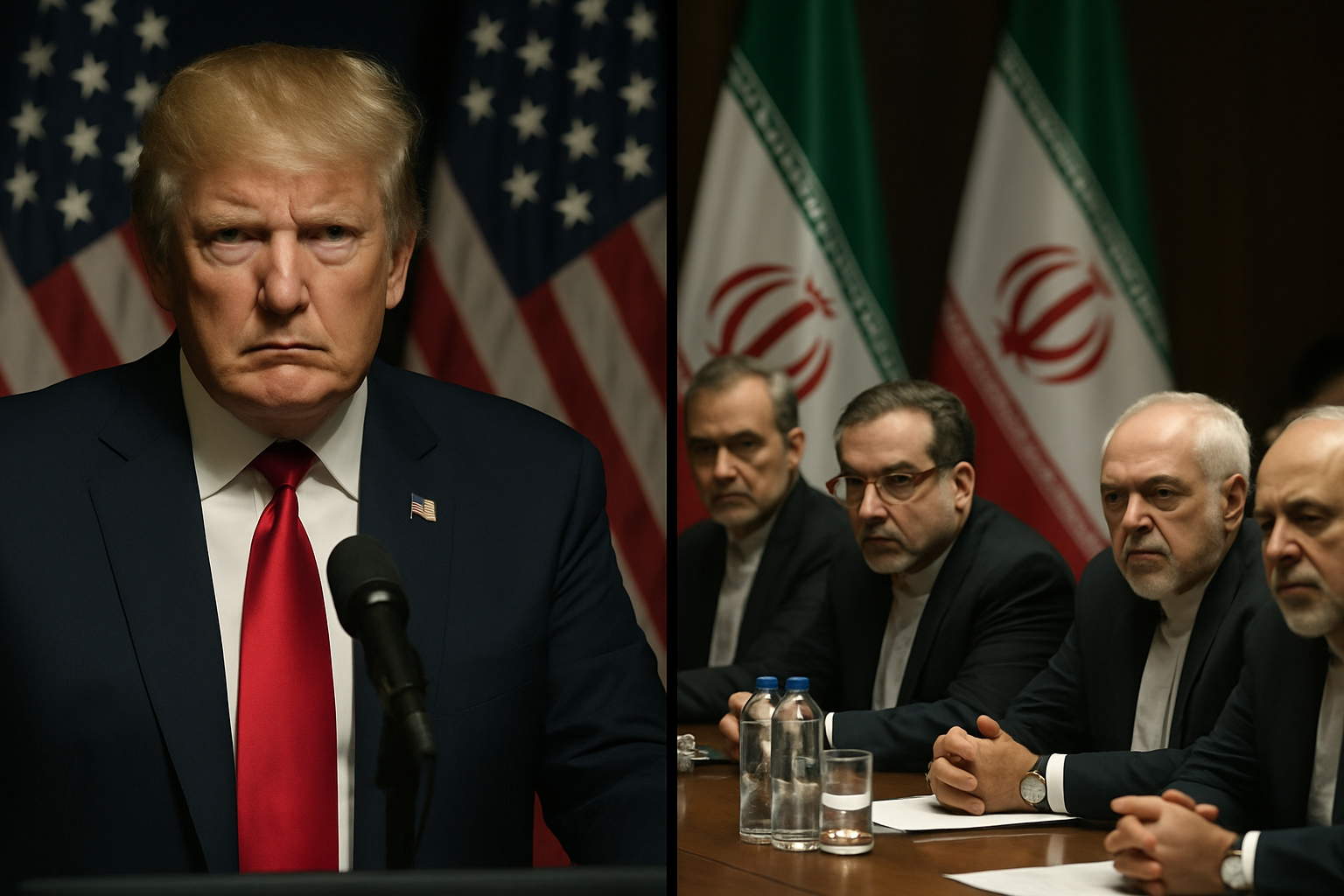
President Donald Trump expressed frustration with Iran's nuclear negotiating stance Friday, declaring he is "not exactly happy" with their approach while maintaining that military options remain available if diplomacy fails.
The President's comments come after three rounds of high-stakes nuclear negotiations in Geneva that achieved what Iranian Foreign Minister Abbas Araghchi described as "broad agreement on guiding principles" - the most significant diplomatic progress since the collapse of the Joint Comprehensive Plan of Action (JCPOA) in 2018.
Speaking to reporters while departing the White House for Texas, Trump stated: "We're not exactly happy with the way they negotiated. They cannot have nuclear weapons, and we're not thrilled with the way they're negotiating." He emphasized that while negotiations continue, "sometimes you have to use force" if diplomatic efforts prove insufficient.
Contrasting Assessments Create Diplomatic Tension
The President's dissatisfaction stands in stark contrast to optimistic reports from Omani Foreign Minister Badr al-Busaidi, who confirmed "significant progress" following Thursday's Geneva talks. The Sultanate of Oman, serving as mediator between Washington and Tehran, reported that technical discussions are scheduled to continue next week at the International Atomic Energy Agency (IAEA) headquarters in Vienna.
This diplomatic dichotomy reflects the fundamental challenges that have plagued US-Iran nuclear negotiations for over a decade. Despite achieving framework agreements in Geneva, core disagreements over the scope and substance of any potential deal remain unresolved.
"Iran agrees not to keep enriched uranium on its territory that could be used to produce a nuclear weapon."
— Omani Foreign Minister Badr al-Busaidi
Critical Nuclear Status and Iranian Position
Iran continues enriching uranium at 60% purity - significantly above the 3.67% limit established by the original JCPOA and approaching the 90% threshold required for weapons-grade material. According to former IAEA inspector Dr. Yusri Abu Shadi, Iran possesses over 400 kilograms of enriched uranium, making nuclear weapons "easily achievable" if Tehran chooses to weaponize its stockpile.
Iranian officials have maintained defiant positions throughout the negotiations. Foreign Minister Araghchi previously declared Iran would "never abandon enrichment even if war is imposed," while simultaneously engaging in what both sides have characterized as constructive dialogue.
However, there are signs of potential Iranian flexibility. President Masoud Pezeshkian recently declared Iran is "open to verification" - representing a significant policy shift from previous hardline stances. Intelligence reports suggest Iran may consider a three-year enrichment halt and transferring existing stockpiles to Russia as confidence-building measures.
Fundamental Scope Disagreement Persists
The central obstacle to breakthrough progress remains a fundamental disagreement over negotiation scope. Iran has established "red lines" excluding ballistic missiles and regional proxy activities from discussions, demanding nuclear-only compartmentalized talks. Tehran's position reflects its view that these issues are sovereign matters beyond international negotiation.
Conversely, US Secretary of State Marco Rubio insists any comprehensive agreement must address Iran's missile capabilities, support for armed groups including Hezbollah and Hamas, and human rights concerns. This integrated threat assessment represents the structural disagreement that has prevented agreements for over a decade since the JCPOA's collapse.
Regional Coalition Supports Diplomacy
Despite these challenges, an unprecedented regional coalition continues backing the diplomatic process. Saudi Arabia, the United Arab Emirates, Qatar, and Egypt have all endorsed negotiations - representing extraordinary Middle Eastern consensus for preventing military confrontation.
This regional support reflects shared concerns over Persian Gulf stability, given that 40% of global oil transit passes through the Strait of Hormuz. Energy security considerations have created massive economic stakes driving regional investment in diplomatic solutions over military escalation.
Unprecedented Military Pressure
Trump's diplomatic engagement occurs against a backdrop of unprecedented military pressure. The deployment of dual aircraft carriers - USS Gerald R. Ford and USS Abraham Lincoln - represents the largest US naval presence in the Middle East since the 2003 Iraq invasion, with approximately one-third of the active Navy fleet positioned 800 kilometers from Iran's coast.
Military tensions have escalated alongside diplomatic efforts. A US F-35C fighter recently shot down an Iranian Shahed-139 drone near the Abraham Lincoln, while Islamic Revolutionary Guard Corps vessels have harassed US tankers in the Strait of Hormuz. These incidents have contributed to oil price increases of over $1 per barrel.
Pentagon officials have confirmed preparation for "potentially weeks-long operations against Iran," with scenarios ranging from targeted nuclear facility strikes to broader Revolutionary Guard infrastructure campaigns. However, Trump has not made a final decision on military authorization, maintaining diplomatic options while demonstrating military readiness.
Israeli Coordination and Security Concerns
Israeli Prime Minister Benjamin Netanyahu's coordination with Trump has established comprehensive Israeli red lines for any agreement. Netanyahu emphasized that "all negotiations must include limiting ballistic missiles and ending support for the Iranian axis," referring to Tehran's support network including Hezbollah, Hamas, and Houthi rebels.
Israel views nuclear-only frameworks as insufficient for addressing existential security threats from Iran's integrated missile and proxy network. This coordination complicates negotiations by expanding US demands beyond nuclear issues to encompass regional security architecture.
Domestic Pressures on Both Sides
Severe domestic pressures affect both negotiating parties. Iran faces over 42,000 arrests since 2022 protests, with Nobel Peace Prize laureate Narges Mohammadi receiving an additional 7.5-year sentence during the current talks. Despite economic sanctions creating regime survival pressure, Tehran appears to prioritize nuclear capabilities over sanctions relief.
Trump administration faces Republican hawk pressure viewing diplomatic engagement as appeasement, while simultaneously seeking foreign policy victories. This dynamic creates complex political calculations affecting negotiation flexibility and public messaging around diplomatic progress.
Global Nuclear Governance Crisis Context
These negotiations occur amid a broader nuclear governance crisis. The New START treaty between the US and Russia expired on February 5, marking the first time in over 50 years without nuclear constraints between the superpowers. China's nuclear expansion and the breakdown of multilateral arms control frameworks create additional urgency for preventing Iranian weapons development.
UN Secretary-General António Guterres has warned that nuclear risks are at their "highest level in decades," emphasizing the global implications of US-Iran negotiations for nuclear non-proliferation norms worldwide.
Economic and Energy Security Implications
The stakes extend far beyond regional security. Maximum pressure sanctions continue through threats of 25% tariffs on Iran-trading countries, while oil market volatility demonstrates economic vulnerabilities. Any closure of the Strait of Hormuz would affect global supply chains with worldwide economic implications extending far beyond the immediate region.
Iran has positioned potential economic cooperation as incentive for agreements, highlighting "trillion-dollar opportunities" in energy and mining sectors for US firms. However, these economic propositions remain contingent on resolving fundamental security disagreements.
Technical Verification Challenges
Even if political breakthroughs occur, implementation would face unprecedented technical challenges. Iran's nuclear infrastructure has expanded significantly since 2018, featuring advanced centrifuge technology, sophisticated facilities, and dispersed capabilities requiring monitoring mechanisms far exceeding original JCPOA complexity.
IAEA inspections have been suspended since November 2025, requiring comprehensive access restoration for any verification regime. The technical obstacles remain substantial even if scope disagreements are resolved through innovative diplomatic solutions.
Vienna Phase: Critical Next Step
Next week's technical discussions at IAEA headquarters in Vienna represent a critical test of whether Geneva framework agreements can translate into substantive monitoring and verification protocols. These talks will address sanctions relief mechanisms, implementation timelines, and the complex technical requirements for overseeing Iran's advanced nuclear capabilities.
The Vienna phase will determine whether the diplomatic momentum achieved in Geneva can overcome decade-old structural obstacles or represents another false start in nuclear crisis resolution efforts.
Global Template-Setting Moment
These negotiations represent a template-setting moment for 21st-century diplomacy versus military confrontation in addressing nuclear proliferation crises. Success could prevent regional war while providing a diplomatic framework for similar international disputes. Failure may accelerate military solutions, reshape Middle Eastern geopolitics for decades, and encourage nuclear proliferation elsewhere while undermining diplomatic credibility for international conflict resolution.
The stakes encompass regional war prevention, global energy security, nuclear governance credibility, Middle East stability architecture evolution, and international law enforcement mechanisms in an increasingly multipolar world order.
As technical teams prepare for Vienna discussions, the world watches whether innovative compromise solutions can bridge longstanding disagreements or whether military confrontation becomes inevitable despite unprecedented regional and international investment in diplomatic resolution.