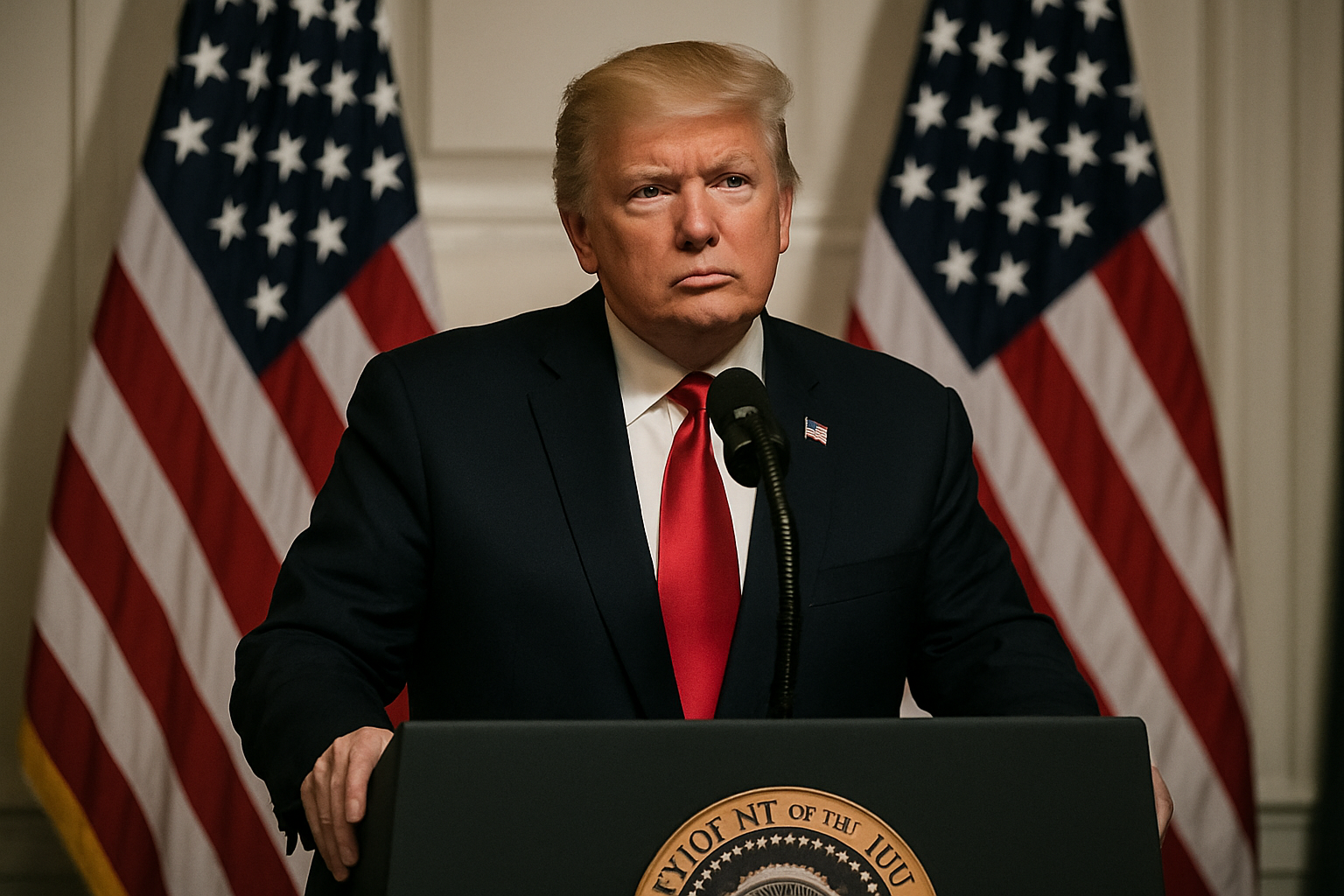
President Trump delivered his strongest rebuke yet to Iran's negotiating tactics Saturday, declaring that Iran "got a little cute" by re-closing the Strait of Hormuz but asserting that the regime "can't blackmail us" into unfavorable terms, even as nuclear talks continue showing promise.
Speaking during a White House briefing amid escalating tensions over the strategic waterway that handles 40% of global oil transit, Trump maintained his characteristically defiant tone while acknowledging that negotiations are proceeding "really well" despite Iran's latest pressure tactics.
The comments come as international mediators work frantically to prevent a full breakdown of diplomatic efforts that began in February with unprecedented breakthrough talks in Geneva, achieving what Iranian Foreign Minister Abbas Araghchi called "broad agreement on guiding principles" - the most significant progress since the 2018 collapse of the Joint Comprehensive Plan of Action (JCPOA).
Iran Escalates Pressure Through Hormuz Blockade
Iran's Supreme National Security Council announced Saturday its decision to maintain control over the Strait of Hormuz "until the war fully ends," effectively keeping the crucial shipping lane closed for the second time in recent weeks. The move represents a significant escalation in Iran's negotiating strategy, using economic leverage to pressure the United States and its allies into more favorable nuclear deal terms.
The closure has already sent shockwaves through global energy markets, with oil prices surging past $119 per barrel before moderating slightly on reports of continued diplomatic progress. The International Energy Agency has activated its largest-ever strategic petroleum reserve release of 400 million barrels to cushion market volatility.
German sources confirm that Iran has deployed an estimated 2,000-6,000 naval mines throughout the narrow 21-mile waterway, effectively blocking commercial shipping and stranding over 150 tankers worth billions in cargo. Major shipping companies including Maersk and MSC have suspended Persian Gulf operations indefinitely.
Nuclear Diplomacy Enters Critical Phase
Despite the military posturing, diplomatic channels remain active with multiple sources indicating potential breakthrough meetings could occur as early as this weekend. According to Russian media reports citing Pakistani diplomatic sources, formal Iran-US talks may take place in Islamabad on April 26, building on Pakistan's successful mediation efforts that helped prevent all-out conflict earlier this month.
The nuclear crisis stems from Iran's continued uranium enrichment at 60% purity - far exceeding the 3.67% limit established under the original JCPOA and approaching the 90% threshold needed for weapons-grade material. International inspectors confirm Iran possesses over 400 kilograms of enriched uranium, sufficient for multiple nuclear weapons if weaponized.
"Iran is positioning itself for maximum leverage, but they're also showing flexibility on verification mechanisms that could form the basis of a new agreement."
— Senior Western Diplomat, speaking anonymously
Egypt's Foreign Minister has indicated that Cairo and Islamabad are "working hard on a final agreement" between Iran and the United States, suggesting intensive behind-the-scenes diplomacy continues despite public tensions.
Regional Coalition Maintains Diplomatic Support
One of the most remarkable aspects of the current crisis has been the unprecedented unity among Middle Eastern powers in supporting diplomatic solutions. Saudi Arabia, the United Arab Emirates, Qatar, and Egypt have maintained a coordinated stance backing negotiated settlement, representing extraordinary consensus in a region typically divided by sectarian and geopolitical rivalries.
This regional coalition has proven crucial in preventing military escalation, with Gulf states offering alternative shipping routes and energy supplies while maintaining pressure on all parties to pursue negotiated solutions. The Persian Gulf monarchies have particularly strong incentives to resolve the crisis peacefully, given their dependence on maritime trade routes and energy exports.
Israel has emerged as a key factor in shaping any potential agreement, with Prime Minister Netanyahu conducting multiple meetings with Trump to emphasize comprehensive security requirements. Israeli officials maintain that any nuclear deal must include "limiting ballistic missiles and ending Iranian axis support" for proxy groups including Hezbollah, Hamas, and the Houthis.
Fundamental Obstacles Persist
Despite diplomatic momentum, fundamental disagreements continue to complicate negotiations. Iran maintains that ballistic missiles and regional proxy relationships are "red lines" that must be excluded from nuclear-focused talks, insisting on compartmentalized negotiations addressing only atomic issues.
The Trump administration, supported by Secretary of State Marco Rubio, demands comprehensive agreements addressing what it views as an integrated threat matrix including missiles, armed groups, and human rights concerns. This scope disagreement has proven the primary obstacle preventing breakthrough agreements for over a decade since the original JCPOA negotiations.
Iranian negotiators led by Araghchi have maintained that the country will "never abandon uranium enrichment even if war is imposed," while simultaneously signaling openness to enhanced verification measures and potential temporary restrictions on enrichment activities.
Global Energy Security at Stake
The economic implications of the crisis extend far beyond the Middle East, affecting global supply chains, consumer prices, and energy security from Europe to Asia. The Strait of Hormuz closure has triggered the most severe energy disruption since the 1970s oil shocks, with ripple effects across multiple industries.
Aviation has been particularly hard hit, with over 18,000 flights cancelled at COVID-19 scale disruption levels. Dubai International Airport remains shuttered indefinitely due to regional tensions, while eight Middle Eastern countries have closed airspace creating severe disruptions to Asia-Europe travel corridors.
Consumer impacts are already visible globally, with Bangladesh reviewing fuel rationing for 170 million people, Pakistan implementing wartime austerity measures including four-day work weeks, and European households facing potential energy cost increases as natural gas prices surge 24% in Europe and 78% in the United States.
Military Tensions Continue
The diplomatic efforts proceed against a backdrop of significant military tensions, with the United States maintaining an unprecedented dual-carrier deployment in the region. The USS Gerald R. Ford and USS Abraham Lincoln represent the largest American naval presence in the Middle East since the 2003 Iraq invasion, positioned approximately 800 kilometers from Iran's coast.
Recent incidents include U.S. F-35C fighter jets shooting down Iranian Shahed-139 drones that approached American vessels, while Islamic Revolutionary Guard Corps forces have harassed commercial tankers attempting to transit Hormuz waters. These incidents demonstrate the hair-trigger environment in which diplomats are attempting to craft sustainable agreements.
Operation Epic Fury, the U.S. military response to the crisis, has cost an estimated $11.3 billion in its first week alone, making it the most expensive Middle East operation since the Iraq invasion. Congressional opposition has reached historic levels, with only 25% public support representing "almost unprecedented" unpopularity for early-stage military operations.
Nuclear Governance Crisis Context
The Iran nuclear standoff occurs within a broader crisis of global nuclear governance following the February 2026 expiration of the New START treaty between the United States and Russia - the first time in over 50 years without bilateral nuclear constraints between the superpowers. China's nuclear expansion and broader arms control breakdown has created urgency for preventing Iranian weapons development.
UN Secretary-General Antonio Guterres has characterized the current period as representing nuclear risks at their "highest level in decades," making the Iran negotiations a crucial test case for 21st-century nuclear crisis resolution. Success could provide a template for managing proliferation challenges, while failure might encourage military solutions and undermine diplomatic credibility globally.
Pakistan's Mediation Role
Pakistan has emerged as a crucial mediator in the crisis, with Prime Minister Shehbaz Sharif and Field Marshal Asim Munir developing innovative "message relay systems" to facilitate communication between Washington and Tehran when direct channels become strained. This middle-power diplomacy has proven essential in preventing complete breakdown of negotiations.
The potential April 26 Islamabad talks would represent the most direct U.S.-Iran diplomatic engagement in decades, possibly including Vice President JD Vance and other senior American officials. Iran's 10-point proposal reportedly addresses Hormuz protocols, sanctions relief, regional conflicts, and security guarantees in the most comprehensive framework presented since negotiations began.
Economic Incentives and Sanctions
Iran has positioned potential agreement benefits as "trillion-dollar opportunities" in energy and mining sectors, while the United States continues maximum pressure campaigns including 25% tariffs on Iran-trading countries. This dual-track approach of incentives and coercion reflects the complex dynamics of economic statecraft in modern nuclear negotiations.
The broader economic implications include supply chain disruptions affecting automotive, electronics, and textiles manufacturing dependent on Persian Gulf trade routes. The crisis has exposed dangerous over-dependence on strategic chokepoints, requiring fundamental restructuring to reduce geopolitical vulnerability in global logistics networks.
Looking Ahead: Critical Decisions
The coming weeks represent a decisive phase for determining whether innovative diplomatic solutions can bridge decade-old challenges or whether military confrontation becomes inevitable. Stakes encompass regional war prevention, global energy security, nuclear governance credibility, and 21st-century conflict resolution precedents extending far beyond the immediate crisis.
Trump's assertion that Iran "can't blackmail us" reflects determination to resist economic pressure while maintaining negotiating flexibility. However, Iran's Supreme National Security Council has characterized current positions as achieving a "historic victory" by forcing American engagement on more favorable terms, suggesting both sides see advantages in current dynamics.
Success in resolving the crisis could provide a template for nuclear crisis management in an era of great power competition and proliferation challenges. Failure might accelerate military solutions, encourage nuclear proliferation elsewhere, and undermine diplomatic credibility for territorial and security disputes worldwide.
As intensive diplomatic efforts continue behind closed doors, the world watches to see whether the most dangerous international crisis since the Cold War's end can be resolved through negotiation, or whether it will reshape global security architecture through military confrontation with implications lasting decades beyond current events.