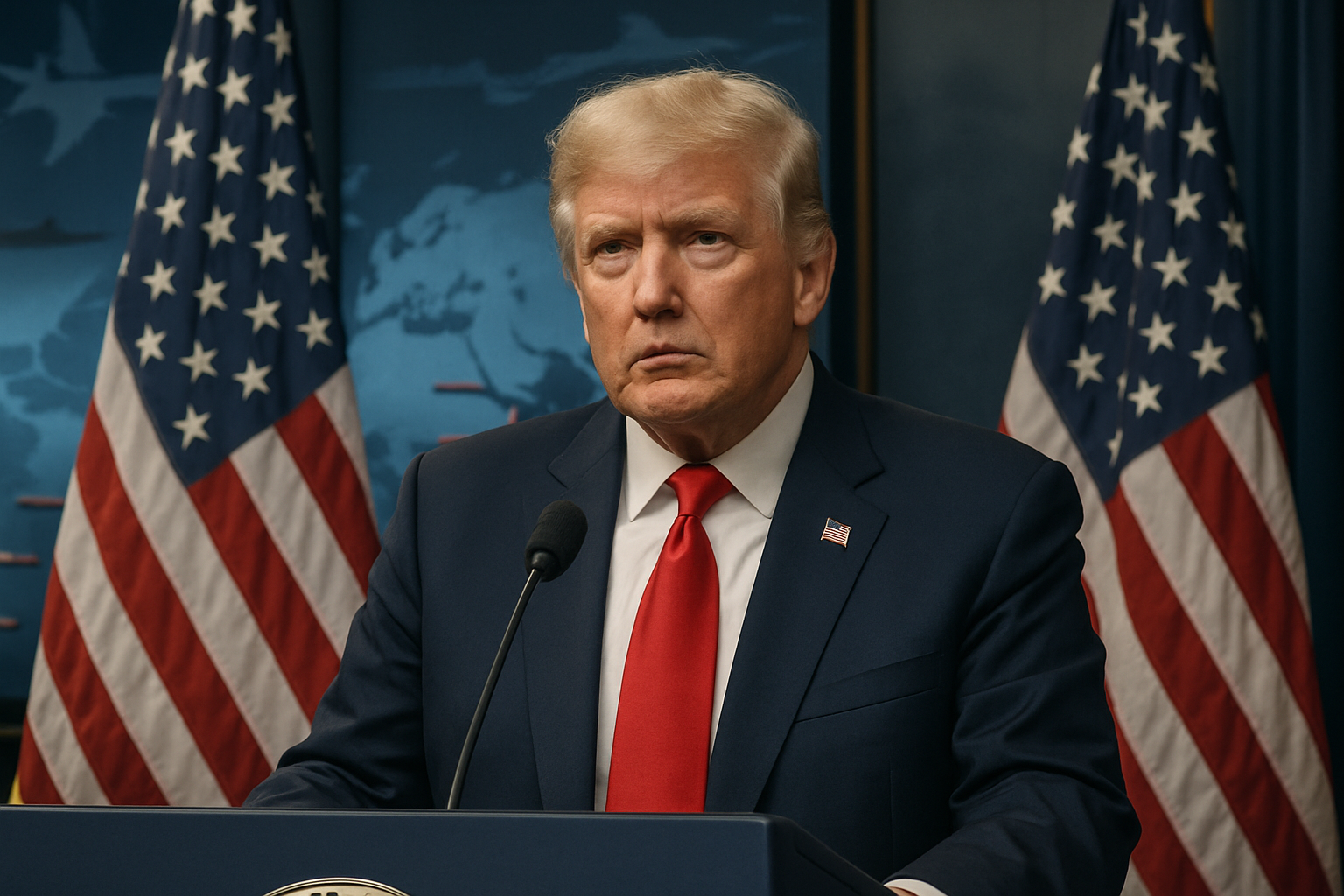
President Donald Trump revealed Thursday that Iran's mysterious "gift" to the United States consisted of allowing ten oil tankers to pass through the Strait of Hormuz, marking a potential diplomatic breakthrough as peace negotiations continue through Pakistani intermediaries despite nearly a month of devastating warfare.
The revelation came during a White House cabinet meeting where Trump disclosed details of what he had previously described only as Iran delivering "a very big present" to demonstrate good faith in ongoing peace discussions. According to the president, Iranian negotiators promised to allow eight oil tankers through the strategic waterway under Pakistani flags, with an additional two vessels subsequently permitted passage.
Pakistan Confirms Mediation Role in 15-Point Peace Framework
Pakistan's Foreign Ministry officially confirmed for the first time that Islamabad is facilitating indirect talks between Washington and Tehran, with the United States having transmitted a comprehensive 15-point peace proposal that Iran is currently deliberating. Foreign Minister Ishaq Dar stated that "US-Iran indirect talks are taking place through messages being relayed by Pakistan," while noting that "Turkey, Egypt and other countries are also extending support to this initiative."
The confirmation represents a significant diplomatic development in what UN Secretary-General António Guterres has called "the most dangerous international crisis since the Cold War ended." The Pakistani mediation comes as the conflict has created unprecedented global disruption, with over 18,000 flights cancelled worldwide, oil prices surging past $100 per barrel, and the Strait of Hormuz effectively closed to normal commercial shipping.
Iranian Counter-Conditions Challenge U.S. Framework
Despite Trump's optimistic assessment that Iran is "begging" for a deal, Tehran has reportedly responded to the American peace proposal with five stringent conditions of its own. According to diplomatic sources, Iran demands: complete cessation of all military aggression, concrete guarantees preventing future attacks, full war damage reparations from both the United States and Israel, an end to military operations against all resistance groups including Hezbollah and Hamas, and recognition of Iranian sovereignty over the Strait of Hormuz.
Iranian Foreign Minister Abbas Araghchi has characterized the ongoing communication as an "exchange of messages" rather than formal negotiations, describing U.S. overtures as "an admission of defeat." This contradiction with Trump's claims highlights the complex information warfare dynamics surrounding the diplomatic efforts.
Military Operations Continue Despite Diplomatic Overtures
The peace initiatives unfold against the backdrop of "Operation Epic Fury," the largest U.S.-Israeli coordinated military campaign since 2003, which has already cost $27 billion and is running at approximately $1 billion daily. The operation utilizes dual-carrier deployment of the USS Gerald R. Ford and USS Abraham Lincoln, representing roughly one-third of the active U.S. Navy fleet positioned near Iranian waters.
Iran's retaliatory "Operation True Promise 4" has created significant regional casualties, with the Islamic Revolutionary Guard Corps declaring that "no red lines remain." The Iranian response has directly affected neighboring Gulf states, with one civilian killed in Abu Dhabi, 32 injured in Kuwait airport strikes, and eight wounded in Qatar despite successful interception of 65 missiles and 12 drones by Patriot defense systems.
Global Economic and Energy Crisis Intensifies
The conflict has triggered the most severe global energy crisis since the 1970s oil shocks, with Iran's deployment of an estimated 2,000 to 6,000 naval mines effectively closing the 21-mile Strait of Hormuz that handles 40% of global seaborne oil transit. Major shipping companies including Maersk and MSC have suspended all Persian Gulf operations, leaving over 150 oil and LNG tankers stranded with cargo worth billions of dollars.
In response to the crisis, the International Energy Agency authorized the largest strategic petroleum reserve release in its 50-year history, deploying 400 million barrels from 32 member countries. Japan alone is releasing 80 million barrels in its first emergency deployment since the 2011 Fukushima disaster, reflecting the 95% Middle Eastern oil dependence that makes the nation particularly vulnerable to Strait of Hormuz disruptions.
Regional Coalition Under Severe Strain
The unprecedented diplomatic consensus among Saudi Arabia, UAE, Qatar, and Egypt supporting peace efforts faces severe testing as Iranian attacks have directly targeted coalition member territories. Egyptian President Abdel Fattah el-Sisi condemned attacks on "sisterly Arab countries," warning of "comprehensive chaos" if the conflict continues to expand regionally.
The strain on regional relationships represents a significant departure from the initial unity behind diplomatic solutions, with member states now caught between maintaining U.S. alliance commitments and protecting their populations from Iranian retaliation.
Nuclear Dimensions Add Urgency to Crisis
The current military crisis emerged from the complete breakdown of nuclear negotiations despite achieving "broad agreement on guiding principles" in Geneva talks—representing the most progress in U.S.-Iran nuclear diplomacy since the 2018 JCPOA collapse. Iran continues uranium enrichment at 60% purity with over 400 kilograms of weapons-grade material, sufficient for multiple nuclear weapons if weaponized.
The timing coincides with broader nuclear governance challenges, including the February 2026 expiration of the New START treaty between the United States and Russia—the first time in over 50 years that the two nuclear superpowers operate without arms control constraints. UN officials warn that nuclear risks are at their "highest in decades."
Congressional Opposition Mounts
Domestic pressure on the Trump administration continues to intensify, with only 25% of Americans supporting the military operations in what analysts describe as "almost unprecedented" unpopularity for early-stage military action. Senator Richard Blumenthal has expressed being "more concerned than ever" about potential ground troop deployment, while the Pentagon prepares for operations potentially extending through September—far beyond the initial 4-6 week timeline.
The financial markets have served as what one portfolio strategist termed the "ultimate constraint" on prolonged conflict, with stock exchanges worldwide experiencing severe volatility. Pakistan's KSE-100 suffered its largest single-day decline in history, while the postponement of major corporate initiatives like PayPal's $1.1 billion IPO demonstrates the global economic reverberations.
Aviation Industry Faces Unprecedented Disruption
The conflict has created the most extensive global aviation crisis since COVID-19, with eight Middle Eastern countries simultaneously closing their airspace. Dubai International Airport, the world's busiest with 86 million annual passengers, remains completely shut down after sustaining missile damage. Major carriers including Emirates, Air France-KLM, and Wizz Air have suspended operations indefinitely, stranding hundreds of thousands of passengers worldwide.
The crisis has forced a fundamental reconsideration of international aviation route planning, with airlines implementing complex rerouting strategies through Caribbean stopovers for trans-Pacific routes and substantially increased operational costs that are being passed to consumers globally.
Template-Setting Implications for 21st Century Diplomacy
Intelligence analysts and diplomatic observers view the current crisis as potentially "template-setting" for how international conflicts unfold in an interconnected multipolar world. The rapid transition from diplomatic breakthrough to military escalation demonstrates what experts characterize as the "fragility of modern crisis management."
Success in containing the conflict and achieving a negotiated resolution could provide a framework for future nuclear crisis resolution and strengthen diplomatic precedents for territorial disputes. However, failure could accelerate military solutions as preferred approaches to international disagreements, potentially undermining diplomatic credibility for decades and encouraging nuclear proliferation globally.
Looking Ahead: Narrow Window for Diplomatic Resolution
Despite the contradictory claims from both sides about the nature and progress of negotiations, the Pakistani mediation represents what many analysts view as potentially the last major diplomatic opening before further escalation. The Revolutionary Guard maintains that it has "surprises" and "special plans" in preparation, while Trump continues to issue increasingly stark warnings about the consequences of Iranian non-compliance.
The stakes extend far beyond the immediate region, encompassing global energy security, nuclear governance credibility, international law enforcement, and the sustainability of post-World War II order principles. As the conflict enters its fourth week, the coming days may prove decisive in determining whether innovative diplomatic solutions can bridge fundamental disagreements or whether the world faces a prolonged military confrontation with implications extending decades beyond the current crisis.
The revelation of Iran's oil tanker "gift" and ongoing Pakistani mediation efforts offer a glimmer of hope amid what Secretary-General Guterres has termed "the greatest test of multilateral cooperation in the modern era." Whether these diplomatic channels can produce substantive progress remains the critical question facing international leaders as they navigate the most dangerous global crisis since the Cold War's end.