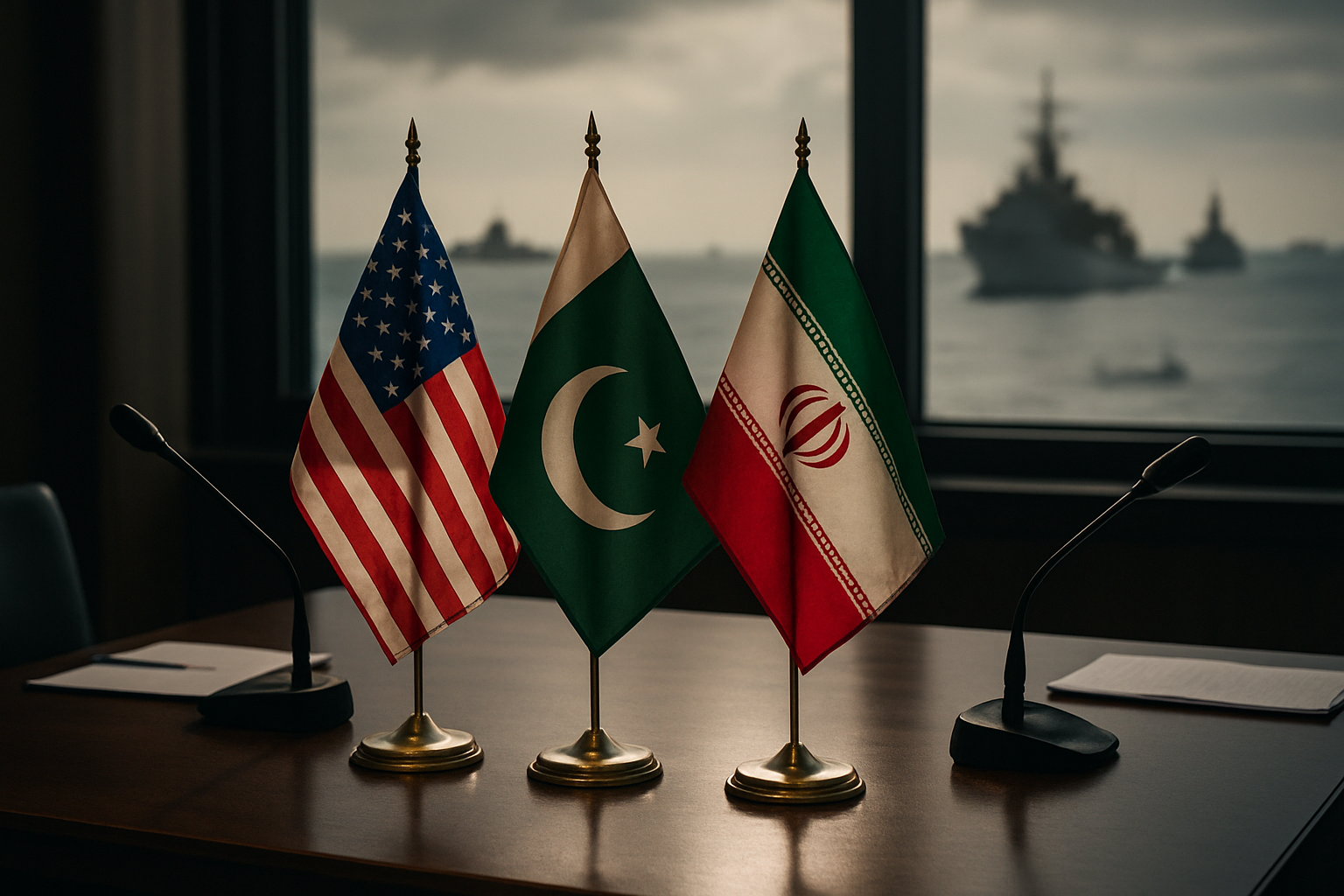
President Donald Trump announced Sunday that US representatives will travel to Islamabad Monday evening for renewed negotiations with Iran while simultaneously claiming American naval forces seized an Iranian cargo ship attempting to breach the ongoing US blockade in the Gulf of Oman.
The dual announcements represent the latest dramatic developments in what has become the most dangerous international crisis since the Cold War, combining diplomatic overtures with military confrontation as the fragile ceasefire mediated by Pakistan earlier this month continues to strain under fundamental disagreements.
Renewed Diplomatic Efforts Through Pakistani Mediation
Trump's Truth Social posts confirmed a US delegation would be "there tomorrow evening for negotiations" with Iran, building on Pakistan's unprecedented mediation success through the "Islamabad Accord" framework that achieved a historic ceasefire just 88 minutes before Trump's "whole civilization will die tonight" deadline on April 8.
The announcement comes as multiple sources report Iranian state media rejecting participation in new talks, citing "excessive demands from Washington, unrealistic expectations, constant shifts in position, contradictions repeated and the ongoing naval blockade" as reasons for Tehran's absence.
"We're offering a very fair and reasonable DEAL, and I hope they take it because, if they don't, the United States is going to knock out every single Power Plant, and every single Bridge, in Iran," Trump warned. "NO MORE MR. NICE GUY!"
— President Donald Trump, Truth Social
The composition of the US delegation remains unclear, with conflicting reports about Vice President JD Vance's participation. While Trump initially suggested Vance would lead the mission, later statements from White House officials and security concerns about arranging the vice president's travel on short notice have created uncertainty about the delegation's leadership.
Naval Confrontation in Gulf of Oman
Simultaneously, Trump claimed US naval forces had taken control of an Iranian cargo ship named "Touska" in the Gulf of Oman, alleging the vessel attempted to breach the American blockade of Iranian ports implemented following the collapse of peace talks on April 12-13.
According to Trump's account, the Iranian crew initially refused to comply with orders to stop, prompting US forces to fire on the vessel before taking it under custody. Multiple international sources confirmed similar incidents, with Norwegian and Swedish media reporting attacks on Iranian vessels attempting to transit the strategic waterway.
Iran's Revolutionary Guard maintains "complete control" over the Strait of Hormuz, threatening a "deadly whirlpool" for any vessels challenging Iranian sovereignty over the waterway that handles 40% of global oil transit.
Pakistan's Crucial Mediation Role
Pakistan Prime Minister Shehbaz Sharif held a 45-minute telephone conversation with Iranian President Masoud Pezeshkian on Sunday, reaffirming Pakistan's commitment to "honest and sincere efforts to advance regional peace and security."
The conversation occurred shortly after Trump's announcement, highlighting Pakistan's continued central role in facilitating communication between the adversaries through what officials describe as a sophisticated "message relay system."
Pakistan's mediation efforts have achieved remarkable success, having previously crashed oil prices by 20% from $119.50 to $100 per barrel when the initial ceasefire was announced. The breakthrough prevented what many analysts consider the closest the world has come to catastrophic conflict since the Cuban Missile Crisis.
The Nuclear Sticking Point
Despite the diplomatic momentum, fundamental disagreements persist over Iran's nuclear program. The previous round of talks collapsed after 21 hours of marathon negotiations led by VP Vance, primarily over US demands that Iran suspend its 60% uranium enrichment program and abandon its stockpile of 400kg+ weapons-grade material.
Iranian Foreign Minister Abbas Araghchi has maintained Iran "will never abandon enrichment even if war is imposed," representing the same structural obstacle that has prevented breakthrough agreements since the 2018 collapse of the Joint Comprehensive Plan of Action (JCPOA).
The nuclear governance crisis has been exacerbated by the expiration of the New START treaty in February 2026, creating the first 50+ year period without US-Russia nuclear constraints and adding urgency to preventing further proliferation.
Regional Coalition Under Strain
The ongoing crisis has tested the unprecedented coalition of Saudi Arabia, UAE, Qatar, and Egypt that has supported diplomatic solutions. These nations faced direct Iranian retaliation during "Operation True Promise 4," with casualties including one killed in Abu Dhabi, 32 injured at Kuwait airports, and eight wounded in Qatar despite Patriot missile intercepts.
Egyptian President Abdel Fattah el-Sisi's warnings about "comprehensive chaos among sisterly countries" have proven increasingly prophetic as diplomatic solutions face mounting challenges.
Energy Security and Economic Implications
The crisis has exposed catastrophic vulnerabilities in global energy architecture, with the 21-mile Strait of Hormuz serving as a critical single-point failure for modern logistics. Major shipping companies including Maersk and MSC have suspended Persian Gulf operations indefinitely, leaving 150+ tankers stranded with billions of dollars in cargo.
Oil prices have surged above $100 per barrel for the second time in 2026, with Brent crude reaching $106.04 and WTI hitting $104.29. The International Energy Agency maintains its record 400 million barrel strategic reserve release—the largest in its 50-year history.
Consumer impacts extend globally, with Bangladesh implementing fuel rationing for 170 million people and Pakistan maintaining wartime austerity measures including four-day work weeks.
International Opposition to US Naval Blockade
The US naval blockade of Iranian ports, widely considered an act of war under international law, has faced significant opposition from traditional allies. UK Prime Minister Keir Starmer declared Britain "will not be dragged into Iran war," while France and Germany have emphasized diplomatic approaches over military solutions.
Australia and Japan have declined to provide naval vessels to support the blockade, representing the most significant rejection of American military leadership since the 2003 Iraq War. Only Israel has offered full support, with Prime Minister Benjamin Netanyahu promising "close coordination" with Washington.
Congressional and Domestic Opposition
The military operations face unprecedented domestic opposition, with public support dropping to just 25%—an historic low for early-stage military operations. Senator Richard Blumenthal has expressed growing concern about potential ground troop deployment, while Operation Epic Fury has already cost $11.3 billion in its first week alone.
Pentagon officials project operations continuing through September, far beyond initial 4-6 week timelines, with financial markets serving as what officials describe as the "ultimate constraint" on prolonged military confrontation.
Lebanon Crisis Complicates Negotiations
A critical complication emerged from Netanyahu's explicit exclusion of Lebanon from the broader ceasefire framework. Israeli strikes killed 254+ people in a single day during the previous talks—the deadliest bombardment since the conflict began—displacing 1.2 million Lebanese (25% of the population).
Iran has threatened withdrawal from any regional talks unless comprehensive enforcement covers all fronts, creating what VP Vance acknowledged as Iran's "legitimate misunderstanding" about the scope of agreements.
Historical and Strategic Implications
UN Secretary-General António Guterres has described the crisis as "the greatest test of multilateral cooperation in the modern era," with implications extending far beyond the immediate US-Iran relationship.
The stakes affect global energy security architecture, nuclear governance credibility, international law enforcement mechanisms, and conflict resolution approaches that will influence international relations for decades.
Pakistan's emergence as a crucial mediator demonstrates the potential for middle-power diplomacy to bridge major adversaries when traditional great power mechanisms fail, providing a template for 21st-century crisis management.
Looking Forward
As the US delegation prepares for what could be the final diplomatic opportunity before further escalation, fundamental disagreements remain over Iran's ballistic missile program, regional proxy relationships, and nuclear capabilities versus US demands for comprehensive disarmament.
The success or failure of the upcoming talks will determine whether innovative diplomatic solutions can bridge decades-old challenges or whether the world returns to the most dangerous international crisis since the Cold War ended.
With oil markets volatile, regional coalitions strained, and nuclear governance mechanisms under unprecedented pressure, the coming days represent a watershed moment for both international diplomacy and global energy security in the multipolar era.