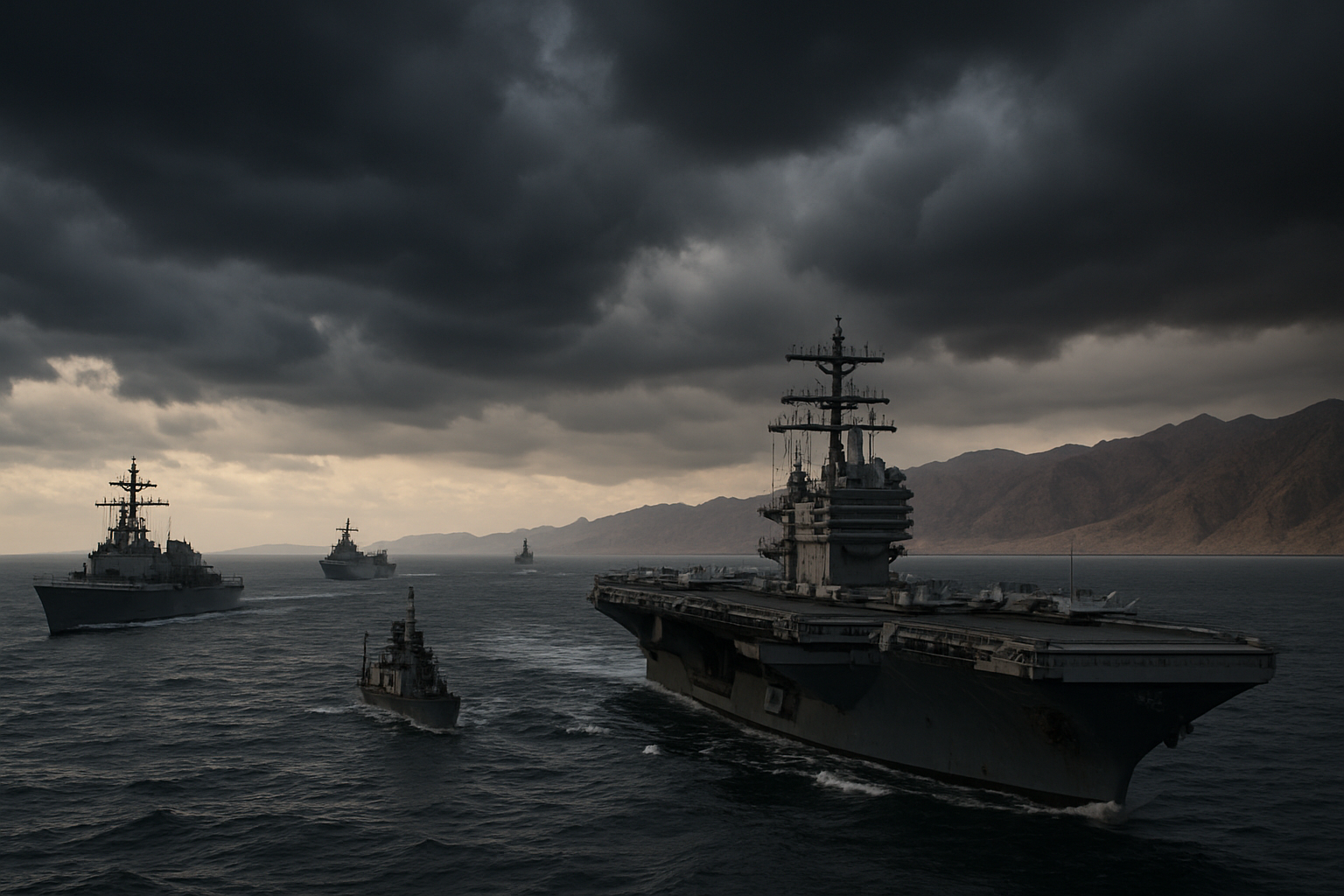
President Donald Trump ordered an immediate US Navy blockade of the Strait of Hormuz affecting all Iranian ports after historic Pakistan-mediated peace talks collapsed following 21 hours of intensive negotiations in Islamabad, marking the failure of the most direct US-Iran diplomatic engagement since the 1979 Islamic Revolution.
The dramatic announcement, delivered via Truth Social on Monday morning, represents a potential act of war under international maritime law and threatens to disrupt 40% of global oil transit through the world's most critical energy chokepoint. Oil prices immediately surged above $100 per barrel for the second time in 2026, with Brent crude hitting $106.04 and WTI reaching $104.29 as markets reacted to the escalating crisis.
Pakistan's Historic Mediation Effort Ends in Failure
Vice President JD Vance announced the breakdown of negotiations at a somber press conference in Islamabad, stating that after "21 hours of substantive discussions, we have not reached an agreement." The talks, mediated by Pakistani Prime Minister Shehbaz Sharif and Field Marshal Asim Munir, had represented the culmination of an unprecedented "Islamabad Accord" framework that had successfully brokered a temporary ceasefire just 88 minutes before Trump's previous "whole civilization will die tonight" deadline on April 8.
The primary sticking point remained Iran's nuclear program, with the United States demanding an affirmative commitment that Iran would not seek nuclear weapons development or rapid production capabilities. Iran maintained its 60% uranium enrichment levels and refused to abandon what officials described as over 400 kilograms of weapons-grade material.
"Iran will never abandon enrichment even if war is imposed upon us."
— Abbas Araghchi, Iranian Foreign Minister
The Lebanon Loophole That Doomed Talks
A critical obstacle emerged when Israeli Prime Minister Benjamin Netanyahu explicitly excluded Lebanon from any ceasefire arrangement, creating what Iranian negotiators called an "unbridgeable gap." Israeli strikes during the talks killed 254 people in a single day - the deadliest bombardment since the conflict began - while 1.2 million Lebanese remained displaced.
Iran had threatened withdrawal from negotiations unless comprehensive enforcement covered all conflict fronts. VP Vance acknowledged Iranian concerns as a "legitimate misunderstanding" but confirmed the United States had never agreed to include Lebanese operations in the ceasefire framework.
Naval Blockade: Act of War
The US Central Command announced the blockade would be "enforced impartially against vessels of all nations entering or departing Iranian ports and coastal areas," taking effect at 3:00 PM GMT Monday. The action is generally considered an act of war under international maritime law.
Iran's Revolutionary Guard immediately responded with threats to create a "deadly whirlpool" for any military vessels attempting to challenge Iranian sovereignty in the Strait. The IRGC declared "complete control" over the waterway and warned that "no port in the Persian Gulf or Arabian Sea will remain secure" if Iranian facilities are threatened.
Global Economic Shockwaves
The collapse of diplomacy triggered immediate market chaos worldwide. The Pakistan Stock Exchange's benchmark KSE-100 index shed 6,600 points in a turbulent session, representing a 3.95% decline as investors fled emerging markets. South Africa's rand weakened 0.8% against the dollar as crude prices pushed back above the psychologically important $100 threshold.
Aviation networks, which had begun recovering from the previous crisis phase that saw 18,000 flight cancellations, now face renewed uncertainty. Dubai International Airport, the world's busiest by international passengers, remains closed due to previous missile damage, while eight countries maintain airspace restrictions across the Middle East.
International Response Fractures
The blockade announcement exposed deep fractures within the international community. British Prime Minister Keir Starmer declared that the United Kingdom would not support the US blockade, emphasizing that Britain "would not be dragged into the Iran war" despite growing pressure from Washington.
France and Germany also distanced themselves from Trump's decision, with European Union officials calling the continued closure of the Strait "extremely harmful" to global commerce. European Commission President Ursula von der Leyen stressed that restoring free navigation was "of paramount importance" for international stability.
"We're not supporting the blockade. We were clear that we will not allow ourselves to be drawn into this war."
— Keir Starmer, British Prime Minister
Meanwhile, Israeli Prime Minister Netanyahu offered full support for Trump's decision, stating his government was in "close coordination" with Washington on the matter and that Iran had "violated the rules" of international conduct.
Energy Security Crisis Deepens
The Strait of Hormuz, a narrow 21-mile waterway between Iran and Oman, serves as the world's most critical energy transit point. Iran's deployment of an estimated 2,000-6,000 naval mines has effectively closed the passage to commercial shipping, stranding over 150 oil and LNG tankers worth billions in cargo.
Major shipping companies including Maersk and MSC have suspended operations in the Persian Gulf indefinitely, unwilling to risk vessels in the volatile security environment. The crisis has forced the International Energy Agency to maintain its record-breaking release of 400 million barrels from strategic petroleum reserves - the largest intervention in the agency's 50-year history.
Consumer impacts are already being felt globally. Bangladesh continues fuel rationing for 170 million people, Pakistan maintains wartime austerity measures, and European households face rising heating costs as natural gas prices surge 24% above pre-crisis levels.
Congressional Opposition Mounts
The failed diplomacy and renewed military escalation face unprecedented opposition in Congress, where only 25% of Americans support continued military operations - historically low approval ratings for any conflict. Senator Richard Blumenthal expressed being "more concerned than ever" about the potential deployment of ground troops.
Pentagon officials acknowledge that operations could extend through September, far beyond initial 4-6 week projections. Operation Epic Fury has already cost $11.3 billion in its first week alone, with daily expenditures exceeding $1 billion as two aircraft carrier strike groups maintain position in the Arabian Sea.
Nuclear Governance Crisis Compounds Tensions
The diplomatic collapse occurs against the backdrop of a broader nuclear governance crisis. The New START treaty between the United States and Russia expired in February 2026, marking the first time in over 50 years that the world's two largest nuclear powers operate without arms control constraints.
Iran continues uranium enrichment at 60% purity levels, approaching the 90% threshold required for weapons-grade material. Former IAEA inspector Dr. Yusri Abu Shadi confirms Iran possesses sufficient enriched uranium to produce multiple nuclear weapons "easily" if the decision were made to weaponize the material.
Humanitarian Toll Escalates
The human cost of the crisis continues mounting, with the Iranian Red Crescent reporting over 787 civilian casualties since the conflict's escalation. The Pentagon has acknowledged responsibility for elementary school strikes that killed between 165-185 students, attributing the attacks to "outdated targeting data" now subject to war crimes investigations.
International evacuations have reached levels not seen since the 2011 Arab Spring, with Australia reporting 115,000 citizens trapped in the region and Germany evacuating 30,000 nationals. Multiple countries have issued "extremely uncertain security" warnings for the entire Persian Gulf region.
Template-Setting Moment for 21st Century Diplomacy
UN Secretary-General António Guterres has described the crisis as the "greatest test of multilateral cooperation in the modern era." The rapid transition from diplomatic breakthrough to military confrontation demonstrates what experts call "multipolar era fragility" in crisis management mechanisms.
Pakistan's innovative "message relay system" had demonstrated that middle powers could successfully bridge major adversary divisions when traditional diplomatic mechanisms fail. The collapse represents a significant blow to confidence in diplomatic solutions during volatile international periods.
Regional Coalition Under Extreme Strain
The unprecedented coalition of Saudi Arabia, UAE, Qatar, and Egypt that had supported the diplomatic process now faces severe testing. Iran's systematic "Operation True Promise 4" attacks on coalition territories during the crisis killed one person in Abu Dhabi, injured 32 in Kuwait airport strikes, and wounded eight Qataris despite Patriot missile defenses intercepting 65 missiles and 12 drones.
Egyptian President Abdel Fattah al-Sisi had warned of "comprehensive chaos" spreading to "sisterly countries" if diplomatic solutions failed - a prophecy that appears increasingly prescient as military options return to prominence.
The Path Forward Uncertain
With the failure of the most direct US-Iran diplomatic engagement in over four decades, the region faces the prospect of returning to the maximum international crisis that had threatened global stability. Trump's naval blockade, widely considered an act of war under international law, sets the stage for potential maritime confrontations that could escalate beyond the Middle East.
The two-week diplomatic window that Pakistan's mediation had created appears to have closed without achieving the lasting peace framework many had hoped would emerge from the historic talks. As oil prices surge and international partners distance themselves from US actions, the world watches to see whether military confrontation or renewed diplomatic innovation will determine the crisis's ultimate resolution.
The stakes extend far beyond the immediate US-Iran dispute, affecting global energy architecture, nuclear governance credibility, and international law enforcement mechanisms in what many experts describe as a template-setting moment for 21st-century conflict resolution approaches worldwide.