President Donald Trump issued Iran a stark 48-hour ultimatum on March 22, 2026, demanding Tehran immediately reopen the Strait of Hormuz to global shipping or face American strikes targeting the country's power infrastructure, including its largest power plants.
The unprecedented threat, posted on Trump's Truth Social platform at 23:44 GMT Saturday, represents the most explicit escalation of the three-week-old conflict between the United States, Israel, and Iran, threatening to expand the scope of military operations to civilian energy infrastructure.
"If Iran doesn't FULLY OPEN, WITHOUT THREAT, the Strait of Hormuz, within 48 HOURS from this exact point in time, the United States of America will hit and obliterate their various POWER PLANTS, STARTING WITH THE BIGGEST ONE FIRST!" Trump declared in the social media post.
Critical Energy Chokepoint Under Siege
The 21-mile Strait of Hormuz has been effectively closed to commercial shipping since Iran began Operation True Promise 4, deploying an estimated 2,000 to 6,000 naval mines throughout the waterway that serves as the conduit for approximately 40 percent of global seaborne oil transit. The closure has triggered the most severe energy crisis since the 1970s oil shocks.
Oil prices have surged past $100 per barrel for the first time since 2022, with Brent crude reaching a peak of $119.50 and West Texas Intermediate hitting $108.15 in an 18.98 percent record single-day jump. Natural gas prices have exploded by 24 percent in Europe and 78 percent in the United States, reaching €47.32 per megawatt-hour, the highest levels since February 2025.
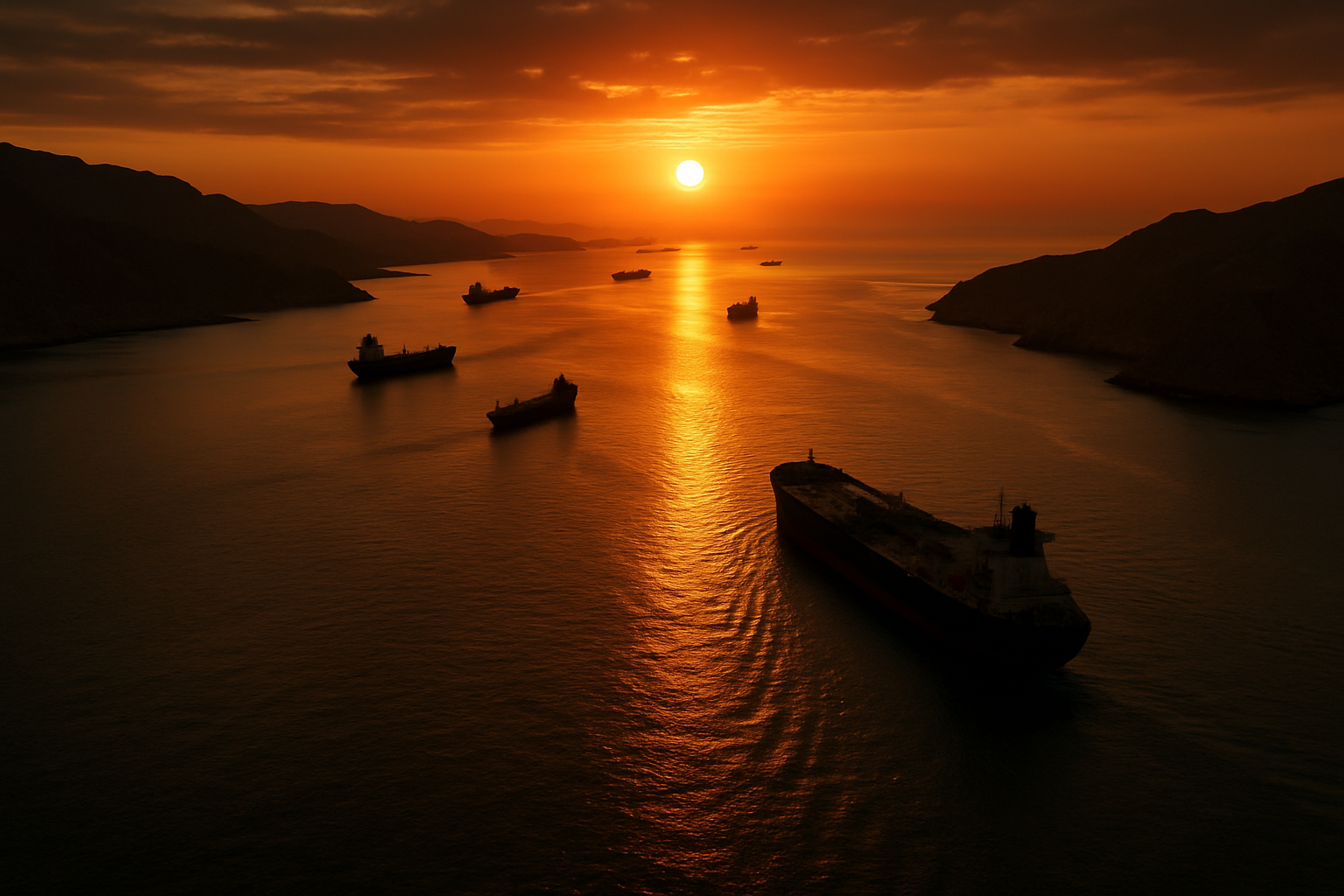
More than 150 oil and liquefied natural gas tankers remain stranded in the Persian Gulf, representing billions of dollars in cargo value. Major shipping companies including Maersk and MSC have suspended operations in the region indefinitely.
Global Aviation Crisis Deepens
The conflict has also created unprecedented disruption to international aviation, with over 18,000 flights cancelled worldwide - the most severe disruption since the COVID-19 pandemic. Eight Middle Eastern countries have simultaneously closed their airspace, including Iran, Iraq, Israel, the UAE, Qatar, Syria, Kuwait, and Bahrain, effectively severing critical Asia-Europe air corridors.
Dubai International Airport, the world's busiest with 86 million passengers annually, remains completely shut down due to missile damage. Major carriers including Emirates, Air France-KLM, and Wizz Air have suspended operations indefinitely, affecting hundreds of thousands of passengers globally.
Operation Epic Fury Costs Mount
Trump's ultimatum comes as the costs of Operation Epic Fury, the largest coordinated U.S.-Israeli military campaign since 2003, continue to escalate. The Pentagon has confirmed first-week costs of $11.3 billion, with daily expenditures of $891.4 million. Operations are now planned to continue through September 2026, far beyond the initial 4-6 week timeline.
The human toll is also mounting, with 150 U.S. troops wounded (eight in critical condition) and three confirmed deaths. The USS Charlotte submarine achieved a historic milestone by sinking the Iranian frigate IRIS Dena near Sri Lanka, marking the first enemy vessel sunk by a U.S. submarine since World War II.
Regional Coalition Under Strain
The Iranian retaliation has severely strained what was previously an unprecedented regional coalition supporting diplomatic resolution. Saudi Arabia, the UAE, Qatar, and Egypt had formed extraordinary Middle Eastern consensus backing negotiations, but Iranian attacks on member territories have fractured this unity.
Egyptian President Abdel Fattah el-Sisi condemned Iranian attacks on "sisterly Arab countries," warning of "comprehensive chaos" spreading across the region. The UAE has suffered one civilian death in Abu Dhabi, Kuwait has experienced 32 injuries from airport strikes, and Qatar has sustained eight wounded despite successful Patriot missile interceptions of 65 missiles and 12 drones.
Nuclear Diplomacy Breakdown
The current crisis stems from the complete breakdown of U.S.-Iran nuclear negotiations, despite achieving what diplomats called a "broad agreement on guiding principles" in Geneva talks - the most significant progress since the 2018 collapse of the Joint Comprehensive Plan of Action (JCPOA).
The fundamental obstacle remained unchanged: Iran excluded ballistic missiles and regional proxies as "red lines," demanding nuclear-only talks, while the United States insisted on a comprehensive agreement addressing missiles, armed groups, and human rights issues.
Iran continues uranium enrichment at 60 percent purity, approaching the 90 percent threshold needed for weapons-grade material. Intelligence assessments confirm Iran possesses over 400 kilograms of enriched uranium, sufficient for multiple nuclear weapons if weaponized.
European Territory Attacked
In a dramatic escalation that expanded the conflict beyond Middle Eastern boundaries, Iranian drones struck RAF Akrotiri in Cyprus - the first attack on European territory since World War II. The assault prompted an unprecedented naval coalition response, with HMS Dragon leading British forces alongside Spanish, Italian, French, Dutch, and Greek vessels.
The European Union activated its ESTIA crisis mechanism for the first time in the bloc's history, coordinating the largest international evacuation since the Arab Spring of 2011. Australia has 115,000 citizens trapped in the region, while Germany is evacuating 30,000 nationals.
Trump's Regime Change Demands
Beyond the immediate ultimatum, President Trump has dramatically expanded American objectives, demanding Iran's "unconditional surrender" and claiming the right to personally choose the next Iranian Supreme Leader. Trump has rejected the succession of Mojtaba Khamenei, son of the late Ali Khamenei who died March 1, calling him a "lightweight."
This represents the most direct assertion of American control over Iranian affairs since the 1979 Islamic Revolution and marks a policy evolution from nuclear-focused negotiations to comprehensive regime change objectives.
"The unconditional surrender is what we want from Iran, and we're going to get it."
— President Donald Trump, Truth Social
Congressional Opposition Mounts
On Capitol Hill, bipartisan opposition to the conflict is intensifying. Senator Richard Blumenthal stated he is "more concerned than ever" about potential ground troop deployment, while the conflict's unpopularity among Americans has reached "almost unprecedented" levels with only 25 percent public support for the military action.
Financial markets have become what Defense officials privately call the "ultimate constraint" on prolonged military action. Pakistan's KSE-100 stock exchange suffered its largest decline in history at -8.97 percent, while South Korea's KOSPI dropped 12 percent, triggering circuit breakers as the Korean won hit a 17-year low.
Nuclear Governance Crisis
The Iran crisis unfolds against the backdrop of a broader nuclear governance crisis. The New START treaty between the United States and Russia expired on February 5, 2026, marking the first time in over 50 years that the world's two largest nuclear powers operate without bilateral constraints. Combined with China's ongoing nuclear expansion, UN Secretary-General António Guterres has warned that nuclear risks are at their "highest in decades."
International Response
Guterres has characterized the current crisis as the "greatest test of multilateral cooperation and crisis management in the modern era." The rapid transition from diplomatic framework to military escalation demonstrates what analysts describe as the fragility of crisis management mechanisms in the multipolar era.
The International Energy Agency has implemented the largest strategic petroleum reserve release in its 50-year history, coordinating the release of 400 million barrels from 32 countries - double the response to the 2022 Ukraine crisis. Japan has released 80 million barrels for the first time since the 2011 Fukushima disaster.
Template-Setting Moment
March 22, 2026, represents what diplomatic historians are already calling a watershed moment in international relations, establishing precedents for 21st-century conflict resolution that will influence global governance mechanisms for decades. The crisis affects regional war prevention, global energy security, nuclear governance credibility, and international law enforcement of post-World War II order principles simultaneously.
Success in containing the crisis could provide a framework for future nuclear dispute resolution, while failure may accelerate military solutions to international conflicts, potentially encouraging nuclear proliferation elsewhere and undermining diplomatic credibility worldwide.
The 48-Hour Countdown
As Trump's ultimatum enters its critical phase, the world watches to see whether Iran will comply with American demands to reopen the Strait of Hormuz or whether the United States will follow through on its threat to target civilian power infrastructure - a move that would represent an unprecedented escalation in the targeting of civilian energy facilities during the conflict.
The outcome of the next 48 hours will likely determine whether this crisis remains a contained regional confrontation or escalates into the most dangerous international conflict since the end of the Cold War, with implications extending far beyond the Middle East to affect global energy architecture, supply chain resilience, and the fundamental approaches to international crisis resolution in the coming decades.