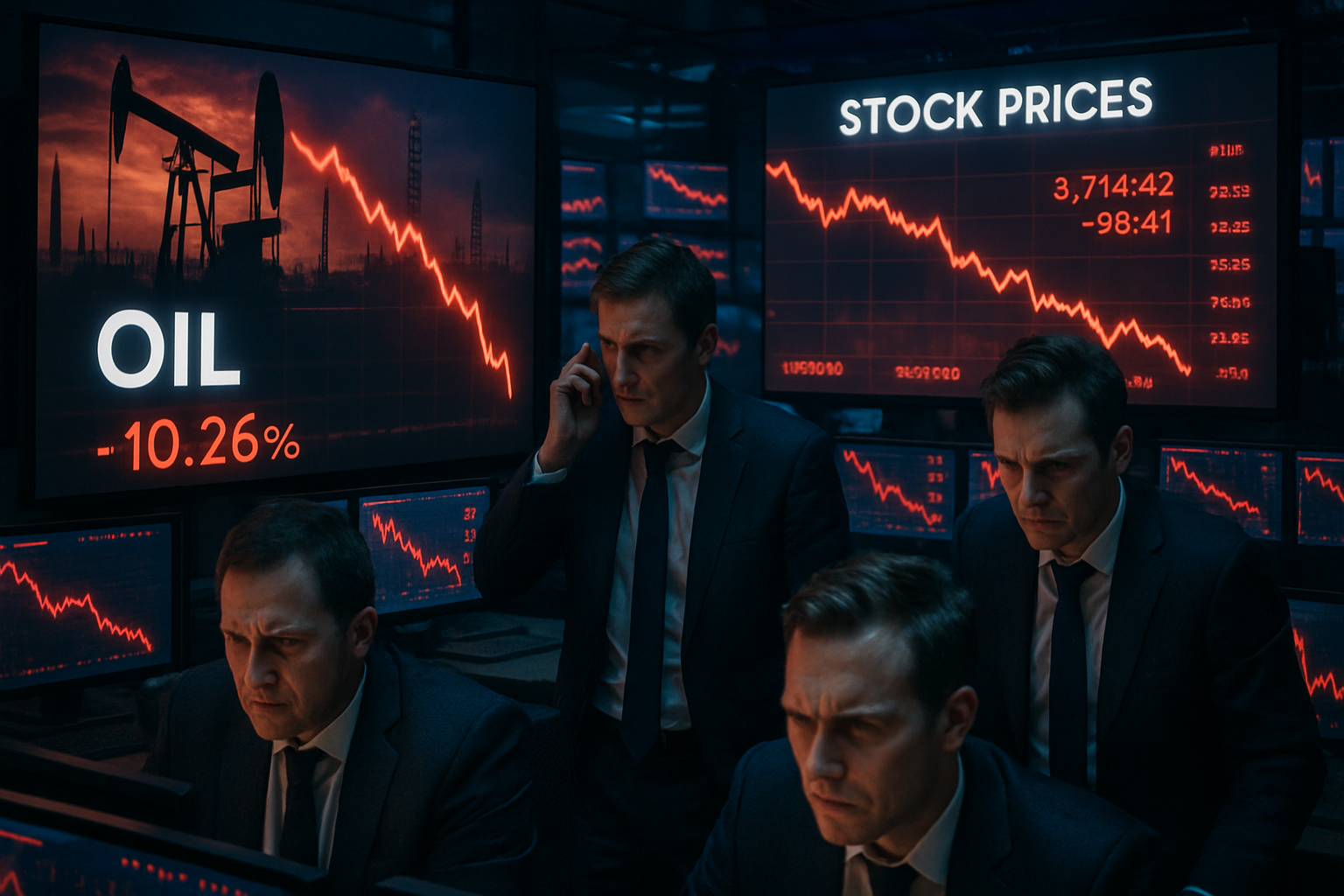
Global energy markets experienced dramatic reversals Monday as President Donald Trump announced a five-day postponement of planned military strikes against Iranian energy infrastructure, triggering oil price drops exceeding 10% and sparking massive stock market rallies worldwide.
The announcement, made amid what Trump described as "constructive dialogue" with Iran, marked a stunning pivot from weeks of military escalation that had driven oil prices above $100 per barrel for the first time since 2022. Brent crude, which had peaked at $119.50 last week, plummeted below $100 within hours of Trump's statement, while European markets that had opened sharply lower reversed course dramatically.
Dramatic Market Reversals
The speed of the market turnaround caught investors off guard globally. Spain's Ibex 35 index, which had fallen 2.5% in early trading, surged to gains of 1% following Trump's announcement. Similar reversals occurred across European markets, with Germany's DAX recovering from early losses to post significant gains.
"The viraje of Trump has been proportional to the markets; of 180 degrees," reported Spanish financial media, noting that oil prices collapsed to trade below $100 per barrel after weeks above that psychologically important threshold.
"Trump has a pain threshold, which is not measured in polls, but in stock markets; in the quotations of the stock exchange, debt and raw materials."
— Spanish Financial Analysis
Portugal's markets reflected the global sentiment, with Brent crude falling more than 9% following Trump's announcement about dialogue with Iran. The dramatic price movements highlighted the extent to which energy markets had been driven by geopolitical tensions rather than fundamental supply and demand factors.
Context of the Crisis
The recent energy crisis had emerged from the complete breakdown of US-Iran nuclear negotiations despite what had been described as "broad agreement on guiding principles" – the most progress since the 2018 JCPOA collapse. The diplomatic failure led to Operation Epic Fury, the largest coordinated US-Israeli military operation since 2003, which prompted Iranian retaliation closing the Strait of Hormuz.
The Strait's closure had blocked 40% of global seaborne oil transit, triggering the most severe energy crisis since the 1970s oil shocks. Natural gas prices had exploded 24% in Europe and 78% in the US, while over 18,000 flights were cancelled worldwide as eight Middle Eastern countries simultaneously closed their airspace.
Financial markets had crashed globally, with Pakistan's KSE-100 suffering its largest single-day decline in history (-8.97%) and South Korea's KOSPI falling 12% before circuit breakers were activated. The Korean won hit a 17-year low as investors fled risk assets.
Energy Market Response
The International Energy Agency had announced the largest strategic petroleum reserve release in its 50-year history – 400 million barrels from 32 countries – in an attempt to stabilize markets. Japan alone committed to releasing 80 million barrels, its first such deployment since the 2011 Fukushima disaster, reflecting the severity of the crisis for a nation 95% dependent on Middle Eastern oil.
Qatar's Energy Minister Saad Al Kaabi had warned that Gulf states might be forced to declare force majeure "within weeks" if the crisis continued, with oil potentially reaching $150 per barrel and threatening to "bring down the economies of the world."
The supply chain implications had been massive, with shipping giants Maersk and MSC suspending all Persian Gulf operations, leaving 150+ oil and LNG tankers stranded representing billions in cargo value. Manufacturing sectors dependent on Gulf logistics networks – from automotive to electronics to textiles – faced severe disruptions.
Geopolitical Implications
Trump's shift toward dialogue represented a dramatic reversal from his administration's previous stance demanding Iran's "unconditional surrender." The decision appeared influenced by mounting congressional opposition, with conflict support polling at a historically low 25% among Americans, and concerns about the $11.3 billion cost of just the first week of operations.
Regional coalition partners that had supported the diplomatic approach – Saudi Arabia, UAE, Qatar, and Egypt – had seen their consensus severely tested by Iranian retaliation targeting their territories. The UAE suffered one civilian death in Abu Dhabi, Kuwait had 32 injured in airport strikes, while Qatar intercepted 65 missiles and 12 drones, resulting in 8 wounded despite Patriot missile defenses.
"The reactions are emotional, based on the uncertainty"
— Mihai Mureșan, Fund Sales Director
Nuclear Governance Context
The crisis had unfolded against a backdrop of deteriorating nuclear governance, with the New START treaty expiring February 5 – the first time in over 50 years without US-Russia nuclear constraints. Iran's uranium enrichment had reached 60% purity with over 400kg of weapons-grade material, approaching multiple weapons capability, while China continued its nuclear expansion.
UN Secretary-General António Guterres had described nuclear risks as at their "highest in decades," calling the situation "the greatest test of multilateral cooperation in the modern era."
Consumer Impact Reversal
The diplomatic shift provided immediate relief for consumers worldwide who had faced severe fuel rationing and price increases. Bangladesh had implemented fuel rationing for 170 million people, while Pakistan had imposed wartime austerity measures including four-day government work weeks. European nations had seen gasoline approach €2 per liter in some markets.
Emergency government responses had included Hungary implementing immediate price caps against "war-driven price explosions," France deploying 500 fuel inspectors to prevent price manipulation, and Romania preparing five scenarios to prevent diesel from exceeding 10 lei per liter.
Looking Forward
While markets celebrated the diplomatic opening, analysts cautioned that the underlying vulnerabilities exposed by the crisis remained unresolved. The 21-mile Strait of Hormuz had demonstrated its role as a critical single-point failure for modern global logistics, with no realistic alternatives for handling the diverted volume.
Energy security experts emphasized that the crisis highlighted the dangerous over-dependence on strategic chokepoints, requiring fundamental restructuring of global energy architecture. Strategic petroleum reserves, while providing temporary relief, offered only limited protection against sustained disruptions.
The rapid shift from military confrontation back to diplomatic engagement illustrated both the power of financial markets as constraints on prolonged conflict and the fragility of crisis management mechanisms in the current multipolar era. As one portfolio strategist noted, the "situation had been going longer than people initially thought," with financial markets serving as the "ultimate constraint on prolonged conflict."
Whether this diplomatic window can produce lasting solutions to the underlying nuclear and regional security issues that sparked the crisis remains to be seen, but Monday's market reversals demonstrated the global economy's desperate hunger for de-escalation after weeks of the most severe energy crisis in decades.