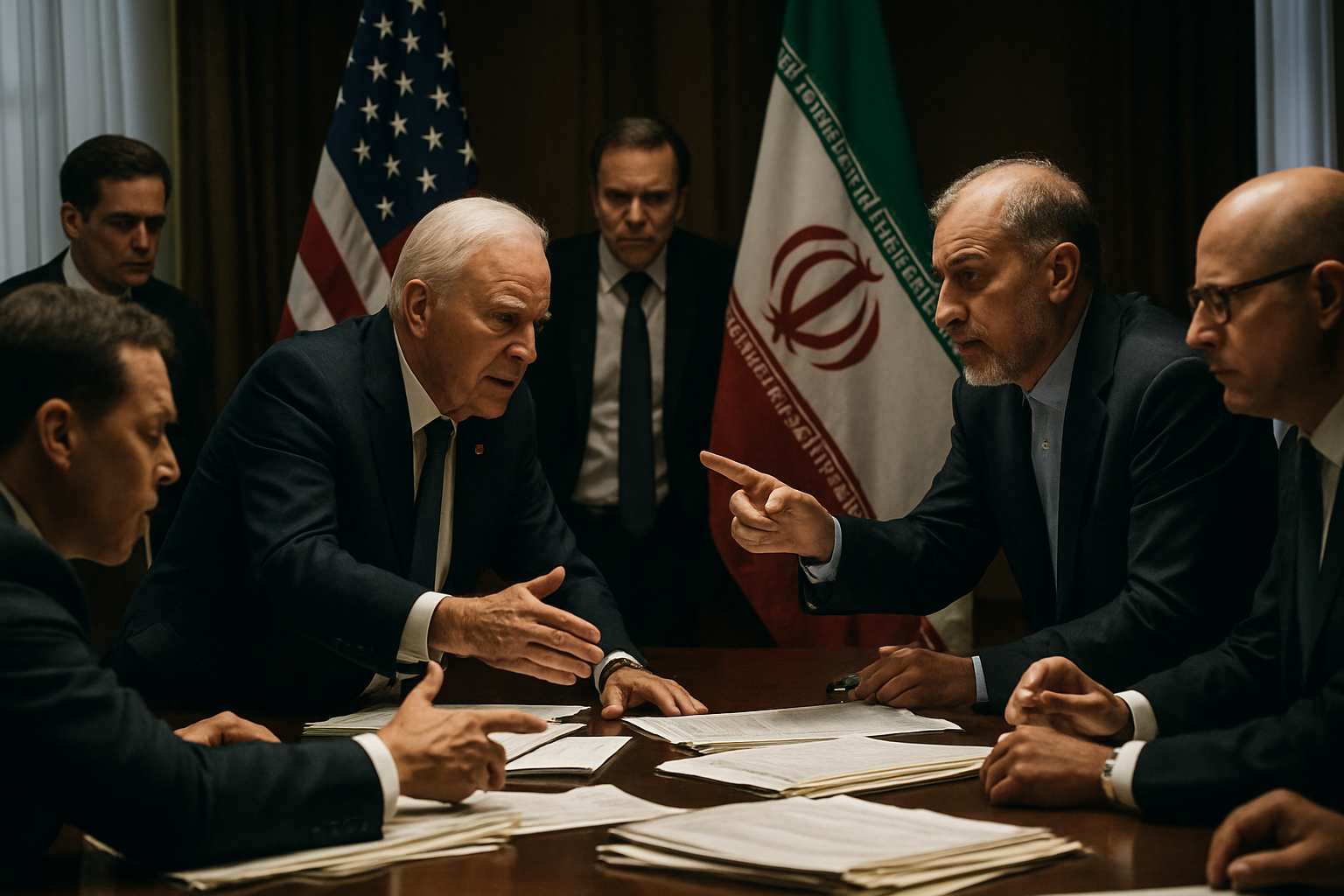
President Donald Trump announced a dramatic five-day postponement of planned military strikes against Iranian energy infrastructure on Monday, claiming "very good and productive conversations" with Tehran over the past two days regarding a "complete and total resolution of our hostilities in the Middle East." However, Iranian officials swiftly and categorically denied any such negotiations are taking place, creating a stark contradiction at the center of one of the most dangerous international crises since the Cold War.
The announcement, delivered via Trump's Truth Social platform just hours before the expiration of his unprecedented 48-hour ultimatum to Iran, triggered immediate volatility in global markets. Oil prices plunged over 10% following Trump's claims of dialogue, with Brent crude falling from record highs of $119.50 to below $100 per barrel within hours. European stock markets reversed dramatic early losses, with Spain's Ibex 35 surging from a 2.5% decline to 1% positive territory.
Iran's Categorical Denial
Iran's response was swift and unequivocal. Speaking to state news agency IRNA, Iranian Foreign Ministry spokesman Esmaeil Baghaei stated: "We have received messages from some friendly countries regarding the US request for negotiations to end the war." However, he emphasized that Iran has warned of "serious consequences" should attacks on critical energy infrastructure proceed.
More significantly, a senior Iranian security official told Tasnim news agency that Trump had backed down after facing "credible military threats from Iran regarding attacks on critical infrastructure." The source explained that pressures from financial markets and risks to bonds in the US and West had additionally escalated, forcing a strategic recalculation.
"We have not negotiated with the US, nor will we. Trump backed down."
— Senior Iranian Official, Tasnim News Agency
Iran's Parliament Speaker Mohammad Bagher Qalibaf was even more direct, dismissing reports of talks as "fake news" designed to "manipulate financial and oil markets" and help the US and Israel escape their current "quagmire."
Back-Channel Diplomatic Efforts
Despite the public denials, multiple sources suggest intensive behind-the-scenes diplomacy may be underway. Pakistani officials confirmed to Dawn newspaper that Pakistan, along with Turkey and Egypt, is engaged in "active back-channel diplomacy" to "bridge the gap between" the US and Iran.
The effort involves US Special Envoy to the Middle East Steve Witkoff and Iranian Foreign Minister Abbas Araghchi, with sources describing "quiet communication" aimed at restoring peace. This "strategic synergy" between Ankara, Cairo, and Islamabad has established what officials call a "vital diplomatic conduit," demonstrating that regional cooperation could serve as "the most effective antidote to escalation."
Market Relief and Economic Stakes
The dramatic market reversal following Trump's announcement highlights the desperate global hunger for de-escalation after weeks of the most severe energy crisis since the 1970s oil shocks. The speed of the turnaround caught investors worldwide off guard, with analysts noting the "emotional reactions based on uncertainty" that have characterized trading during the conflict.
The stakes are enormous: Iran's closure of the Strait of Hormuz has blocked 40% of global oil transit, while natural gas prices have exploded 24% in Europe and 78% in the US. Over 18,000 flights have been cancelled worldwide, with eight Middle Eastern countries maintaining closed airspace in what represents the most severe aviation disruption since COVID-19.
Nuclear Diplomacy Background
The current crisis stems from the complete collapse of nuclear negotiations despite achieving a "broad agreement on guiding principles" in Geneva talks earlier this year - representing the most significant progress since the 2018 JCPOA collapse. However, fundamental disagreements proved insurmountable: Iran excluded ballistic missiles and regional proxies as "red lines," demanding nuclear-only discussions, while the US insisted on comprehensive agreements addressing missiles, armed groups, and human rights.
Iran continues uranium enrichment at 60% purity, with over 400kg of enriched material approaching weapons-grade levels - sufficient for multiple nuclear weapons if weaponized. The breakdown of these talks led to the current military confrontation, dubbed "Operation Epic Fury," which represents the largest US-Israeli operation since 2003.
Regional Coalition Under Strain
The conflict has severely tested what was previously an unprecedented regional coalition. Saudi Arabia, UAE, Qatar, and Egypt had backed the diplomatic process with extraordinary Middle Eastern consensus. However, Iranian retaliation has directly targeted coalition member territories: the UAE suffered one civilian death in Abu Dhabi, Kuwait saw 32 foreign nationals injured in airport strikes, and Qatar wounded eight people while intercepting 65 missiles and 12 drones.
Egyptian President Abdel Fattah el-Sisi condemned the attacks on "sisterly Arab countries," warning of "comprehensive chaos" - marking a departure from the remarkable unity that had supported diplomatic efforts.
Congressional and International Pressure
Trump's apparent shift toward dialogue comes amid mounting domestic opposition, with only 25% of Americans supporting the conflict - described by analysts as "almost unprecedented" unpopularity for early-stage military operations. The financial cost has reached $11.3 billion in the first week alone, with operations running at $1 billion daily.
Internationally, European allies have offered historic rejection of US military leadership. German Defense Minister Boris Pistorius led resistance, asking "What does Donald Trump expect a handful of European frigates to do that the powerful US Navy cannot?" France explicitly rejected warship deployment, while Japan and Australia declined naval vessels despite their oil dependence.
Nuclear Governance Crisis
The current crisis unfolds against the backdrop of broader nuclear governance challenges. The New START treaty expired in February 2026 - marking the first time in over 50 years without US-Russia nuclear constraints. Combined with China's nuclear expansion, UN Secretary-General António Guterres has warned that nuclear risks are at their "highest in decades," calling the current moment "the greatest test of multilateral cooperation in the modern era."
Historical Watershed Moment
The March 23 announcement represents a critical decision point in what experts describe as the most dangerous international crisis since the Cold War's end. The rapid transition from diplomatic framework to military escalation demonstrates the fragility of crisis management in the multipolar era.
Whether Trump's five-day postponement provides a genuine window for diplomatic resolution remains uncertain, particularly given the contradictory claims about negotiations. However, the dramatic market reversals demonstrate desperate global need for stability after unprecedented volatility affecting energy security, nuclear governance, and international law enforcement simultaneously.
The stakes could not be higher: success in containing the crisis could provide a template for nuclear dispute resolution in the 21st century, while failure may accelerate military solutions that reshape international approaches to conflict resolution for decades to come, encouraging proliferation and undermining diplomatic credibility worldwide.
As global leaders and markets await developments in the coming days, the world watches to see whether diplomacy can prevail over military confrontation in one of the most consequential crises affecting Middle East geopolitics, energy architecture evolution, and international stability mechanisms in modern history.