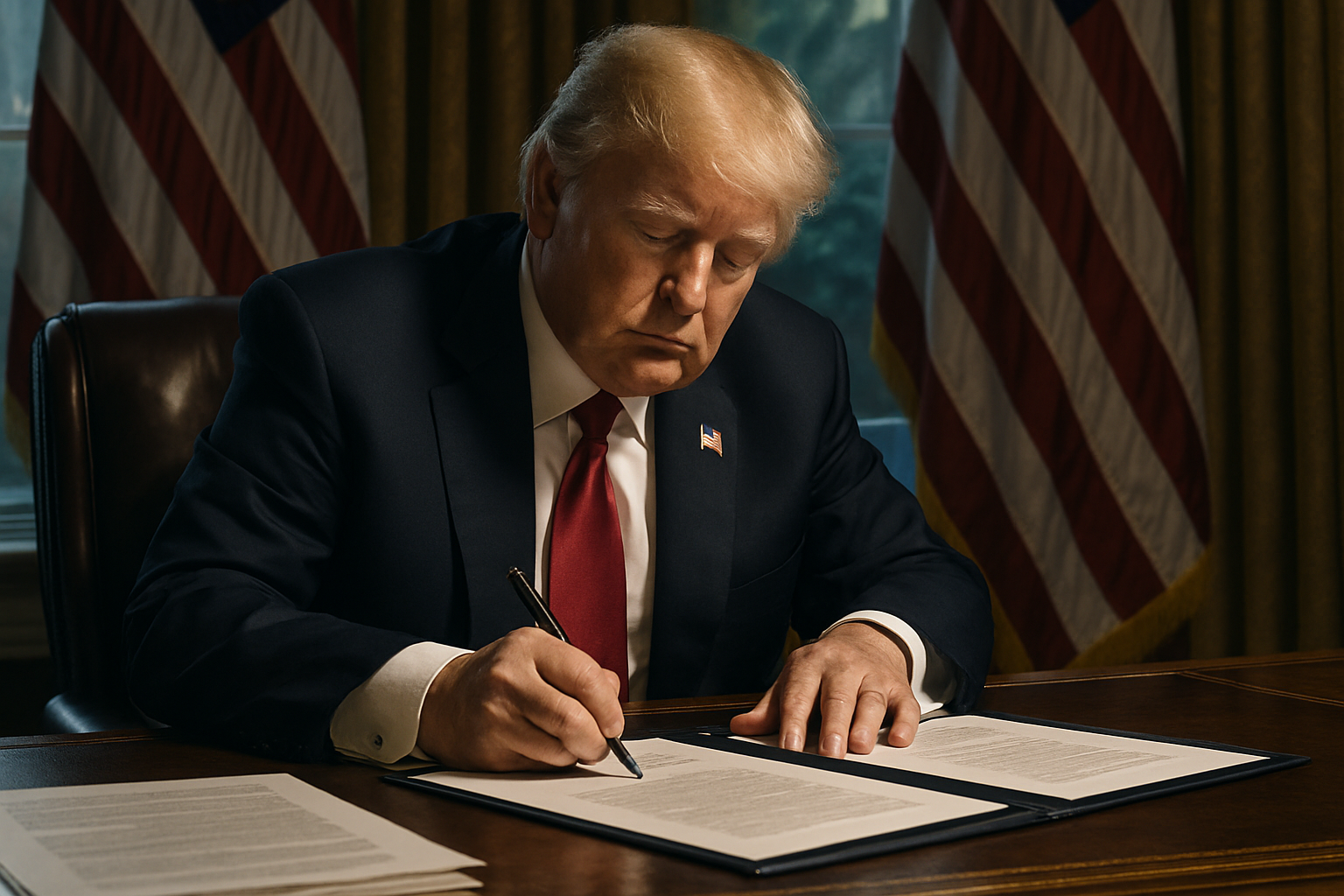
President Donald Trump signed a sweeping executive order on Friday that threatens to impose additional 25% tariffs on countries conducting business with Iran, while simultaneously canceling existing penalty tariffs on India in a dramatic reversal of trade policy that reflects the administration's complex diplomatic balancing act in the Middle East and South Asia.
The dual-track executive action, signed as tensions continue to simmer with Iran ahead of critical nuclear talks, represents one of the most significant trade policy shifts of Trump's second term, demonstrating how economic sanctions have become a cornerstone of American foreign policy under the current administration.
Iran Sanctions Framework
The executive order targeting Iran-trading nations establishes a framework for imposing tariffs on goods imported to the United States from any country that "directly or indirectly purchases, imports, or otherwise acquires any goods or services from Iran." While the order does not specify a fixed tariff rate, it cites 25% as an example that would apply broadly to imports from non-compliant nations.
According to Bulgarian media reports, the order authorizes the Trump administration to introduce these secondary sanctions without immediately implementing them, creating what analysts describe as a "sword of Damocles" over international trade relationships with Tehran. The timing of the order, coming just hours after nuclear negotiations concluded in Muscat, Oman, has drawn criticism for potentially undermining diplomatic momentum.
The sanctions framework comes as part of what administration officials characterize as a "maximum pressure" campaign designed to isolate Iran economically while pursuing diplomatic engagement. This dual approach has been a hallmark of Trump's Iran strategy, combining economic coercion with periodic offers of negotiation.
India Trade Relief
In a parallel but contrasting move, Trump's executive order officially canceled the 25% tariffs that had been imposed on Indian goods due to India's purchases of Russian oil. The sanctions relief, which takes effect immediately, resolves a major source of diplomatic friction between Washington and New Delhi that had complicated the recently finalized India-US trade framework.
The order specifies that if the US Commerce Department determines India has resumed direct or indirect exports of Russian oil, the tariffs could be reinstated. However, the immediate relief provides breathing room for the broader US-India strategic partnership, which includes agreements worth an estimated $500 billion in bilateral trade cooperation.
Slovak media reports indicate Trump's decision to lift the India sanctions reflects the administration's recognition of the complex energy security challenges facing New Delhi, while also acknowledging India's gradual scaling back of Russian oil purchases from the previous 1.5 million barrels per day.
Strategic Context and Timing
The executive orders come at a particularly sensitive moment in Middle Eastern diplomacy. Trump declared Friday's Iran nuclear talks in Oman as "very good" while noting that Iran appeared "very eager to make a deal." The talks, mediated by Omani officials, represented the most significant US-Iran diplomatic engagement since the collapse of the Joint Comprehensive Plan of Action (JCPOA) in 2018.
However, fundamental disagreements persist between the two sides. Iran has rejected US demands to halt uranium enrichment entirely and maintains "red lines" excluding ballistic missiles and regional proxy activities from nuclear-focused discussions. The US, led by Secretary of State Marco Rubio, insists any comprehensive agreement must address Iran's missile capabilities and support for armed groups throughout the region.
Afghan media sources report that both sides agreed to continue negotiations "early next week," suggesting the diplomatic process remains viable despite the new tariff threats. The talks occur against a backdrop of continued military tensions, including the recent US shoot-down of an Iranian Shahed-139 drone near the USS Abraham Lincoln in the Arabian Sea.
International Reactions and Economic Impact
The sanctions announcement has already begun to affect global oil markets, with prices rising more than $1 per barrel following news of the executive order. Energy analysts warn that the broad scope of potential tariffs could disrupt global supply chains and create uncertainty in international commodity markets.
European Union officials, speaking on condition of anonymity, expressed concern about the extraterritorial nature of the proposed sanctions, which could affect EU member states' sovereign trade relationships. Several European companies maintain legitimate business relationships with Iran under existing international frameworks, creating potential compliance challenges.
Regional powers in the Middle East have shown unprecedented consensus in supporting the diplomatic process with Iran. Saudi Arabia, the UAE, Qatar, and Egypt have all endorsed continued negotiations, reflecting regional investment in preventing military confrontation that could destabilize global energy markets.
Economic Pressure Strategy
The Iran tariff threat represents an evolution of Trump's economic pressure tactics, extending beyond traditional sanctions to encompass third-country trade relationships. Administration officials argue this approach is necessary to prevent sanctions evasion while maintaining maximum economic pressure on Tehran.
Current data shows Iran enriching uranium at 60% purity, significantly above the 3.67% limit established under the original JCPOA and approaching the 90% threshold required for weapons-grade material. Intelligence reports suggest Iran may consider a three-year enrichment halt and transfer of existing stockpiles to Russia as potential concessions in future negotiations.
The comprehensive approach also reflects lessons learned from previous sanctions regimes, where secondary sanctions proved more effective than bilateral restrictions alone. Trade data indicates Iran has maintained significant commercial relationships with regional partners despite existing US sanctions, creating the rationale for expanded enforcement mechanisms.
Implementation Challenges
Implementing the proposed tariff framework faces significant practical and legal hurdles. International trade law experts note that World Trade Organization rules limit the scope of unilateral tariff actions, potentially creating grounds for legal challenges from affected countries.
The order's broad language requiring determination of "direct or indirect" Iranian business relationships could prove difficult to enforce consistently. Global supply chains often involve multiple intermediaries, making it challenging to trace ultimate origins of goods and services.
Additionally, the threat to impose tariffs on allied nations conducting legitimate business with Iran under existing international agreements could strain relationships with key partners. European officials have already indicated they would view such measures as violations of sovereignty and international law.
Regional Security Implications
The executive order comes as Iran faces significant domestic pressure from ongoing protests and economic sanctions. Human rights organizations report more than 42,000 arrests related to anti-government demonstrations, with thousands facing serious charges including death sentences for political activities.
Military tensions continue to escalate despite diplomatic engagement. Iranian Revolutionary Guard Corps vessels recently harassed a US-flagged tanker in the Strait of Hormuz, while US forces maintain a significant naval presence in the region. These incidents underscore the fragile nature of current diplomatic efforts.
The timing of new sanctions threats during active negotiations has drawn criticism from former diplomats, who argue economic pressure tactics can undermine trust-building essential for successful diplomatic outcomes. However, administration officials maintain that sustained pressure provides necessary leverage for achieving meaningful concessions.
Congressional and Political Response
Congressional reaction to the executive orders has largely fallen along partisan lines, with Republicans praising the administration's tough stance on Iran while Democrats express concern about the potential impact on diplomatic efforts and allied relationships.
House Democrats have indicated they may seek to review the legal authority for implementing such broad tariff measures, particularly those affecting allied nations. Several prominent senators from both parties have called for briefings on the administration's broader Iran strategy and its coordination with international partners.
The orders also reflect Trump's preference for executive action over congressional approval, allowing for rapid policy implementation while avoiding potentially contentious legislative debates over Iran policy and trade relationships.
Looking Ahead
The success of Trump's dual-track approach—combining economic pressure with diplomatic engagement—will likely be determined in the coming weeks as both Iran negotiations and trade implementation proceed. The administration faces the delicate challenge of maintaining pressure while preserving space for meaningful diplomatic progress.
Future negotiations will need to address fundamental disagreements over the scope of any potential agreement, with Iran maintaining its exclusion of missile and regional activities while the US insists on comprehensive solutions. The role of regional mediators, particularly Oman, will prove crucial in bridging these positions.
The broader implications extend beyond bilateral US-Iran relations, potentially setting precedents for how economic sanctions are applied in complex multilateral diplomatic scenarios. The international community will be watching closely to see whether this approach produces diplomatic breakthroughs or further escalates regional tensions.
As both diplomatic and economic tracks continue to develop, the coming weeks will provide critical tests of whether Trump's strategy of combining maximum pressure with selective engagement can achieve the administration's goals of preventing Iranian nuclear weapons development while maintaining strategic partnerships with key allies like India.