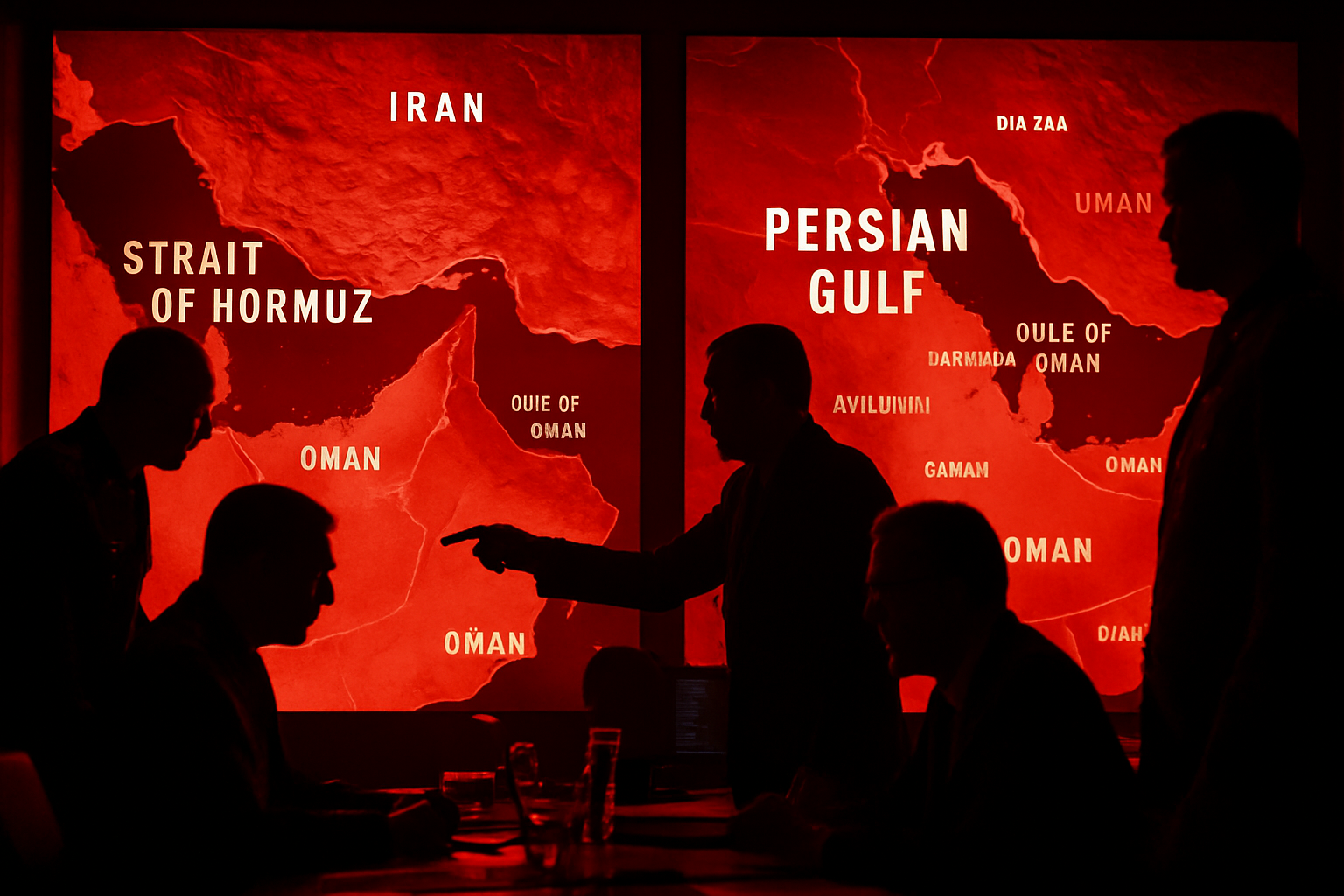
President Donald Trump issued his most explosive ultimatum yet on Saturday, giving Iran 48 hours to make a deal on opening the Strait of Hormuz or face "Hell" as U.S. and Iranian forces race to locate a missing American pilot whose F-15E Strike Eagle was shot down over the critical waterway.
The dramatic escalation comes amid what intelligence officials describe as the most dangerous international crisis since the Cold War, with global energy markets in turmoil and aviation networks paralyzed as the Iran conflict enters its sixth week. One crew member from the downed aircraft has been rescued, while the second remains missing in what analysts describe as a high-stakes manhunt with enormous strategic implications.
Trump's 48-Hour Deadline Raises Stakes
In a Truth Social post Saturday, Trump declared: "Remember when I gave Iran 10 days to MAKE A DEAL or OPEN UP THE HORMUZ STRAIT. Time is running out – 48 hours before all Hell will reign down on them. Glory be to GOD!"
The ultimatum represents the latest in a series of escalating threats as Iran continues to maintain effective control over the Strait of Hormuz through naval mining operations. The 21-mile waterway carries approximately 40% of global seaborne oil transit, making its closure a critical threat to worldwide energy security.
Iranian Revolutionary Guard officials have confirmed that one of their military commanders offered a bounty for the capture of the missing American crew member, with reports suggesting rewards as high as Rs18 million (approximately $2.5 million) for information leading to the pilot's recovery.
Search Operations Intensify
Multiple sources confirm both U.S. and Iranian special forces are conducting urgent search operations in hostile territory, with the missing airman described as a weapons systems officer from the F-15E Strike Eagle that was shot down Friday. The other crew member was successfully rescued in what Pentagon sources describe as a complex extraction operation.
Laurel Rapp, a defense researcher, told Swedish media that capturing the American pilot would represent "a very large trophy" for Iran, given the strategic intelligence value and propaganda potential of holding a U.S. service member during active hostilities.
The incident marks a significant escalation in what has been dubbed "Operation Epic Fury" – the largest U.S.-Israeli coordinated military campaign since the 2003 Iraq invasion, with costs already exceeding $11.3 billion in the first week alone.
Global Crisis Reaches Peak
The missing pilot search unfolds against the backdrop of unprecedented global disruption. Over 18,000 flights have been cancelled worldwide – the most severe aviation crisis since COVID-19 – with eight Middle Eastern countries maintaining simultaneous airspace closures that have effectively severed Asia-Europe flight corridors.
"This is the greatest test of multilateral cooperation in the modern era."
— UN Secretary-General António Guterres
Oil prices have surged past $100 per barrel for the first time since 2014, with warnings that continued escalation could drive prices toward $200. Iran's deployment of an estimated 2,000-6,000 naval mines throughout the Strait of Hormuz has stranded over 150 oil tankers worth billions of dollars in cargo.
The International Energy Agency has authorized its largest strategic petroleum reserve release in 50 years – 400 million barrels from 32 countries – in an attempt to stabilize global energy markets.
Iran's Hereditary Succession During Wartime
The crisis occurs amid Iran's most significant leadership transition since the 1979 revolution. Mojtaba Khamenei, son of the late Supreme Leader Ali Khamenei who was killed March 1, has emerged as Iran's new Supreme Leader – marking the first hereditary succession in the Islamic Republic's 47-year history.
CIA assessments suggest the Revolutionary Guards have consolidated unprecedented military control over Iranian governance, representing a historic shift from clerical to military leadership during active warfare. Trump has explicitly rejected the succession, claiming the right to "personally choose" Iran's next leader – the most direct assertion of American control over Iranian affairs since 1979.
European Territory Under Attack
In a development that has fundamentally altered the conflict's scope, Iranian drones struck RAF Akrotiri in Cyprus – the first attack on European territory since World War II. The assault prompted an unprecedented naval coalition response, with HMS Dragon leading British forces alongside Spanish, Italian, French, Dutch, and Greek vessels.
The European Union activated its ESTIA crisis evacuation mechanism for the first time in the bloc's history, while conducting the largest coordinated international evacuation since the 2011 Arab Spring, with Australia alone reporting 115,000 nationals trapped in the region.
Congressional Opposition Mounts
Domestic pressure on the Trump administration continues to intensify, with bipartisan lawmakers demanding comprehensive briefings on strategy, costs, and potential ground troop deployment. Senator Richard Blumenthal warned he is "more concerned than ever" about the possibility of American boots on the ground.
The conflict maintains only 25% public support among Americans – described by analysts as "almost unprecedented" unpopularity for early-stage military operations. Financial markets have emerged as what economists term the "ultimate constraint" on continued escalation, with Pakistan's stock exchange suffering its largest single-day decline in history.
Nuclear Diplomacy Collapse
The current military confrontation emerged from the complete breakdown of nuclear negotiations that had achieved what diplomats described as "broad agreement on guiding principles" – the most significant progress since the 2018 JCPOA collapse.
However, insurmountable scope disagreements proved decisive, with Iran maintaining its nuclear-only approach while excluding ballistic missiles and proxy forces as "red lines," versus U.S. demands for comprehensive agreements addressing missiles, armed groups, and human rights concerns.
Iran continues 60% uranium enrichment with over 400kg of weapons-grade material, while the broader nuclear governance crisis is complicated by the recent expiration of the New START Treaty – creating the first 50+ year gap without U.S.-Russia nuclear constraints.
Regional Coalition Under Strain
What had been an unprecedented coalition of Saudi Arabia, UAE, Qatar, and Egypt supporting diplomatic solutions has come under severe strain as Iranian "Operation True Promise 4" systematically targets coalition member territories.
Recent Iranian strikes have caused casualties across the region: one civilian killed in Abu Dhabi, 32 injured in Kuwait airport strikes, and eight wounded in Qatar despite Patriot missile systems intercepting 65 missiles and 12 drones. Egyptian President Abdel Fattah el-Sisi condemned attacks on "sisterly countries" while warning of "comprehensive chaos" spreading throughout the region.
Template-Setting Crisis
Intelligence analysts and diplomatic observers describe the current crisis as template-setting for 21st-century international relations, determining whether diplomatic or military solutions will become the preferred approach for future territorial and nuclear disputes globally.
The rapid transition from diplomatic breakthrough to military confrontation demonstrates what experts characterize as "multipolar era crisis management fragility," with success or failure likely to influence international approaches to conflict resolution for decades.
Stakes include regional war prevention, global energy security architecture evolution, nuclear governance credibility, and international law enforcement – all tested simultaneously in what UN Secretary-General Guterres has described as the most dangerous crisis since the Cold War's end.
Coming Days Critical
As Trump's 48-hour ultimatum counts down, the search for the missing American pilot continues in increasingly hostile conditions. The outcome will likely determine whether the crisis remains a contained regional confrontation or escalates into the most dangerous international conflict in decades.
The Pentagon has prepared operations extending through September 2026, far beyond the initial 4-6 week timeline, while Iran shows no signs of backing down from its closure of the Strait of Hormuz. With global energy markets on edge and aviation networks paralyzed, the coming hours represent a critical decision point that could reshape international relations and energy security for decades to come.
The fate of one missing American pilot has become symbolic of broader questions about diplomatic versus military solutions, alliance structures, and the sustainability of the post-World War II international order in an increasingly multipolar world.