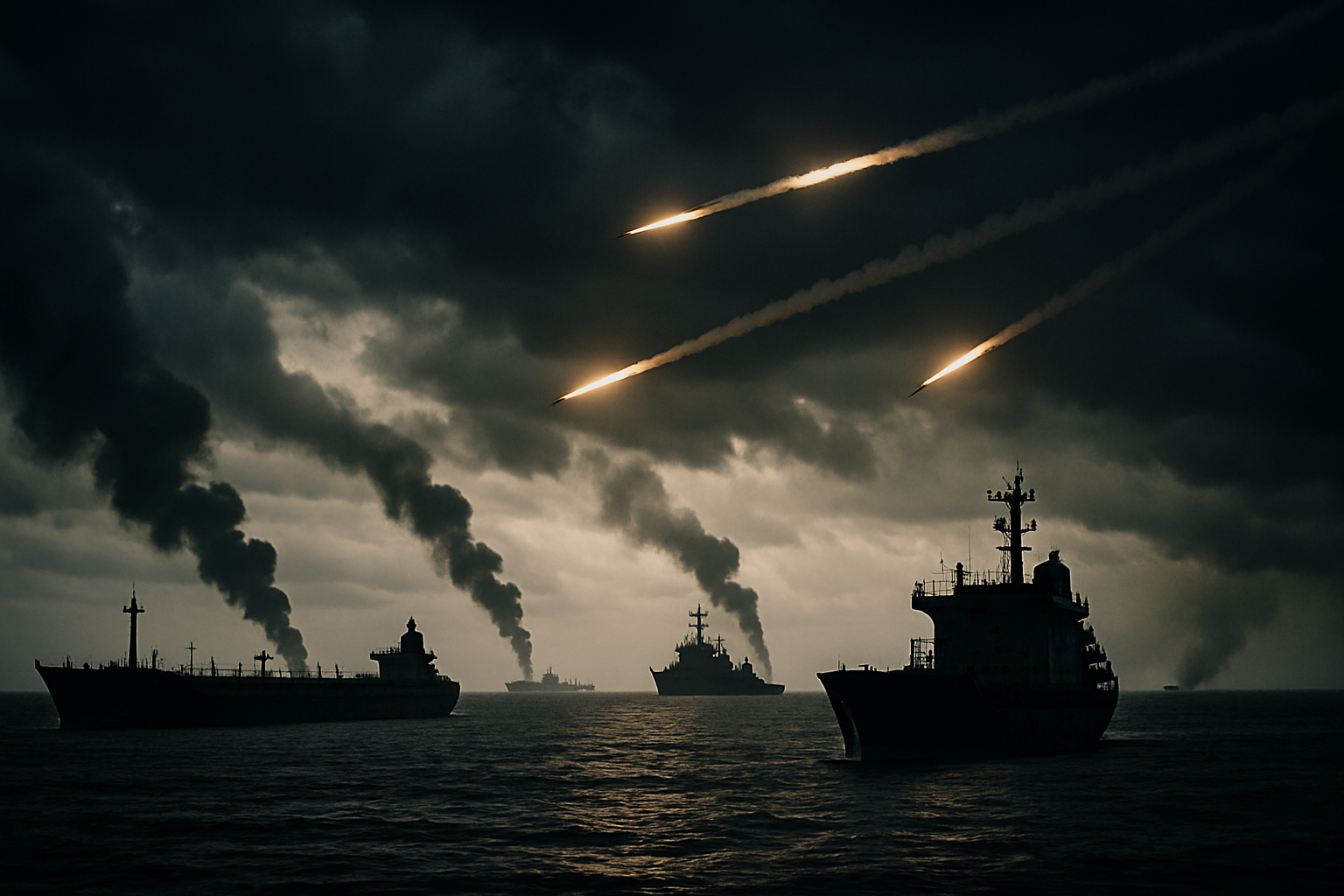
President Donald Trump has issued his most explosive threat yet against Iran's civilian infrastructure, declaring the United States plans to "destroy every bridge and power plant in Iran Tuesday night" if no ceasefire is reached, as the five-week Middle East crisis reaches its most dangerous escalation point.
Speaking at the White House on Monday, Trump declared that "all of Iran can be taken out in one night... and that night might be tomorrow night," referring to his Tuesday 8 PM Eastern deadline for Iran to reopen the strategically vital Strait of Hormuz. The ultimatum represents an unprecedented threat against civilian infrastructure in what military analysts describe as the most dangerous international crisis since the Cold War.
The escalation comes as Iran categorically rejected a 45-day ceasefire proposal brokered through Pakistan, instead demanding a permanent end to the conflict. Iranian Foreign Minister Abbas Araghchi dismissed Trump's threats as "baseless" warnings from a "delusional US president," while the Islamic Revolutionary Guard Corps maintained its position of "no red lines remaining" in systematic regional retaliation.
Global Crisis Reaches Peak Intensity
The ongoing conflict has triggered an unprecedented global crisis affecting energy markets, aviation networks, and international stability. Oil prices have surged past $119 per barrel on Brent crude, heading toward analysts' warnings of $200, as Iran has effectively closed the Strait of Hormuz using between 2,000-6,000 naval mines. The waterway normally carries 40% of global seaborne oil transit.
The International Energy Agency responded with the largest strategic petroleum reserve release in its 50-year history, coordinating the release of 400 million barrels from 32 countries to stabilize global markets. Despite these emergency measures, over 150 oil and LNG tankers remain stranded in the Persian Gulf, carrying cargo worth billions of dollars.
Aviation has been equally devastated, with over 18,000 flights cancelled worldwide - the most severe disruption since COVID-19. Eight Middle Eastern countries have simultaneously closed their airspace, severing crucial Asia-Europe air corridors. Dubai International Airport, the world's busiest with 86 million annual passengers, remains shuttered due to missile damage.
Operation Epic Fury: Historic Military Scale
Trump's ultimatum comes amid Operation Epic Fury, the largest coordinated US-Israeli military campaign since the 2003 Iraq invasion. The operation has cost $11.3 billion in its first week alone, with Pentagon officials projecting operations through September - far beyond the initially planned 4-6 week timeline.
The US has deployed dual aircraft carriers - the USS Gerald Ford and USS Abraham Lincoln - representing approximately one-third of the active US Navy fleet positioned 800 kilometers from Iran's coast. The operation has resulted in the first American combat deaths in the region since 2003, with 3 service members killed and 150 wounded, including 8 in critical condition.
In a historic naval engagement, the USS Charlotte submarine sank the Iranian frigate IRIS Dena near Sri Lanka, killing over 80 crew members - marking the first enemy vessel destroyed by a US submarine since World War II. The incident expanded the conflict beyond the Middle East into the Indian Ocean.
European Territory Attacked for First Time Since WWII
The conflict has taken an unprecedented turn with Iranian drone strikes on RAF Akrotiri in Cyprus - the first attack on European territory since World War II. The strikes prompted an extraordinary multinational naval response, with HMS Dragon joined by Spanish, Italian, French, Dutch, and Greek vessels forming an unprecedented coalition to protect European interests.
The European Union activated its ESTIA crisis mechanism for the first time in the bloc's history, coordinating the evacuation of Cyprus while demonstrating how the Middle East crisis has expanded far beyond its regional boundaries.
Hereditary Succession Transforms Iranian Leadership
The crisis began following the confirmed death of Iran's Supreme Leader Ayatollah Ali Khamenei on March 1, ending his 37-year rule. His son, Mojtaba Khamenei, has emerged as the new Supreme Leader - marking the first hereditary succession in the Islamic Republic's 47-year history and representing a fundamental shift from clerical to military governance under Revolutionary Guard control.
Trump has explicitly rejected this succession, claiming the right to personally choose Iran's next leader and calling Mojtaba Khamenei a "lightweight" - the most direct assertion of American control over Iranian internal affairs since the 1979 revolution.
Nuclear Diplomacy Collapses Despite Initial Progress
The current military confrontation emerged from the complete breakdown of nuclear negotiations despite achieving what Iranian Foreign Minister Araghchi called "broad agreement on guiding principles" in Geneva talks - the most significant diplomatic progress since the 2018 JCPOA collapse.
The fundamental obstacle remained insurmountable: Iran excluded ballistic missiles and regional proxies as "red lines," demanding nuclear-only talks, while the US insisted on comprehensive agreements addressing missiles, armed groups, and human rights. Iran continues uranium enrichment at 60% purity with over 400 kilograms of weapons-grade material - sufficient for multiple nuclear weapons.
The diplomatic failure occurs amid a broader nuclear governance crisis following the February 5 expiration of the New START treaty - the first time in over 50 years without US-Russia nuclear constraints, while China expands its nuclear arsenal and UN Secretary-General António Guterres warns of nuclear risks at their "highest level in decades."
Regional Coalition Under Severe Strain
Iran's "Operation True Promise 4" systematic regional targeting has severely strained the unprecedented diplomatic coalition of Saudi Arabia, UAE, Qatar, and Egypt that had supported diplomatic solutions. The Iranian retaliation has directly targeted coalition member territories:
- UAE: 1 civilian killed in Abu Dhabi, with Dubai International Airport shut down
- Kuwait: 32 injured in airport strikes, forcing airline relocations
- Qatar: 8 wounded despite intercepting 65 missiles and 12 drones using Patriot systems
- Cyprus: European territory attacked for the first time since WWII
Egyptian President Abdel Fattah el-Sisi condemned Iranian attacks on "sisterly countries," warning of "comprehensive chaos" spreading across the region. The fracturing of this coalition represents a significant diplomatic victory for Iran in isolating US regional support.
Congressional Opposition Reaches Historic Levels
Domestic opposition to the conflict has reached unprecedented levels, with only 25% of Americans supporting the military operations - among the lowest public approval ratings for any early-stage military action in modern US history. Senator Chris Blumenthal expressed being "more concerned than ever" about potential ground troop deployment, while Senator Chris Murphy declared Trump has "lost control" of the Iran war and appears "unsettled and disorganized."
Congress is demanding comprehensive briefings on strategy, costs, and ground troop plans as Pentagon requests over $200 billion in emergency military appropriations. Financial markets serve as what analysts call the "ultimate constraint" on prolonged military action, with Pakistan's stock exchange suffering its largest single-day decline in history.
Humanitarian Crisis Reaches Critical Scale
The humanitarian impact has reached critical proportions, with the Iran Red Crescent reporting over 787 civilian casualties from US-Israeli strikes. The Pentagon confirmed responsibility for elementary school strikes that killed between 165-185 students due to "outdated targeting data," prompting calls for Geneva Conventions investigations into potential war crimes.
International evacuations have reached the largest scale since the Arab Spring of 2011, with Australia reporting 115,000 nationals trapped in the region and Germany evacuating 30,000 stranded tourists. Multiple countries have ordered immediate evacuations from Iran, citing "extremely uncertain" security conditions.
Pakistan Emerges as Critical Mediator
Pakistan has emerged as the primary mediator in the crisis, with Foreign Minister Ishaq Dar confirming "indirect talks" between the US and Iran through a "message relay system." Pakistan proposed an "Islamabad Accord" featuring a 45-day ceasefire followed by comprehensive negotiations, with support from China.
However, Iran's rejection of the temporary ceasefire framework, demanding instead a permanent end to conflicts and maintaining strategic leverage over the Strait of Hormuz, has complicated mediation efforts. Germany noted "positive signs" that direct US-Iran talks could begin soon with Pakistan as the venue, but fundamental positions remain incompatible.
Template-Setting Crisis for 21st Century
UN Secretary-General António Guterres has called this "the greatest test of multilateral cooperation and crisis management in the modern era." The rapid transition from diplomatic breakthrough to military confrontation demonstrates the fragility of crisis management mechanisms in the multipolar era.
The stakes extend far beyond the immediate conflict, affecting regional war prevention, global energy security, nuclear governance credibility, and international law enforcement. Success in containing the crisis could provide a framework for resolving 21st-century nuclear and territorial disputes through diplomatic means.
Failure, however, may accelerate military solutions as the preferred approach to international conflicts, potentially encouraging nuclear proliferation globally while undermining diplomatic credibility for decades to come.
Tuesday Deadline: Point of No Return
As Trump's Tuesday 8 PM deadline approaches, the world faces what may be a point of no return in the most dangerous international crisis since the Cold War. The President's threat to systematically destroy Iranian civilian infrastructure represents an escalation beyond conventional military targeting that could trigger broader regional warfare.
Iran shows no signs of backing down from its strategic closure of the Strait of Hormuz, maintaining that any temporary reopening would compromise its leverage in broader negotiations. The Revolutionary Guard has warned that any strikes on civilian infrastructure will trigger "systematic regional retaliation" targeting US and Israeli energy facilities throughout the Middle East.
The coming hours will determine whether diplomatic solutions remain viable in modern international crises or whether military confrontation becomes the dominant template for resolving 21st-century global disputes - with implications extending decades beyond the current crisis and affecting the fundamental structure of international relations.