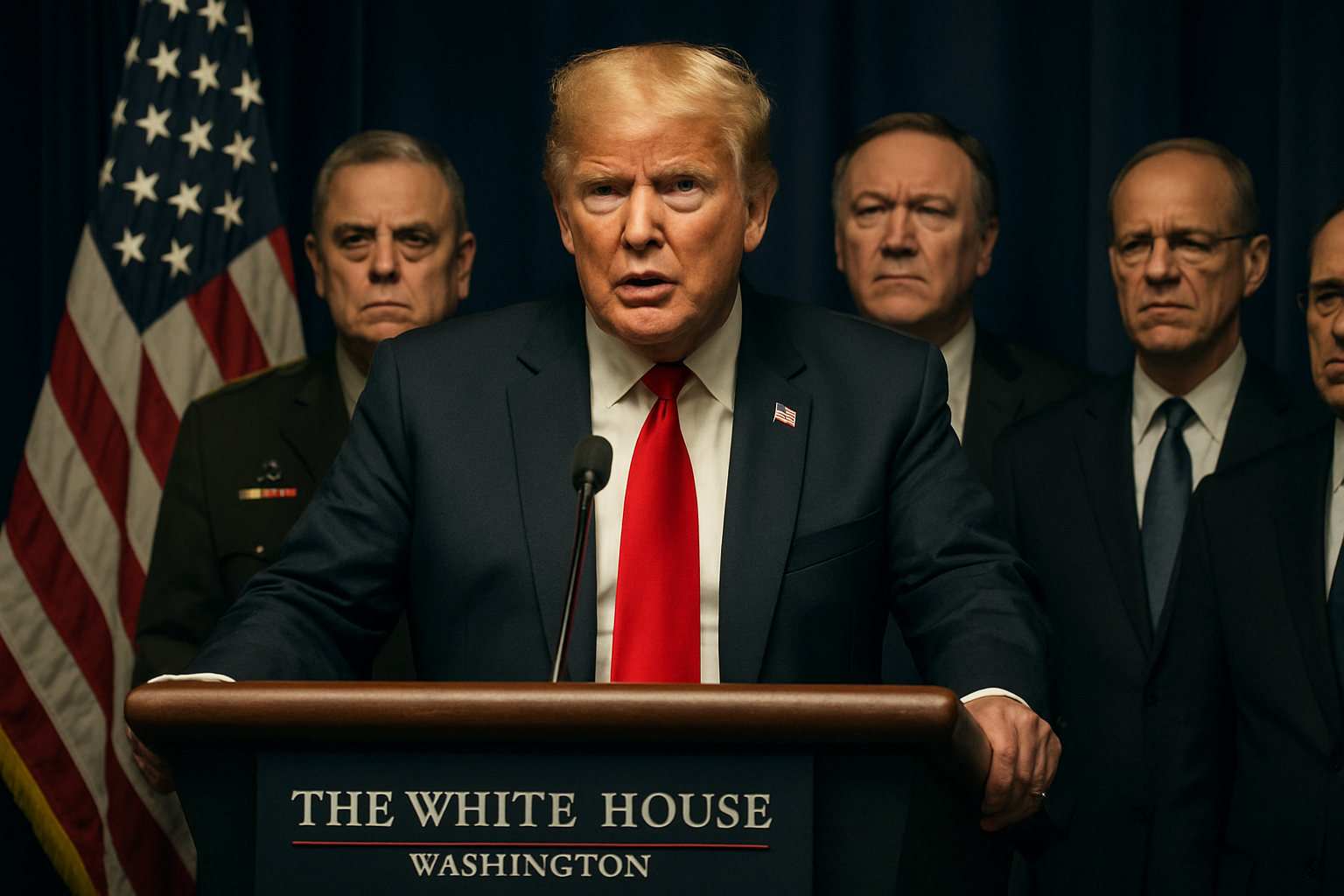
President Donald Trump issued his most explosive threat yet against Iran on Monday, declaring the entire country "can be taken out in one night, and that night might be tomorrow night," as his Tuesday deadline for reopening the Strait of Hormuz approaches amid unprecedented international tensions.
The stark warning came during a White House press conference following the successful rescue of American pilots shot down in Iranian territory, as the 38-day conflict between the US-Israel coalition and Iran reaches what many analysts describe as the most dangerous international crisis since the Cold War ended.
Iran Rejects Ceasefire Framework
Iran has categorically rejected the latest ceasefire proposal, with state-run media reporting that Tehran conveyed its response through intermediary Pakistan, rejecting a temporary 45-day ceasefire and demanding a permanent end to the conflict instead.
According to Iran's official IRNA news agency, the Iranian response consisted of 10 clauses, including an end to all regional conflicts, a protocol for safe passage through the Strait of Hormuz, lifting of sanctions, and reconstruction assistance.
"The entire country can be taken out in one night, and that night might be tomorrow night. I hope I don't have to do it."
— President Donald Trump
Trump dismissed Iran's counter-proposal during Monday's press conference, stating: "They made a proposal, and it's a significant proposal. It's a significant step. It's not good enough." The President reaffirmed that his Tuesday night deadline remains firm, threatening to target Iranian power plants and critical infrastructure if the Strait of Hormuz is not reopened.
Dramatic Rescue Operation Details
Trump provided unprecedented details about the rescue mission that extracted downed American airmen from deep inside Iranian territory, describing it as "one of the most complex and incredible search and rescue operations ever undertaken."
The President revealed that more than 170 aircraft were involved in the two rescue operations, including 21 aircraft for the first mission and 155 for the second, comprising four B-2 bombers, 64 fighter jets, 48 tanker aircraft, and 13 rescue aircraft. The scale of the operation, dubbed "Operation Epic Fury," has cost $11.3 billion in its first week alone.
During the press conference, Trump also addressed media leaks about the rescue operation, threatening imprisonment for journalists who refuse to reveal their sources. "We can find this out because we'll go to that media company that published it and say: national security, give him up or go to jail," Trump declared.
Global Energy Crisis Intensifies
The standoff has created an unprecedented global energy crisis, with oil prices surging past $119 per barrel for Brent crude as Iran has effectively closed the Strait of Hormuz using naval mines. The strategic waterway, which handles 40% of global seaborne oil transit, remains blocked, prompting the International Energy Agency to authorize its largest strategic reserve release in 50 years—400 million barrels from 32 countries.
The aviation industry faces COVID-scale disruptions, with over 18,000 flights cancelled worldwide and eight Middle Eastern countries maintaining simultaneous airspace closures. Dubai International Airport, the world's busiest with 86 million annual passengers, remains shuttered due to missile damage.
Iran's Defiant Response
Iranian officials showed no signs of backing down from their position. Foreign Minister Abbas Araghchi, speaking to his French counterpart, described Trump's latest threats as "normalizing war crimes and genocide." Iran's Revolutionary Guard has maintained that "no red lines remain" and continues to threaten systematic regional retaliation.
Parliamentary Speaker Mohammad Bagher Ghalibaf warned that Iran "won't get anything from war crimes" and that "the region will burn" if Israeli Prime Minister Netanyahu's orders are carried out.
Congressional Opposition Mounts
The conflict has drawn unprecedented criticism from both parties in Congress. Senator Chris Murphy stated that Trump has "lost control" of the Iran war and appears "unsettled and disorganized." Senator Richard Blumenthal expressed being "more concerned than ever" about potential ground troop deployment.
Public support for the operation stands at just 25%, which political analysts describe as "almost unprecedented" unpopularity for early-stage military operations. The Pentagon is now projecting operations continuing through September, well beyond the initial 4-6 week timeline.
European Security Concerns
The conflict has expanded beyond the Middle East for the first time since World War II, with Iranian drones striking RAF Akrotiri in Cyprus. This unprecedented attack on European territory prompted the EU to activate its ESTIA crisis mechanism for the first time in the bloc's history.
A multinational naval coalition including HMS Dragon and Spanish, Italian, French, Dutch, and Greek vessels has been deployed to defend European interests, though several European allies have rejected Trump's demands for broader military support in the Strait of Hormuz.
Economic and Humanitarian Impact
The conflict has triggered massive international evacuations on a scale not seen since the Arab Spring of 2011. Australia has 115,000 citizens trapped in the region, while Germany is evacuating 30,000 nationals. Stock markets have crashed globally, with Pakistan's KSE-100 experiencing its largest decline in history.
Iran's Red Crescent reports 787 civilian casualties from US-Israeli strikes, including a controversial elementary school attack that killed between 165-185 students, which the Pentagon attributed to "outdated targeting data."
Pakistan's Mediation Efforts
Pakistan has emerged as a crucial intermediary, with Foreign Minister Ishaq Dar confirming ongoing "indirect talks" between the US and Iran through a "message relay system." Pakistan has proposed an "Islamabad Accord" featuring a two-phase framework: an immediate 45-day ceasefire followed by comprehensive negotiations for a long-term settlement.
However, Iran's five-point response maintains that it will not reopen the Strait of Hormuz as part of any temporary ceasefire, preserving this as strategic leverage in negotiations.
Nuclear Diplomacy Collapse
The current crisis emerged from the complete breakdown of nuclear negotiations despite achieving what was described as "broad agreement on guiding principles" in Geneva—the most progress since the JCPOA collapse in 2018. The fundamental scope disagreement proved insurmountable, with Iran excluding ballistic missiles and proxies as "red lines" while the US demanded comprehensive agreements addressing all security threats.
Iran continues uranium enrichment at 60% purity with over 400kg of weapons-grade material, which experts say could "easily" be weaponized into multiple nuclear devices.
Historical Stakes
UN Secretary-General António Guterres has called this the "greatest test of multilateral cooperation in the modern era." The rapid transition from diplomatic breakthrough to military confrontation demonstrates the fragility of crisis management mechanisms in the multipolar era.
As Trump's Tuesday deadline approaches, the world watches a critical juncture that will determine whether diplomatic solutions can prevail or if military confrontation will reshape Middle Eastern geopolitics for decades to come. The stakes encompass regional war prevention, global energy security, nuclear governance credibility, and the sustainability of post-WWII international order principles.