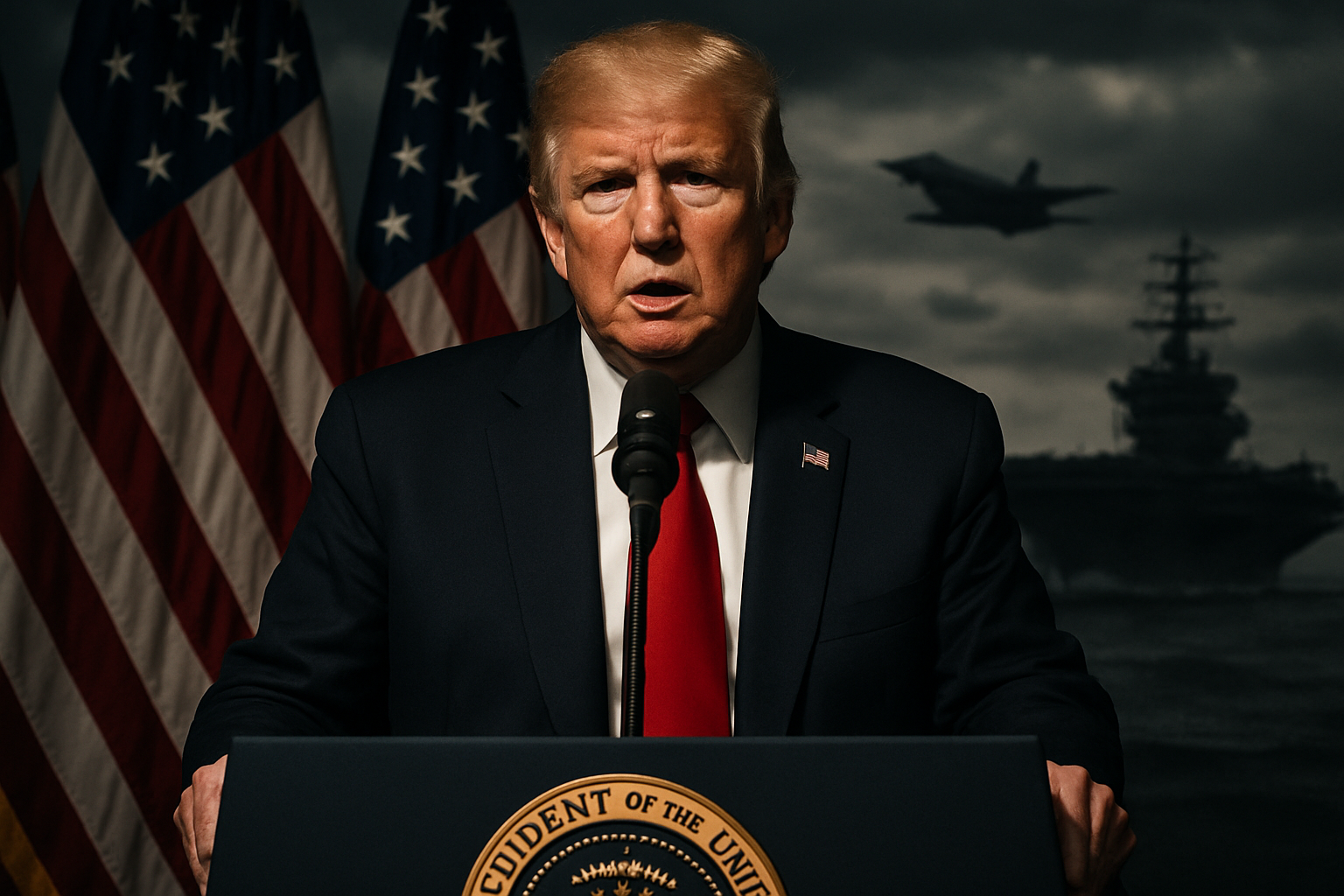
President Donald Trump issued his starkest warning yet to Iran on Sunday, threatening the Islamic Republic with "force that has never been seen before" if they retaliate against recent US-Israeli strikes that reportedly killed Iran's Supreme Leader Ayatollah Ali Khamenei and senior military commanders.
Speaking from Truth Social as Iran launched what it called its "first wave" of retaliatory strikes across the Middle East, Trump declared that Iran had "stated they are going to hit very hard today, harder than they have ever hit before." His warning represents the most explicit military threat against Iran since taking office, marking a dramatic escalation in US-Iran relations that has pushed the region to the brink of wider conflict.
Operation Epic Fury: The Largest Strike Since Iraq Invasion
The current crisis erupted Saturday morning with the launch of "Operation Epic Fury," a coordinated US-Israeli military campaign that American officials describe as the largest Middle East operation since the 2003 Iraq invasion. The strikes employed an unprecedented dual-carrier deployment of the USS Gerald R. Ford and USS Abraham Lincoln, representing approximately one-third of the active US Navy fleet positioned just 800 kilometers from Iran's coast.
While multiple Israeli sources claim the strikes killed Iran's 85-year-old Supreme Leader Ali Khamenei, Iranian officials vehemently deny these reports. Foreign Minister Abbas Araghchi dismissed the claims as "psychological warfare," stating Khamenei remains "alive as far as I know," though he acknowledged that "one or two commanders" were killed in the attacks.
"Iran just stated that they are going to hit very hard today, harder than they have ever hit before. That's not a good idea!"
— Donald Trump, Truth Social
Confirmed casualties include Defense Minister Aziz Nasirzadeh, IRGC Chief Mohammad Pakpour, and senior aide Ali Shamkhani, among over 40 high-ranking officials. The strikes also resulted in tragic civilian casualties, including a devastating attack on a girls' elementary school in Minab that killed between 53-85 students and staff during regular school hours.
Iran's Immediate and Massive Retaliation
Iran's response was swift and extensive. The Islamic Revolutionary Guard Corps launched what it termed a "first wave" of missiles and drones against US and Israeli installations across the region, declaring that "no red lines remain" and all American and Israeli assets are now "legitimate targets."
The retaliatory strikes caused casualties across multiple Gulf states: one civilian was killed in Abu Dhabi from falling debris, Kuwait's airport was hit by drones causing employee injuries, Qatar intercepted 65 missiles and 12 drones using Patriot systems with 8 people injured, and Bahrain's Fifth Fleet headquarters was targeted. Dubai International Airport was completely shut down due to the attacks.
The scale of Iran's retaliation demonstrates the dangerous escalation spiral that Trump's policies have created in the region. Oil prices immediately rose as markets factored in threats to the Strait of Hormuz, through which 40% of global oil transit flows.
The Collapse of Nuclear Diplomacy
The current crisis represents the dramatic collapse of what appeared to be the most promising US-Iran diplomatic opening in years. As recently as last week, Iranian Foreign Minister Abbas Araghchi had announced a "broad agreement on guiding principles" in Geneva talks mediated by Switzerland and Oman—the most significant progress since the 2018 JCPOA collapse.
However, fundamental disagreements proved insurmountable. Iran maintained that ballistic missiles and regional proxy activities were "red lines" to be excluded from nuclear-only talks, while US Secretary of State Marco Rubio insisted on a comprehensive agreement addressing missiles, armed groups, and human rights issues. This same structural disagreement has prevented breakthrough attempts for over a decade.
The diplomatic collapse is particularly concerning given Iran's nuclear advancement. The country continues enriching uranium at 60% purity—far above the 3.67% JCPOA limit and approaching the 90% weapons-grade threshold. Former IAEA inspector Dr. Yusri Abu Shadi confirms Iran possesses over 400 kilograms of enriched uranium, making weapons development "easily achievable" if Tehran chooses to weaponize its program.
Trump's Evolution to Regime Change Policy
Perhaps most significantly, Trump's approach has evolved from nuclear-focused diplomacy to explicit regime change advocacy. In his most direct comments yet, the President called Iranian government overthrow "the best thing that could happen" and directly addressed the Iranian people, urging them to "take control of your country."
This represents a fundamental shift in US policy objectives—from preventing nuclear weapons development to comprehensive political transformation of the Iranian system. The approach marks a return to the most aggressive American posture toward Iran since the 1979 Islamic Revolution.
Global Aviation Crisis and International Response
The conflict has triggered the most extensive regional aviation disruption since COVID-19. Iran, Iraq, Israel, UAE, and Qatar have all closed their airspace to civilian traffic, leading to the cancellation of over 18,000 flights worldwide. Major carriers including Emirates, Air France-KLM, Wizz Air, and Bulgaria Air have suspended Middle East operations, affecting hundreds of thousands of passengers globally.
The UN Security Council has called an emergency session requested by France, China, Russia, Colombia, and Bahrain. Russia condemned what it called "reckless actions by Washington and West Jerusalem" as violations of international law, while UN Secretary-General António Guterres warned of a "serious threat to international peace and security."
Multiple countries have issued evacuation orders: the US authorized departure of non-essential embassy personnel from Israel, with Ambassador Mike Huckabee telling staff wanting to leave to "do so TODAY." Sweden and Serbia issued immediate evacuation orders for citizens in Iran, citing "extremely uncertain" security conditions.
Nuclear Governance Crisis Context
The Iran crisis unfolds against a broader breakdown in global nuclear governance. The New START treaty between the US and Russia expired on February 5, marking the first time in over 50 years without bilateral nuclear constraints between the superpowers. Combined with China's nuclear expansion and what UN Secretary-General Guterres calls nuclear risks at their "highest level in decades," the Iran confrontation represents a template-setting moment for 21st-century nuclear crisis management.
The rapid transition from diplomatic framework agreements to military strikes demonstrates the fragility of modern crisis management in an increasingly multipolar world order. The success or failure of Trump's approach will likely influence how future territorial and nuclear disputes are resolved globally, potentially setting a precedent for military solutions over diplomatic ones.
Regional Coalition Under Severe Strain
The military escalation has severely strained an unprecedented regional coalition that had backed diplomatic efforts. Saudi Arabia, UAE, Qatar, and Egypt had formed an extraordinary Middle Eastern consensus supporting negotiations—a remarkable development given historical divisions in the region.
However, with Iranian retaliation now targeting these coalition members' territories, the consensus faces severe pressure. Egyptian President Abdel Fattah el-Sisi condemned attacks on "sisterly Arab countries," warning of "comprehensive chaos" in the region.
The Stakes for Global Security
The current crisis carries implications far beyond the Middle East. Success in containing the escalation could provide a framework for managing nuclear crises in the 21st century, while failure may accelerate military solutions to international disputes, encouraging nuclear proliferation elsewhere and undermining diplomatic credibility worldwide.
The Strait of Hormuz remains a critical vulnerability—Iran has warned that shipping through this vital waterway, which handles 40% of global oil transit, is "not allowed" during the conflict. Any sustained disruption would affect worldwide supply chains and global economic stability.
As Trump continues to threaten Iran with unprecedented force while defending the decision to strike, the world watches to see whether diplomatic solutions can still prevent a regional war that could reshape Middle Eastern geopolitics for decades to come. The next few days will likely determine whether the current crisis represents a calculated pressure campaign or the beginning of the most significant Middle Eastern conflict since the Iran-Iraq War of the 1980s.
With nuclear governance in crisis globally and regional tensions at their highest point since 1979, President Trump's Iran policy has brought the world to one of its most dangerous moments since the end of the Cold War. The consequences of these unprecedented threats and military actions will likely reverberate across international relations for years to come.