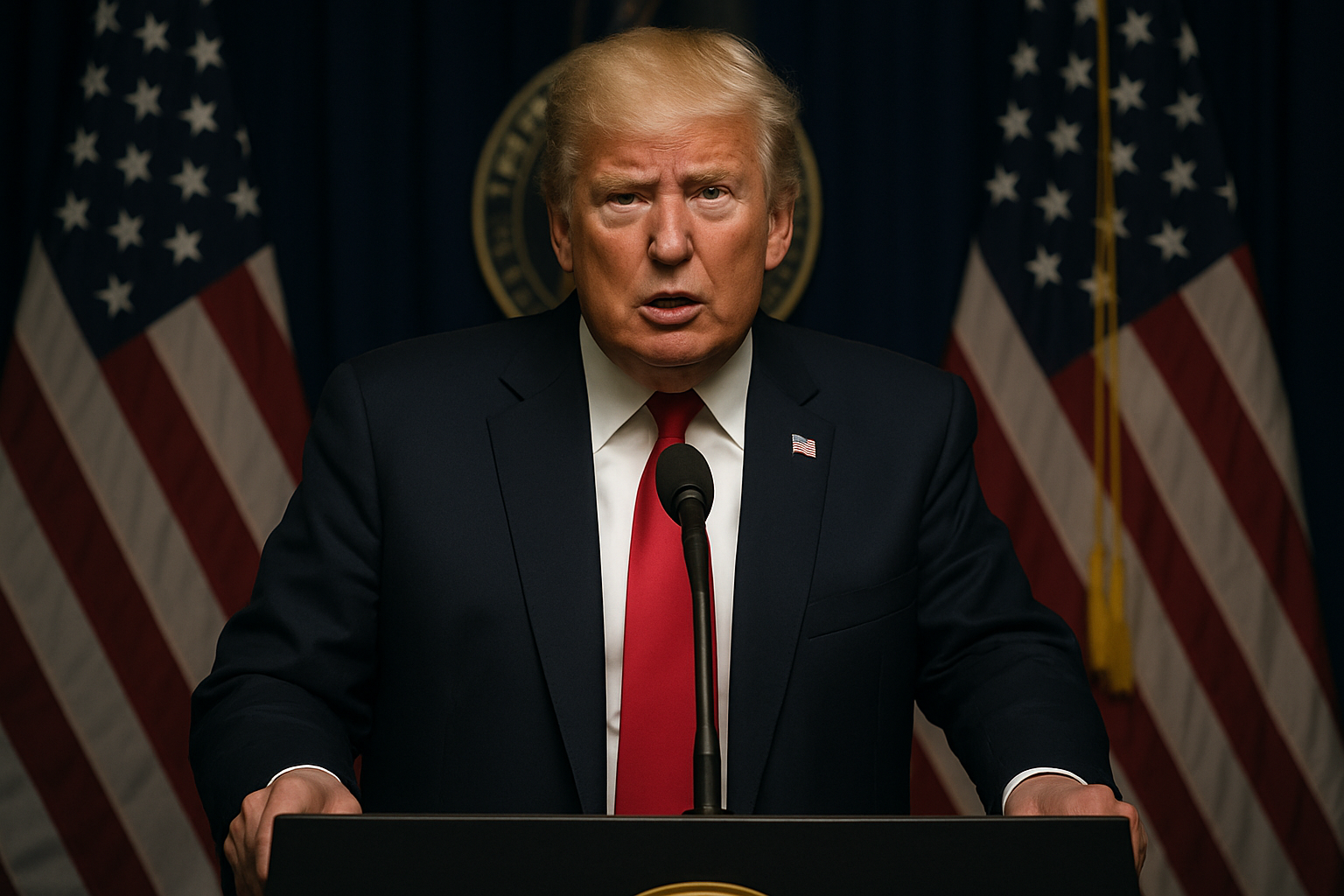
President Donald Trump has dramatically escalated his stance on Iran, demanding the nation's "unconditional surrender" and asserting his right to personally choose the country's next Supreme Leader, marking the most direct assertion of American control over Iranian internal affairs since 1979.
The demands, delivered via Truth Social on March 8, represent a stark evolution from nuclear-focused concerns to comprehensive political transformation. "No deal with Iran except UNCONDITIONAL SURRENDER!" Trump declared, rejecting any diplomatic solution and claiming he must be "involved in appointment" of Iran's next Supreme Leader.
Unprecedented Assertion of Control
Trump's statements come as Iran grapples with a succession crisis following the confirmed death of Supreme Leader Ali Khamenei on March 1 during Operation Epic Fury, the largest US-Israeli military campaign since 2003. The Assembly of Experts has reached consensus on selecting a new leader, though the name remains classified.
The President specifically rejected Mojtaba Khamenei, the deceased leader's son, as a "lightweight," dismissing what would be the first hereditary succession in the Islamic Republic's 47-year history. "The next Iranian Supreme Leader is not going to last long without US approval," Trump stated, according to Israeli media reports.
Iranian Foreign Minister Abbas Araghchi responded defiantly, stating that "it is up to the Iranians to elect their new supreme leader and no one can interfere in this matter." The exchange highlights the fundamental disagreement over sovereignty and international law governing leadership succession.
Global Crisis Deepens
Trump's ultimatum comes amid the most dangerous international crisis since the Cold War, with global implications extending far beyond the Middle East. The ongoing conflict has resulted in:
- 18,000+ flights cancelled worldwide, the most extensive aviation disruption since COVID-19
- Oil prices surging 10% past $80 per barrel as Iran declares the Strait of Hormuz "unsafe"
- 150+ tankers stranded in the Persian Gulf, worth billions in cargo
- Natural gas prices rising 24% in Europe and 78% in the US
The crisis has forced the EU to activate its ESTIA evacuation plan for Cyprus for the first time, with Australia reporting 115,000 nationals trapped in affected regions and Germany citing 30,000 stranded tourists.
Iranian Conditional Response
In a televised address, Iranian President Masoud Pezeshkian offered a conditional ceasefire to neighboring countries while firmly rejecting American surrender demands. "I personally apologize to neighboring countries that were affected by Iran's actions," Pezeshkian said, marking the first such apology in Islamic Republic history.
However, he simultaneously declared that surrender demands were "dreams they should take to their grave," demonstrating Iran's split approach of regional diplomacy while maintaining resistance to US pressure.
"Iran will never surrender to the United States and Israel. We must work with neighboring countries with the aim of ensuring and securing security and peace."
— Masoud Pezeshkian, Iranian President
Nuclear Diplomacy Collapse
The current crisis represents the complete breakdown of nuclear diplomacy, despite earlier progress. In February, Geneva talks achieved "broad agreement on guiding principles" - the most significant progress since the JCPOA collapse in 2018. However, fundamental scope disagreements proved insurmountable.
Iran insisted on nuclear-only discussions while excluding ballistic missiles and regional proxy activities as "red lines." The US demanded comprehensive agreements addressing missiles, armed groups, and human rights issues. Iran continues uranium enrichment at 60% purity, approaching the 90% weapons-grade threshold, with over 400kg of material sufficient for multiple weapons if weaponized.
Military Escalation Unprecedented
Operation Epic Fury has cost $3.7 billion in its first week, with daily expenses reaching $891.4 million. The campaign represents the largest US military operation in the Middle East since the Iraq invasion, utilizing a dual-carrier deployment of the USS Gerald Ford and Abraham Lincoln - approximately one-third of the active US Navy fleet.
The conflict has expanded beyond traditional Middle Eastern boundaries, with the USS Charlotte submarine sinking the Iranian frigate IRIS Dena off Sri Lanka, killing over 80 crew members - the first enemy vessel sunk by a US submarine since World War II. Iranian retaliation under "Operation True Promise 4" has struck targets across the region, including the first attack on European territory since WWII when drones hit RAF Akrotiri in Cyprus.
Congressional Scrutiny Intensifies
Bipartisan lawmakers are demanding comprehensive answers about strategy, costs, and potential ground troop deployment. Senator Richard Blumenthal expressed being "more concerned than ever" about the possibility of boots on the ground, while conflict polling shows "almost unprecedented" unpopularity in its early stages.
The Pentagon is reportedly preparing operations through September, far beyond Trump's initial 4-6 week timeline, raising questions about long-term strategic objectives and exit planning.
Regional Coalition Under Strain
The unprecedented coalition of Saudi Arabia, UAE, Qatar, and Egypt that had supported diplomatic processes is severely strained as Iranian retaliation directly targets their territories. Egyptian President Sisi condemned attacks on "sisterly Arab countries," warning of "comprehensive chaos" spreading throughout the region.
Multiple countries have ordered evacuations, with Sweden and Serbia citing "extremely uncertain" security conditions. The crisis has exposed fundamental vulnerabilities in global systems dependent on Gulf trade networks, affecting manufacturing in automotive, electronics, and textiles sectors worldwide.
Historical Watershed Moment
Analysts describe March 1-8, 2026, as a watershed moment in Middle Eastern geopolitics, with UN Secretary-General António Guterres calling it the "greatest test of multilateral cooperation in crisis management in the modern era." The rapid transition from diplomatic breakthrough to military confrontation demonstrates the fragility of crisis management in the multipolar era.
The stakes extend beyond regional conflict prevention to include global energy security, nuclear governance credibility, and international law enforcement - all being tested simultaneously in what represents the most consequential international crisis since the Cold War's end.
Template-Setting Implications
The outcome of this crisis will likely set precedents for 21st-century conflict resolution approaches. Success in containment could provide a diplomatic framework for future nuclear crises, while failure may accelerate military solutions, potentially encouraging proliferation globally and undermining diplomatic credibility worldwide.
As the conflict enters its second week, Trump's demands for unconditional surrender and leadership selection eliminate negotiated solution possibilities, ensuring prolonged military confrontation with global consequences. The crisis represents a potential turning point in international relations, with implications extending decades beyond current events and fundamentally affecting diplomatic versus military solution precedents for future territorial and nuclear disputes worldwide.
The coming phase will determine whether this remains a contained regional confrontation or escalates into a broader Middle Eastern war with worldwide implications extending far beyond the current crisis scope, affecting energy architecture evolution, supply chain resilience, and the fundamental principles of post-WWII international order.