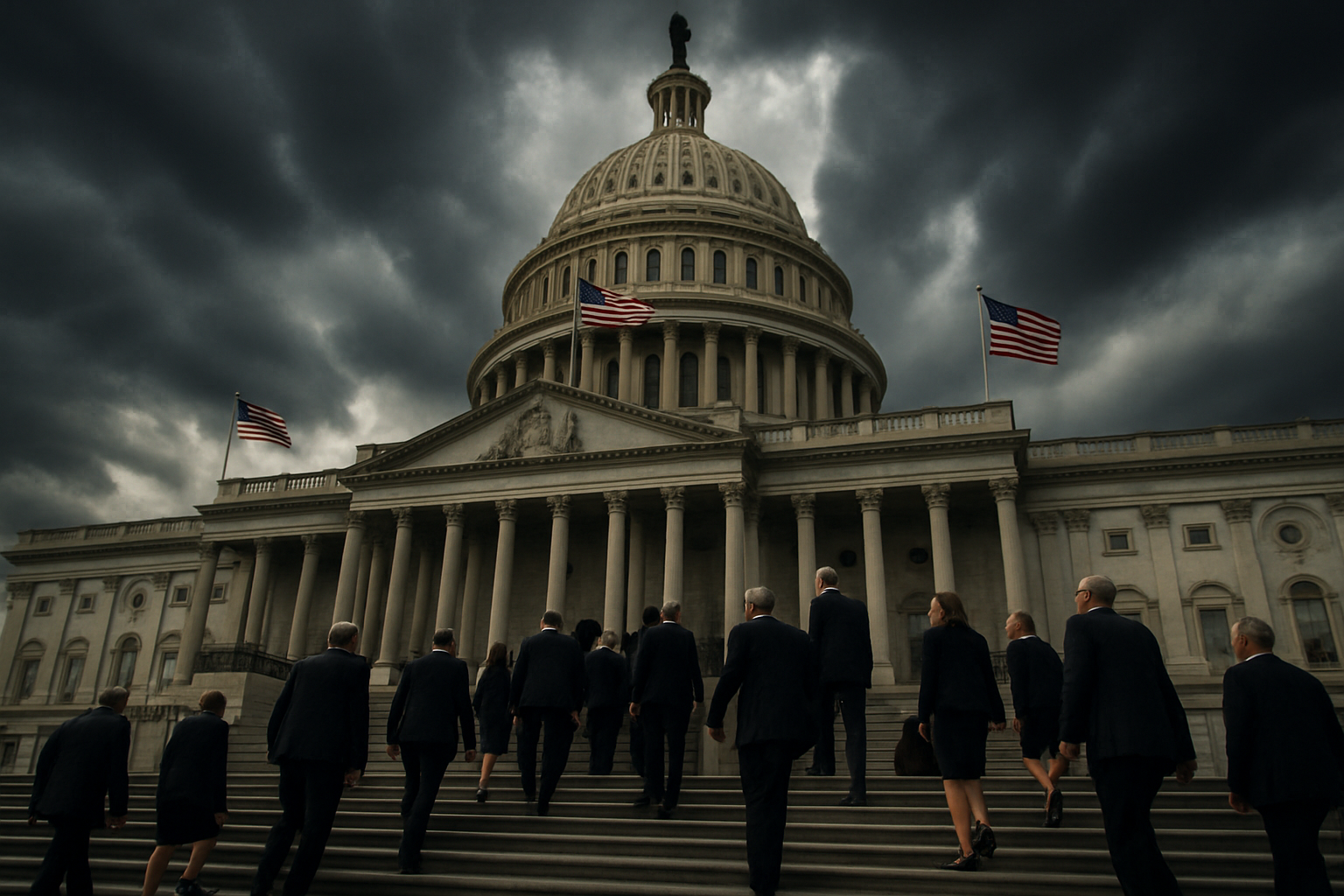
President Donald Trump faces the most significant congressional challenge to his Iran war powers as military operations enter their second month, with lawmakers demanding immediate answers on constitutional authority, escalating costs, and the administration's long-term strategy.
The mounting pressure comes as Operation Epic Fury has consumed over $27 billion in its first month, running at approximately $1 billion daily—far exceeding initial Pentagon projections of a 4-6 week campaign. Congressional sources indicate the president has just one week remaining under the War Powers Resolution before requiring explicit legislative authorization to continue military action.
Constitutional Crisis Deepens
The confrontation represents the most serious test of executive war powers since the 1973 War Powers Resolution, with constitutional scholars debating whether Trump's military campaign exceeds presidential authority without congressional approval. Senator Richard Blumenthal, a key critic, expressed being "more concerned than ever" about potential ground troop deployment, reflecting broader bipartisan unease over the expanding scope of operations.
"The president has constitutional obligations to consult Congress on military operations of this magnitude and duration. We're seeing a dangerous precedent being set for 21st-century executive authority."
— Senator Richard Blumenthal, Armed Services Committee
The crisis has been exacerbated by unprecedented domestic opposition, with polling showing only 25% American support for the Iran strikes—described by political analysts as "almost unprecedented" unpopularity for early-stage military operations. This represents a dramatic departure from historical patterns of initial public support for military interventions.
Seven-Day Countdown
According to sources familiar with Slovak media reporting, Trump's military campaign faces a critical seven-day deadline under what appears to be congressional war powers requirements. The Slovak report suggests that an "old American law" could potentially halt Trump's Iran operations if legislative support is not secured within the specified timeframe.
This deadline creates enormous pressure on both the administration and Congress, with the Pentagon currently preparing operations extending through September 2026—well beyond any constitutional sixty-day window typically associated with the War Powers Resolution.
Mounting Financial Pressure
The economic dimensions of the crisis have become equally problematic for the administration. Operation Epic Fury represents the largest coordinated US-Israeli military campaign since the 2003 Iraq invasion, utilizing dual-carrier deployments that consume approximately one-third of the active US Navy fleet.
Financial markets have emerged as what congressional sources term an "ultimate constraint" on prolonged military action, with global economic disruption reaching crisis levels. The Strait of Hormuz closure has affected 40% of global oil transit, pushing prices above $100 per barrel and prompting the International Energy Agency to authorize its largest strategic petroleum reserve release in 50 years.
Global Economic Impact
The broader economic consequences have been severe, with over 18,000 flights cancelled worldwide—disruption comparable to COVID-19 pandemic levels. Major shipping companies including Maersk and MSC have suspended operations indefinitely, leaving more than 150 tankers stranded with billions in cargo.
Intelligence Community Tensions
Adding to congressional concerns, former National Counterterrorism Center Director Joseph Kent became the first senior administration official to resign in protest over the Iran campaign. Kent, a decorated former Green Beret, stated publicly that "Iran posed no imminent threat" to US interests and accused the administration of succumbing to external pressures rather than legitimate security concerns.
The resignation has emboldened other intelligence officials privately expressing skepticism about the war's necessity, creating internal divisions within the administration's national security apparatus.
Alliance Fractures
Congressional pressure has been intensified by unprecedented rejection from traditional allies. European partners, led by German Defense Minister Boris Pistorius, have questioned American military demands, asking pointedly "What does Donald Trump expect a handful of European frigates to do that the powerful US Navy cannot?"
Spain has gone further, closing its airspace to US military aircraft involved in Iran operations—an escalation beyond previous base access denials that represents the most serious NATO diplomatic crisis since the alliance's formation.
Nuclear Diplomacy Collapse
The military campaign emerged from the complete breakdown of nuclear negotiations despite achieving what Iranian Foreign Minister Abbas Araghchi described as "broad agreement on guiding principles"—the most significant diplomatic progress since the 2018 JCPOA collapse.
The fundamental scope disagreement proved insurmountable: Iran excluded ballistic missiles and regional proxies as "red lines" from nuclear-only talks, while the US demanded comprehensive agreements including missiles, armed groups, and human rights concerns. Iran continues uranium enrichment at 60% purity with over 400kg of weapons-grade material—sufficient for multiple nuclear weapons if weaponized.
Regional Coalition Under Strain
Perhaps most concerning for congressional oversight is the fracturing of the unprecedented regional coalition that had backed diplomatic efforts. Saudi Arabia, UAE, Qatar, and Egypt had achieved remarkable consensus supporting negotiations, but Iranian retaliation has targeted coalition member territories directly.
The UAE has suffered one civilian death in Abu Dhabi, Kuwait reported 32 injuries from airport strikes, and Qatar intercepted 65 missiles and 12 drones with Patriot systems, wounding 8 personnel. Egyptian President Abdel Fattah el-Sisi has warned of "comprehensive chaos" spreading to "sisterly countries."
Humanitarian Concerns Mount
Congressional oversight has also focused on mounting civilian casualties, with the Iranian Red Crescent reporting over 787 civilian deaths from US-Israeli strikes. Most controversially, the Pentagon confirmed responsibility for an elementary school attack in Minab that killed 165-185 students and staff, attributed to "outdated targeting data."
International human rights organizations are demanding Geneva Conventions investigations into potential war crimes, while the largest international evacuation since the Arab Spring has begun, with Australia reporting 115,000 citizens trapped and Germany evacuating 30,000 nationals.
Nuclear Governance Crisis
The congressional challenge occurs within a broader nuclear governance crisis following the February 2026 expiration of the New START treaty—the first time in over 50 years without US-Russia nuclear constraints. UN Secretary-General António Guterres has called the current situation "the greatest test of multilateral cooperation in the modern era," with nuclear risks at their "highest levels in decades."
Template-Setting Precedent
Constitutional scholars and foreign policy experts emphasize the template-setting nature of the current crisis for 21st-century American governance. The resolution of congressional war powers questions will likely establish precedents for executive authority, legislative oversight, and judicial review that could affect governance for generations.
The stakes extend far beyond the immediate conflict, determining whether diplomatic solutions or military confrontation become the preferred template for international disputes. Success in containing the crisis could provide frameworks for nuclear crisis resolution, while failure might accelerate military approaches to international problems, potentially encouraging proliferation and undermining diplomatic credibility worldwide.
Seven Days to Resolution
As the critical seven-day deadline approaches, the administration faces unprecedented pressure from multiple directions: congressional demands for constitutional compliance, financial market constraints on prolonged operations, alliance fractures limiting international support, and domestic opposition reaching historic levels.
The outcome will likely reshape not only US-Iran relations but the fundamental balance between executive and legislative authority in American foreign policy, setting precedents that will influence international crisis management approaches for decades to come.