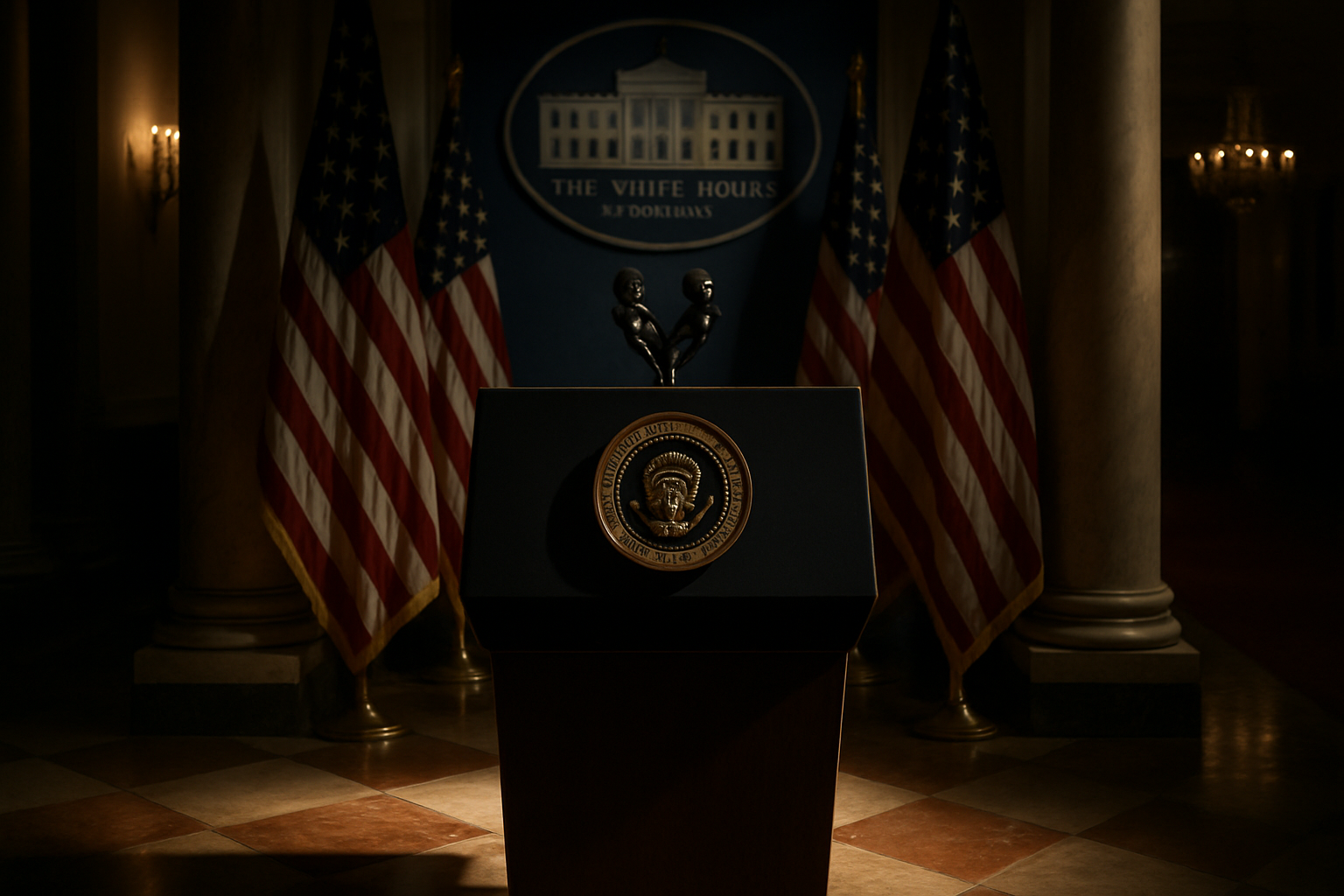
US President Donald Trump delivered a highly anticipated prime-time address to the nation Wednesday evening, promising to hit Iran "extremely hard" over the next two to three weeks while asserting that America's strategic objectives in the ongoing war are nearing completion after 34 days of military operations.
In a 19-minute nationally televised speech from the White House Cross Hall, Trump told war-weary Americans that the US military had delivered "swift, decisive, overwhelming victories on the battlefield" during Operation Epic Fury, the largest coordinated US-Israeli military campaign since the 2003 Iraq invasion. However, the president offered no concrete timeline for ending the conflict that has sparked global economic chaos.
"I can say tonight that we are on track to complete all of America's military objectives shortly, very shortly," Trump declared. "We're going to hit them extremely hard over the next two to three weeks. We're going to bring them back to the Stone Ages where they belong."
Markets React as Oil Prices Surge
Trump's address failed to provide the clarity that global markets had hoped for regarding when the conflict might end, sending oil prices soaring more than 6% in Asian trading. Brent crude jumped past $108.50 per barrel as investors abandoned earlier hopes of a near-term de-escalation.
The Strait of Hormuz remains effectively closed due to Iranian naval mining operations, disrupting 40% of global seaborne oil transit and stranding over 150 tankers worth billions of dollars in the Persian Gulf. The International Energy Agency has authorized the largest strategic petroleum reserve release in its 50-year history, deploying 400 million barrels from 32 countries to stabilize markets.
Asian stock markets fell sharply following the address, with investors particularly concerned about the impact on Southeast Asian economies that rely heavily on oil imports. The prolonged conflict has created the most severe energy crisis since the 1970s oil shocks.
Global Aviation Crisis Continues
The war has triggered an unprecedented global aviation crisis, with over 18,000 flights cancelled worldwide - the most extensive disruption since COVID-19. Eight Middle Eastern countries maintain simultaneous airspace closures, effectively creating an "aviation black hole" that severs critical Europe-Asia flight corridors.
Dubai International Airport, the world's busiest with 86 million annual passengers, remains shuttered due to missile damage from Iranian retaliation strikes. Major carriers including Emirates, Air France-KLM, and Wizz Air have suspended Middle Eastern operations indefinitely, affecting hundreds of thousands of passengers globally.
Iran Vows "Devastating" Response
Hours after Trump's address, Iran's military leadership issued its strongest retaliation threats yet. The Islamic Revolutionary Guard Corps warned of "more destructive, extensive and devastating" attacks against US and Israeli targets, maintaining that Operation True Promise 4 would continue with "no red lines remaining."
Iranian officials categorically rejected any negotiations with the Trump administration, with Foreign Minister Abbas Araghchi telling international media that Tehran would continue missile attacks "as long as necessary." The regime has launched systematic strikes across the region, targeting US military installations and allied nations.
Hereditary Succession Consolidates Power
The conflict has fundamentally altered Iran's governance structure following the confirmed death of Supreme Leader Ali Khamenei on March 1. His son, Mojtaba Khamenei, has emerged as the new Supreme Leader in the first hereditary succession in the Islamic Republic's 47-year history.
CIA assessments suggest the Revolutionary Guards have consolidated unprecedented military control over Iranian governance during the active warfare, representing a historic shift from clerical to military leadership. Trump has explicitly rejected the succession, claiming the right to personally choose Iran's next leader as part of his demands for "unconditional surrender."
International Diplomatic Efforts
Despite the military escalation, diplomatic efforts continue through Pakistan's mediation. Foreign Minister Ishaq Dar confirmed that both the US and Iran have expressed confidence in Pakistan facilitating indirect talks through a "message relay system." The US has reportedly shared a 15-point peace proposal that Iran is currently deliberating.
China has announced "full support" for Pakistan's initiative to host potential US-Iran negotiations in Islamabad "in the coming days," representing a critical diplomatic window as the conflict threatens to expand further.
Congressional Opposition Mounts
Trump's address has intensified bipartisan congressional scrutiny over the war's strategy, costs, and potential for ground troop deployment. Senator Richard Blumenthal expressed being "more concerned than ever" about the possibility of "boots on the ground," while lawmakers demand comprehensive briefings on long-term objectives.
The conflict maintains historically low public support at just 25% approval, with financial markets emerging as what analysts call the "ultimate constraint" on further escalation. Pentagon operations are reportedly planned through September, far beyond the initial 4-6 week timeline suggested by the White House.
European Security Implications
The war's scope expanded dramatically when Iranian drones struck RAF Akrotiri in Cyprus - the first attack on European territory since World War II. This unprecedented escalation prompted the largest Mediterranean naval coalition in decades, with British, Spanish, Italian, French, Dutch, and Greek vessels deployed to protect European interests.
The European Union activated its ESTIA crisis evacuation mechanism for the first time in the bloc's history, fundamentally altering the conflict from a regional Middle Eastern crisis to a broader security challenge affecting European stability.
Humanitarian Crisis Deepens
The humanitarian toll continues to mount on both sides, with Iran's Red Crescent reporting over 787 civilian casualties from US-Israeli strikes. The Pentagon has confirmed responsibility for devastating school attacks that killed 165-185 students due to what officials called "outdated targeting data," raising potential war crimes concerns.
International evacuations have reached the largest scale since the Arab Spring of 2011, with Australia reporting 115,000 nationals trapped in the region and Germany evacuating 30,000 stranded tourists. Multiple countries have ordered immediate evacuations from Iran citing "extremely uncertain" security conditions.
Nuclear Diplomacy Collapse
The current military confrontation emerged from the complete breakdown of nuclear negotiations despite achieving "broad agreement on guiding principles" in Geneva - the most significant diplomatic progress since the 2018 JCPOA collapse. The fundamental scope disagreement proved insurmountable, with Iran demanding nuclear-only talks while the US insisted on comprehensive agreements including missiles, proxies, and human rights.
Iran continues enriching uranium at 60% purity with over 400kg of material approaching the 90% weapons-grade threshold sufficient for multiple weapons. The crisis occurs amid broader nuclear governance breakdown following the New START treaty's expiration in February - the first time in over 50 years without US-Russia nuclear constraints.
Template-Setting Global Implications
UN Secretary-General António Guterres has called the crisis the "greatest test of multilateral cooperation in crisis management of the modern era." The rapid transition from diplomacy to military confrontation demonstrates the fragility of crisis management mechanisms in the multipolar world order.
The conflict's outcome will establish precedents for 21st-century international dispute resolution, affecting approaches to nuclear proliferation, territorial sovereignty enforcement, and energy security architecture for decades to come. Success in containing the crisis could provide a framework for future nuclear crisis resolution, while failure may accelerate military solutions globally, encouraging proliferation and undermining diplomatic credibility worldwide.
As Trump's 48-hour deadline for various ultimatums approaches, the world watches what may become the most consequential international crisis since the Cold War's end, with implications extending far beyond the Middle East to global energy markets, aviation networks, and the fundamental principles of post-World War II international order.